

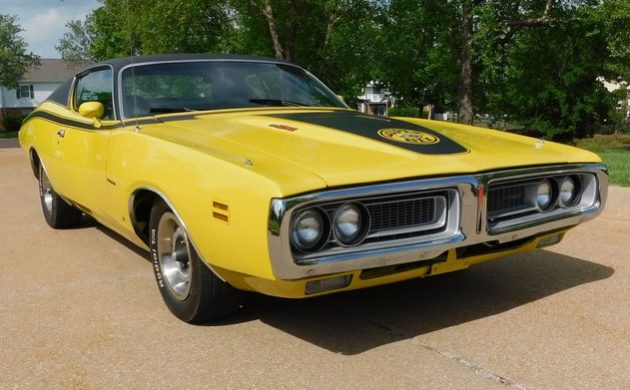
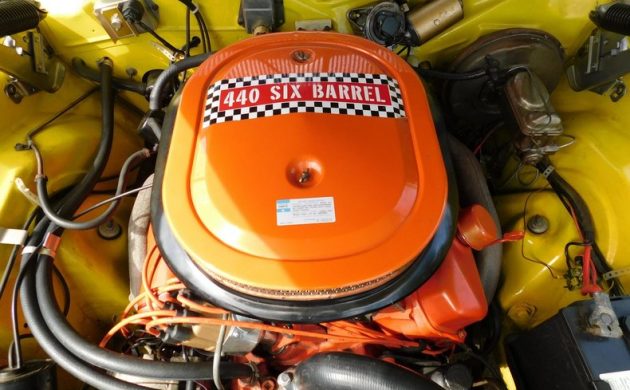
The Super Bee was born in 1968 as a budget muscle car companion to Plymouth’s Road Runner. For its first three years, the Super Bee was based on the Coronet 2-door coupe and hardtop. However, there was no such car in 1971, so the Super Bee moved over to the Charger body for its fourth and last outing. This 1971 Super Bee looks “super” and restored, but we suspect the 440 cubic inch “Six-Pack” V8 was added later. Located in Fenton, Missouri, this potent Mopar is available here on All Collector Cars, where the current bid is $15,050, but the reserve is unmet.
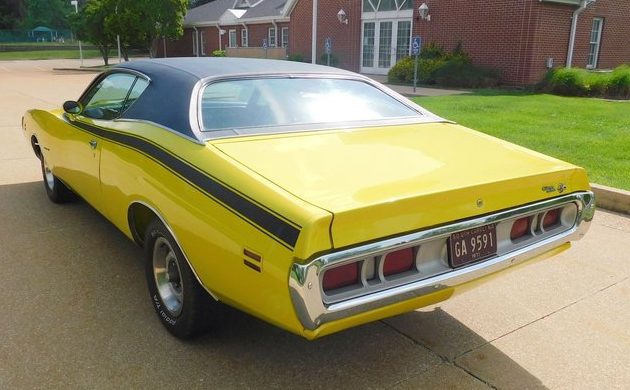
Production numbers for the ’71 Super Bee barely passed the 5,000-unit mark, which probably led to Dodge’s decision to drop it for 1972. The VIN provided by the seller for this car may include a typo, as the “43” is a code for a 4-door hardtop, where “23” is appropriate for this body style. The “N” code in the VIN is for the standard 383 V8, which heavily suggests the Six-Pack here was an afterthought. The Super Bee has the correct N96 Air Grabber Hood and a reported 28,247 miles (no claim is made on the mileage or numbers matching).
No history is provided on this Dodge, with the attributes of the vehicle being primarily touted. It wears Citron Yella paint, but since the fender tag isn’t photographed, we don’t know if that’s the factory hue. The body looks great as it does the finish, and the black bucket seat interior is far from the Super Bee’s original image as an entry-level muscle car. It comes with the Rally Pack gauge set-up, power steering and front disc brakes, and a TorqueFlite automatic transmission.
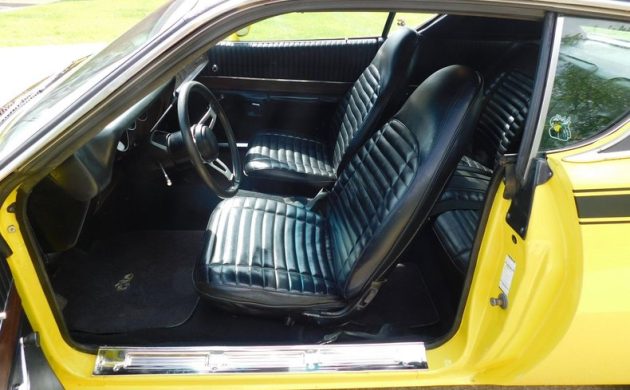
Rally wheels are along for the ride as is an upgraded sound system (goodbye 8-track tape deck!). This is a great-looking vehicle that should impress fans of these hot cars. As long as bidders are aware of what sets a real “V-code” Dodge from one with an “N-code” that may have been cloned, you can bid with a higher level of confidence. Thanks for the tip, “Curvette”!

I agree with the author. One needs to take a gander at the VIN before raising the bid paddle. On the surface, this car does look nice, clone or not.
This is the VIN listed in the ad. WM43723N1G113.
This VIN is a little confusing. From what I read for 1971 the WM designation is correct for the Super Bee. The 43 should be a 23 but then again the WM designation in most cases would denote a Dodge Cornett so I don’t know if the 43, which stands for a four-door, could’ve been a typo from the factory or else the seller has the VIN completely wrong? But then again the VIN is suspect. I only see the VIN as listed by the seller, but no actual pictures of a VIN on the driver side door nor on the dashboard nor on a build sheet or fender tag of any type.
The fifth digit on Mopar VIN of this vintage is typically a letter, not a number. This one has a number seven which would be incorrect.
The sixth digit should be a number one to indicate this is a 1971 model.
The seventh digit should be a letter indicating the plant the car was assembled at. Someone had mentioned about the incorrect rear valence as it doesn’t have the cut out for the machine gun style exhaust tips. If it was produced in Los Angeles, then it would have the letter E as the seventh digit. The seventh digit on this VIN is a 3 which doesn’t make sense as it should be a letter.
The last six digits should be all numbers, which is the sequence number as far as the number of vehicles produced that year or something like that. But regardless, it should be all numbers.
So perhaps the VIN is just all jumbled up? Just for the fun of it I will hedge a guess as to what the actual VIN number is:
WM23N1G113437
Without seeing any actual VIN on the dashboard, fender tag, build sheet, it’s hard to know what this car really is. For all we know without the correct VIN this could be a base model charger with stuff thrown at it.
It doesn’t have the correct rear lower valence panel with the exhaust cutouts or the ‘machine gun’ tips poking out of them. A clone, indeed.
Not going to disagree but cars sold in California had turn down tips for sound reasons
That does not look like Citron Yella in the pics, it looks like regular yellow. It’s entirely possible it’s just the pics, and it really is, or it’s supposed to be, but is a bad paint match, but it’s also possible it’s just yellow and they’re calling it Citron Yella.
When they don’t show trim tag or announce original options, well form your own opinion .
If you like the car, then bid on it based on what it is, a 383 equipped 1971 Super Bee that has a 440 Six Pack swapped into it. It’s a good looking car and would be fun to drive, though a 4spd would be better.
Steve R
Definitely a 4 speed would be better. And bucket seats with auto on the column, just doesn’t work!
i am not seeing a “V” anywhere for the 6 barrels. nice car though
Okay…. is that MOLD on the driver’s side shoulder belt?
Had a 70′ Super Bee with a 383 back in the 80’s. Not a big fan of the post 70′ era body style or especially clone cars but it is pretty sharp looking runner.
Unless you’re prepared to make the journey to Fenton, MO, bid on this car as if it’s a clone. My gut tells me, the seller has dollars signs in his eyes and has set the reserve in $40k-$50k range.