
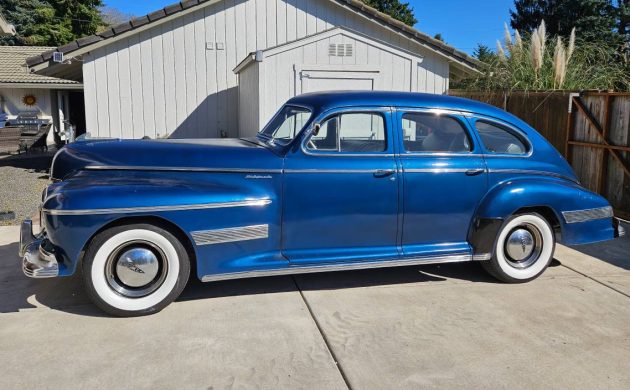
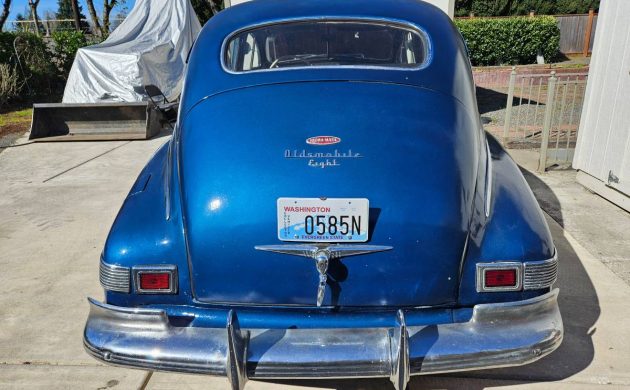
When you think about Oldsmobile, other than it being defunct, what comes to mind? I think of OHV V8s (1949), front wheel drive (1966), air bags (1974), and, of course, automatic transmissions via the Hydramatic (1940). GM’s tech leader? I suppose so. And for that reason, I thought it appropriate today to review this Hydramatic-equipped 1941 Oldsmobile. This is the earliest Hydramatic-equipped Oldsmobile that I have covered, and I thank Curvette for the tip. Vancouver, Washington, is where you’ll find this very blue four-door sedan, and it’s available here on craigslist for $15,000.
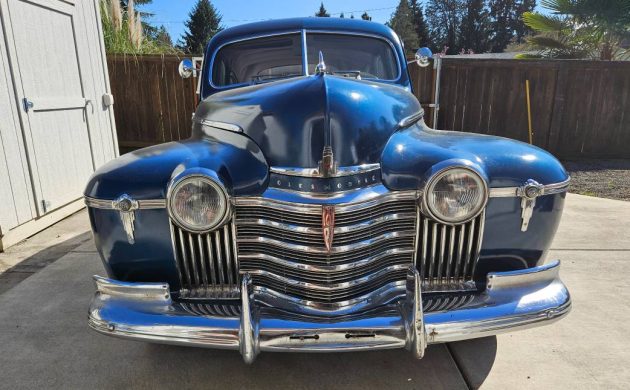
This Oldsmobile 78 is also known as a “Dynamic 8,” and it’s one of 29K assembled in ’41, and body styles included business coupes, along with two and four-door sedans. How many of these were Hydramatic-equipped would be a telling statistic, but it’s one I couldn’t uncover. This is a large car, riding on a 125″ wheelbase, allowing for a commodious rear seating area. The seller states, “average paint job,” and I’d suggest this metallic blue was not in the Oldsmobile palette for ’41. Regardless, it shows well, the stainless trim is great, and the chrome is fair, but get a load of this car’s front end! That is some of the most prolific use of shiny bits that I’ve ever encountered! Anyway, the body of this car is nice and straight with barely a ding and no sign of rot.
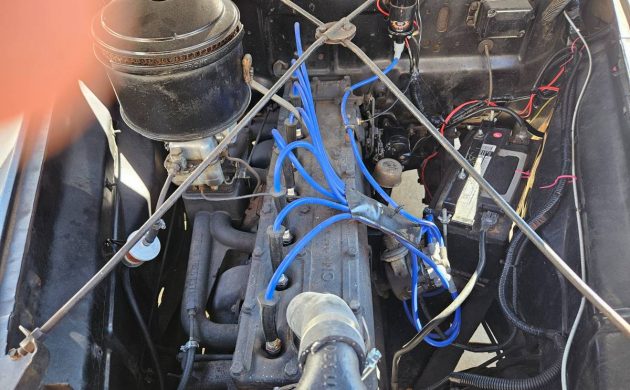
Connected to that second year, four-speed Hydramatic automatic gearbox is a 110 HP, 257 CI, in-line eight-cylinder engine. The seller claims, “runs and drives great.” He further adds, “new brakes, all stock parts are on it, and new wiring with electrical upgrade to 12 volt system and a new upgraded starter. This is a daily driver and mechanically sound.”
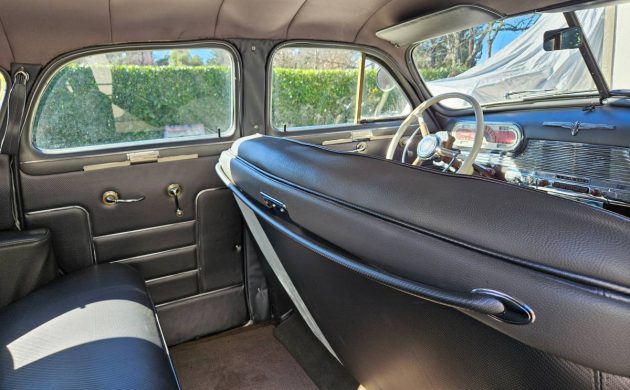
The interior appears to be in very fine condition. The front seat bottom upholstery is a bit loose, but it doesn’t show as worn. The headliner is not gravity-bound, and door panels show no indication of water intrusion – so often the issue with cars of this era. The dash is festooned with a chrome-plated center stack, so typical for cars of the forties. It all appears to be original except for engine gauges that have been added to the lower edge of the dash. Gotta love that huge back seat, you could play rugby in there. Also, I like seeing that hang-on-for-dear-life rope attached to the back of the front seat. Or is it that? I’ve had some suggest that it was for draping shawls, or scarves, etc. over it. I dunno about that. I remember as a wee thing my father had a ’51 Oldsmobile 88 so equipped, and I don’t recall anything being draped over it, just my sister’s small hands hanging on to it.
We discuss cars of this era all the time and postulate over who we think the likely shrinking market for such a rig is. Yes, it’s probably limited, but I wonder if being an early Hydramatic-equipped car will help with the cause. What’s your thought on that matter?


Very nice Olds!!! And really nice early Hydramatic example too. The blue really highlights the chrome too. And thats a lot of chrome on the front end too. If my memory serves me right, our 1970 Olds Ninety Eight had a 126 inch wheel base, so this Olds is most certainly big. I think this would be great own. Once again Curvette found a really nice, rare, early 40’s Olds here, and Jim, I’m glad you wrote this up, its a beautiful car, and I sure hope it get enjoyed by its new owner. Great write up!!! Thank you.
Thank you for the kind comments!
JO
Some are puzzled by the use of 4 speeds in the early Hydros while later transmissions would use only 2 (powerglide) or 3 (turbo-hydros). It’s all about the torque converter. The first hydromatics used fluid couplings and so enjoyed no benefit from the torque multiplication provided by a TC and needed 4 speeds to work.
I have always heard the cord on the back of the front seat was to drape a blanket over, because the heat came from under the seat. With a blanket forming an enclosure to trap the heat, the rear seat passengers were kept comfortable.
Yes, I have been told that too.
JO