

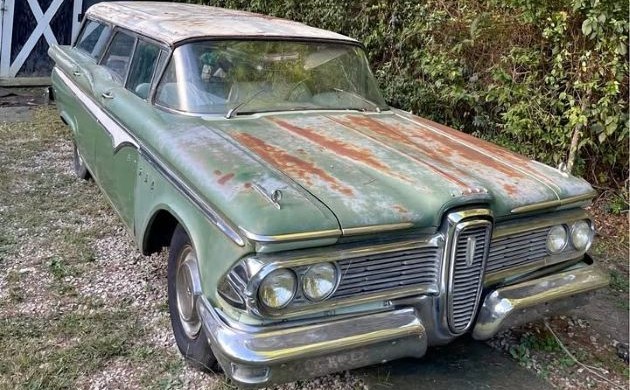
By the outset of the 1959 model year, the writing was already on the wall for Edsel. Despite a spirited marketing effort to depict Edsel as innovative, forward-thinking, and reliable, none of this actually proved to be entirely factual; poor craftsmanship, poor dealer support, and, of course, the infamous front-end styling that became the face of Edsel’s shortcomings were the early hallmarks of failure that would ultimately doom the marque after just two and a quarter model years. Ford knew it needed to pivot big if it wanted to save the nameplate, and this 1959 Villager station wagon, found on Facebook Marketplace in Manchester, Kentucky, with a $3,800 asking price, is an example of that pivot. Big thanks to Barn Finder Pnuts for locating this interesting find.
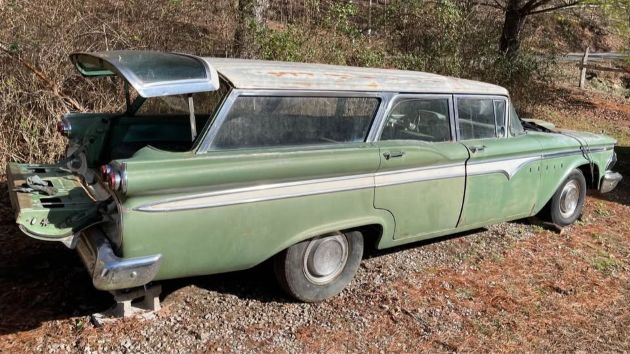
Edsel emphasized economy in 1959. This was evident in all of their sales literature, which touted the 1959 Edsel lineup as “America’s finest car in the low price range”. The original seven models offered in 1958 were reduced to just three for ’59: the base-level Ranger, the higher-priced Corsair, and the Villager, the only of the three wagon models retained beyond 1958. A six-passenger and nine-passenger Villager wagon were produced, though it is difficult from the photos to determine whether or not this particular wagon is a two-row or three-row variant.
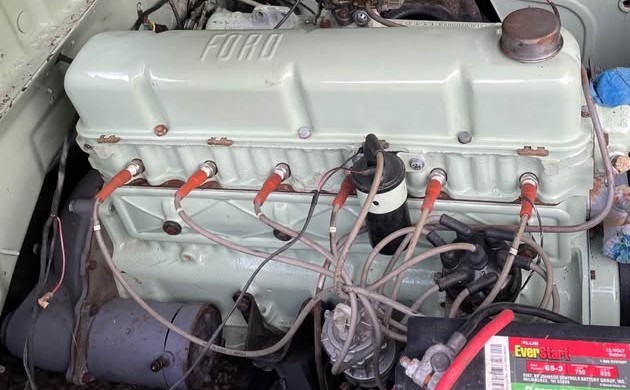
The standard engine that would have come in the Villager for ’59 would have been the “Express V8”, which was the 332 ci Ford FE engine previously only found in export-configured Edsels (and many ’58 Fords as well). For additional cost, the 361 ci “Super Express V8”, previously marketed as the “E400” engine, could be fitted. But this one, at first glance, seems to have been ordered with the cost-reducing engine option, the 223 ci “Economy Six” inline six-cylinder power plant, an interesting choice for a Villager. However, I question the authenticity of whether or not the engine in the car is the original engine to the car. The seller claims the engine is “fresh”, and this may be the case, but the presence of an 8-bolt “Ford” script valve cover instead of the correct two-bolt center-fastened blank valve cover suggests to me that the engine came out of a 1960 or later Ford. At minimum, the cylinder head has been changed; a view of the casting number on the block would clear up a lot of this confusion.
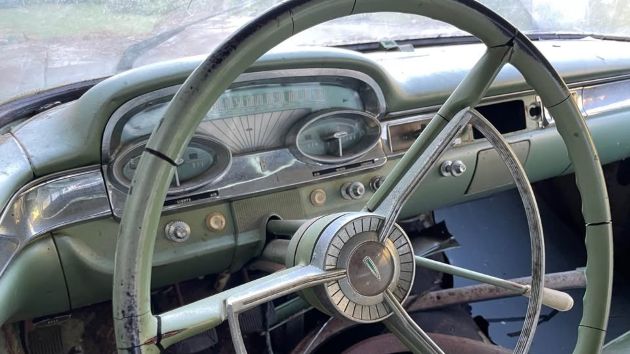
Few interior photos are included, so its overall condition is unknown, but the instrument panel photo at least shows the car was originally ordered with the three-speed, column-shifted manual. The seller incorrectly markets this as a “two-speed” manual transmission, but this type of manual transmission does not exist. While this wagon does not run and needs the engine bay wiring completed in order to do so, the car overall appears to be very solid and complete, with few missing parts. Edsel has a healthy following, so even somewhat hard-to-find parts, like the windshield the seller notes as broken, should be obtainable. There appears to be minimal cancerous rust, as well, and the body panels appear to be straight. The resale market on Edsels remains healthy; at $3,800, is this Villager a fairly priced restoration candidate, or is the asking price just as ambitious as the Edsel was in 1958?

Listing is no longer available. It looked like a decent project at a reasonable price. Good deals don’t last.
Steve R
I thought that the Edsel was discontinued because people thought that the car was ugly, but I know understand that early models suffered from faulty Teletouch push-button automatic transmissions (where wiring shorted near the exhaust), oil leaks, and misaligned parts, creating a legacy of buyer distrust. So it was mechanical issues that forced the Ford Motor Company to discontinue the Edsel.
I like this Station Wagon even though it’s as big as a truck. This one looks to be well preserved. How do collectors, today, deal with the issues that plagued the Edsel 65 years ago?