

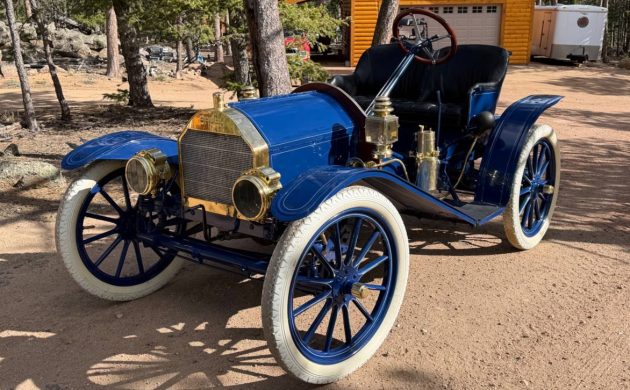
Brush Motor Car Company was one of a raft of auto makers founded in the early 1900s. Brush’s specialty was cheap runabouts, which means a conveyance with almost no weather equipment. Its cars incorporated “innovations” of dubious value, which is probably why the company lasted only a few years. These included wooden underpinnings, including a frame and axles made of hickory, and an engine that turned counterclockwise so a right-handed person starting the car would be less likely to get hurt if the starter crank rebounded. This rare speedster, meticulously restored by a grandson with his grandfather, has been in storage for years and needs a new home. It is advertised here on craigslist for $23,000, and the new owner can pick it up from Red Feather Lakes, Colorado. Thanks to Barney for this unusual find!
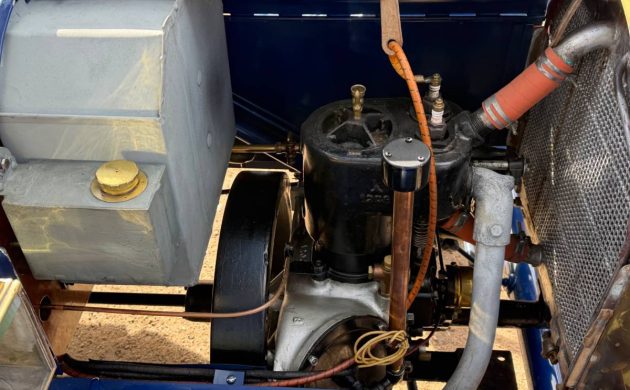
Alanson Partridge Brush was no fly-by-night entrepreneur. He began his career working as an engineer for Cadillac, helping to bring its first car to market in 1902. In an historic stunt, on October 2, 1902, he drove the prototype Cadillac first up, then down the steps of the Wayne County Courthouse in downtown Detroit. The feat advertised the new car’s tractability to excellent effect. But his employer refused his proposal to build a lightweight two-cylinder car, prompting Brush’s resignation. Brush founded his own motorcar company in 1907. He produced several models, mostly differentiated by increasing power output from single-cylinder L-head engines and slightly varied coachwork. The planetary gearbox was his own design.
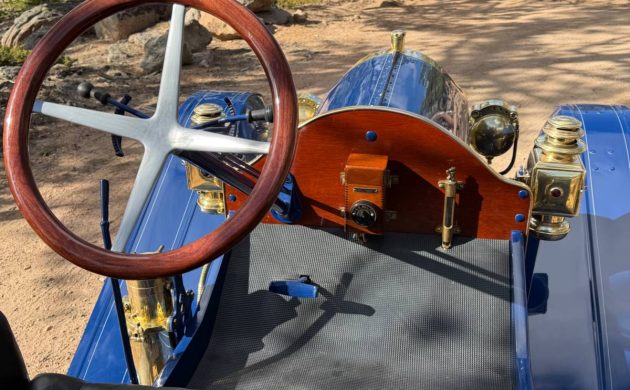
By 1910, Brush had been absorbed into the United States Motor Company, which amounted to a consortium of dealers banded together to achieve selling efficiencies. In only a few more years, Brush – along with many of its peers – was sidelined by the advent of the Model T. But before it closed down, lightweight 6 and 10 hp Brush cars had climbed Pike’s Peak, participated in the Glidden Tour, and driven across the country.
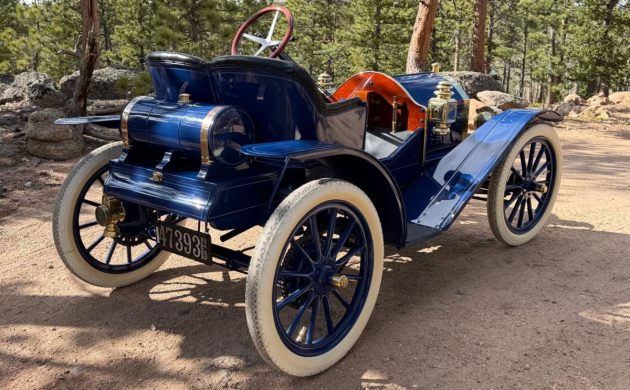
Brush runabouts come to market with some regularity – ok, maybe not every day, but certainly one or two every couple of years. Bonhams has auctioned several, including this outstanding Model A, sold this year for just over $21k. Today’s well-restored Brush speedster is probably priced about right, with a little wiggle room for negotiating. Would you ever own a car from the first days of motoring?

I’ve never heard of Brush motor cars until drinking my cup of coffee this morning. What a beautiful restoration. And the fact that a Grandpa and a Grandson did all this work is even better. I guarantee you, those are cherished memories that would never be forgotten. There’s something about the simplicity of this little buggy that really draws me to it. This is great Michelle. Thank you for all the research you did on this, I enjoyed learning about Brush Motor cars.
Hickory axles? That’s a new one on me!
Very pretty car though. And I imagine if you can keep from breaking an axle, they’d be pretty easy to maintain.
I’ve always thought this time period must have been interesting to be alive in as cars were in their infancy and many different types and feats were achieved. This is a really cool example of that time period.
There were several Brushes in the New London to New Brighton Antique Auto Tour, Minnesota, this past weekend. Along with a plethora of other very early (pre-1910) brass cars. This is a video of the tour from a few years ago when the cars were a little newer.
https://www.bing.com/videos/riverview/relatedvideo?q=new+london+to+new+brighton+antique+auto+tour+videos+youtube&mid=6EEA55BB15145699A0206EEA55BB15145699A020&churl=https%3a%2f%2fwww.youtube.com%2fchannel%2fUCCQZmEgBM-3D2UVDhIzgErw&FORM=VIRE
Thanks for sharing that link. I thoroughly enjoyed it. A few years back, I happened across one of our “Yanks” doing the British run. And, for the first time I managed to see Ed China dressed up and watching the run. I’m a past VP of AACA’s local chapter and a couple of our members belong to the “Really Old Cars” club and have a lot of fun doing road tours. In fact, I’ve helped one of our members do some rear axle repairs to his 1913 Cadillac.
Nice car! Thanks, Michelle-
I can just envision this…. speeding down the interstate at a whoppin’ 35 MPH!
Anyone out there know what company first used the term “speedster”?
the Stutz Bearcat was a speedster, a lightweight two passenger adrenaline machine.
Family lore claimed that my grandfather, who used to drive “hack” with his brother in NYC in the ’20s, at one time had a Stutz but put it off-road and wrecked it. He then took the license plates off it and walked away. I learned some of my driving stye from him, even in the 50s and 60s he regarded the accelerator pedal as a digital tool, either on 100% or off.
The term speedster was used for light, sporty carriages pre-automobile.
Beautiful example of a rare car from a rare era!
Would have to have new driving lessons. I dare say it drives like nothing made since oh about 1930.
I’m sure we could LEARN. i will never forget my grandmother nagging my grandfather, “Don’t ride the clutch, John — don’t ride the clutch!”, when he traded in his 1927 Model T on a brand-new 1939 Mercury. He was, of course, used to driving Model Ts, and he had to ADAPT to the ’39 Merc. I believe that any one of us could adapt to this Brush. I’d LOVE to have that experience!
I don’t disagree. My bigist concern actually would be where to drive it. Needs a country road. Afraid I live on a highway. , takes 10 minutes just get outta the driveway some days in a modern car. Would have to sneak out about 1 am 🤣
I’ve got a soft spot for Brass Era cars. My favorite will always be a 1901 Pope Columbia Mk VIII Runabout. It was the forerunner of modern cars.
Front engine, rear wheel drive, steering wheel on the left. Only variation is transmission attached to the rear axle, like an early ‘60s Pontiac LeMans. There was a Mk 8 in the (former) Long Island Auto Museum. I had a trip there on my bucket list, only to have that dashed when the museum closed the year (1980) I booked my vacation to see it.
I saw a Brush, like this, at a museum outside of Rapid City, SD, back in ‘69. I actually thought that having a wooden frame and front axle would be a good idea although I knew what weather or a fire could do to it. But then, horse-drawn carriages were made of wood.
Thank you Michelle.. you come up with the coolest stuff, and now we have another beautiful old car that I’ve never heard of. And it was restored by a grandfather and grandson.. it doen’t get much better than that. Red Feather Lakes is really beautiful too btw, I’ve been there several times.
I was also surprised the axels were Hickory so I looked it up, and it looks like in their cost cutting they made a pretty decent choice in an alternative.. it’s one of the strongest and most durable woods in existence. Here’s what AI came up with if anyone is interested:
Hardness and Strength Metrics
Janka Hardness: Hickory scores between 1,820 and 1,880 lbf, making it significantly harder than White Oak (1,360 lbf) and Hard Maple (1,450 lbf).
Modulus of Rupture: It boasts a bending strength of approximately 20,200 psi, indicating superior resistance to breaking under load.
Elastic Modulus: With a stiffness rating of 2.16 million psi, hickory is stiffer than most other North American hardwoods.
Density: Its high density (approx. 0.72 specific gravity) contributes to its weight and impact resistance.
Practical Characteristics Durability: Hickory’s combination of hardness and toughness makes it ideal for high-traffic flooring and heavy-use items like axe handles and hockey sticks. It resists dents, scratches, and wear better than oak or maple.
Workability: The same strength that makes hickory durable also makes it difficult to work with. Its hardness can dull cutting tools quickly, and it requires sharp equipment for machining. Additionally, its density makes the wood heavy and challenging to move or install.
Wow, thanks for this info! Adds color to our story here and we appreciate it.
Australian adventurer Francis Birtles bought a brush in 1912