

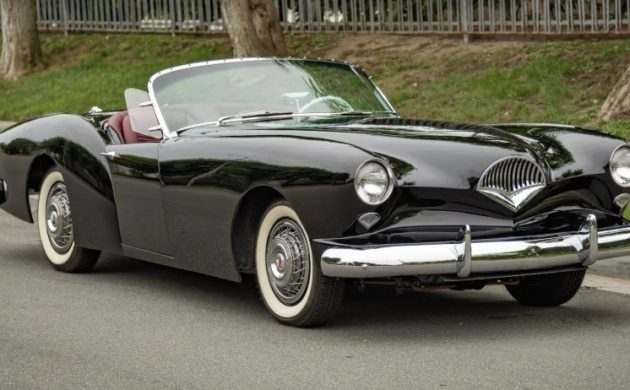
The characters involved in the Kaiser Darrin’s production could populate a small city. Henry Kaiser and his partner Joseph Frazer founded the company that would eventually manufacture the car. His young second wife, Alyce Chester, encouraged her husband to go forward with the rather radical design. The irascible Howard “Dutch” Darrin originally conceived and pitched the car to Kaiser. A cast of several men working at Kaiser was responsible for the car’s final lines, curves, and cabin arrangement. Bill Tritt, founder of Glasspar, made the fiberglass prototypes and constructed the bodies. We ought to thank the Henry J, that odd compact set on a 100″ wheelbase and financed by the US government, for its contribution as well. The efforts of this crowd culminated in 435 units of the car you see here on Hemmings, the Kaiser Darrin roadster. Bid to $76,000 and located in Torrance, California, this example is thoroughly restored. Thanks to PRA4SNW for sending along the tip!
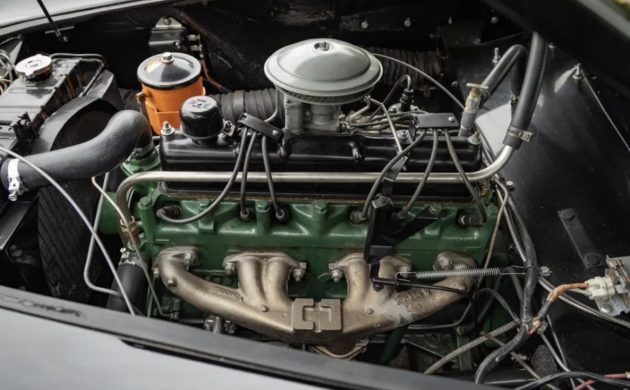
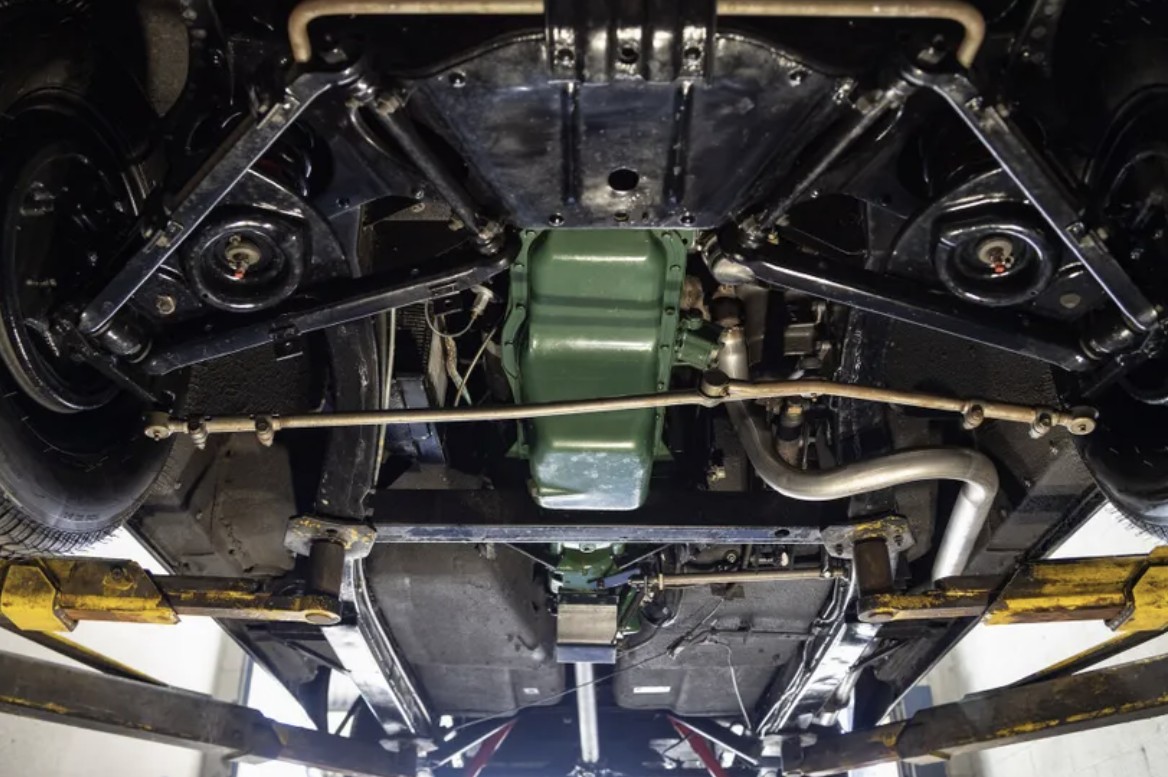
Like everyone else who made cars in America in the 1950s, Kaiser was aware that imported sports cars were filling a niche left vacant by US makers, but he was dead set against entering the segment. Kaiser was more interested in a car for Everyman than catering to the elite. Working in secret, Dutch Darrin created a swoopy body to fit the Henry J chassis and invited Kaiser to its unveiling. Kaiser famously blew up at Darrin, at which point young Alyce piped up with encouragement. She pointed out that if Kaiser didn’t build sports cars, every other maker would, and the company would be left behind. That’s all it took – the Kaiser Darrin was launched in 1954, one year after the Corvette. Like the Corvette, a six-cylinder engine was chosen for the car’s debut – in this case, the aged 161 cu. in. Willys Hurricane OHV F-head. With only 90 hp on tap, the little engine was no match for its competitors, with 60 mph arriving in a leisurely 15 seconds. This one is mated to a three-speed manual. In addition to a very sanitary engine bay, the underside is clean as a whistle. The seller indicates the car drives like new.
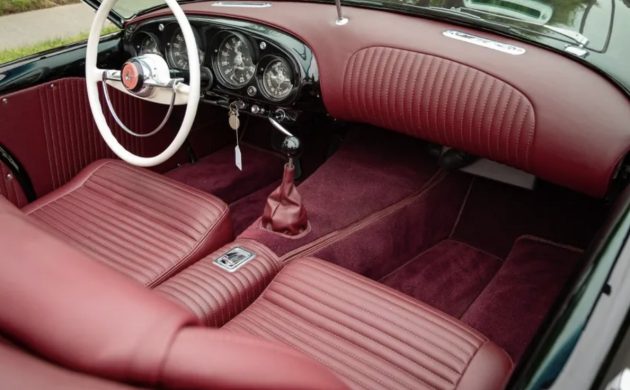
Things get interesting inside. Dutch Darrin had a visceral objection to normal doors; he had patented a sliding mechanism in 1949. Now was his chance to deploy it. The Kaiser Darrin’s doors slide into its front fenders, opening just enough for your eight-year-old grandkid to slip into the seat. Complaints were legion: ingress and egress were challenging, the mechanisms stopped working, and owners had to be meticulous about keeping the tracks clean. Plus, there was no room for windows, so the car was fitted with side curtains. Speaking of which, erecting the top was an additional exercise in flexibility and dexterity. All that said, this interior is marvelous. Commit to driving on sunny days and forget the weather equipment.
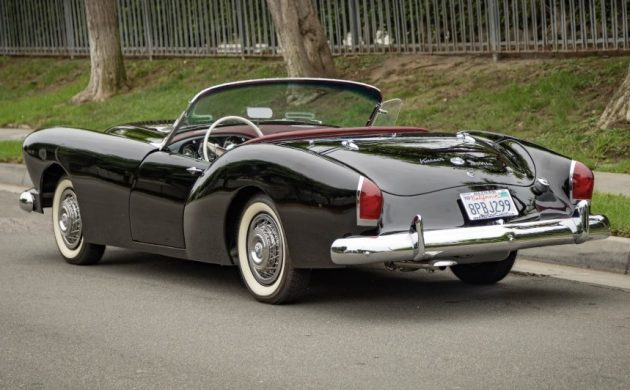
The “Darrin dip” in the car’s topline is on full display here. Overall, the Kaiser Darrin is very handsomely proportioned, and I like it painted in black far better than the usual pastel Easter shades we see. The current bid is just a bit shy of realized auction prices, though we note that some sellers are asking much more for fine examples. Have you ever driven a Kaiser Darrin, or ridden in one? Let us know in the comments section.

All correct except its not a flat head, it’s the Willys Hurricane overhead valve 6.
I don’t recall black being part of the Kaiser-Darrin color palette. Given the quality of fiberglass bodywork in the early 1950s, the actual colors chosen — mainly light pastels — were a better choice for hiding any ripples or other flaws.
jmolsn is correct: the Darrin used the Willys powerplant, though it was actually an F-head design (intake in the head, exhaust in the block) of 161 cubic inches, hence the “161” suffix in the model name.
It’s worth noting that poor sales finally killed off the K-D. In fact, Dutch Darrin bought up many of the leftover unsold cars and peddled them from his shop in Santa Monica, California. He ended up installing Cadillac V8s in some of them, giving them performance to match the swoopy bodies..
Thanks so much to both of you for the correction, and PS, that “report” button is too close to “reply” and I accidentally hit it! Didn’t mean to!
I remember seeing one of these back in the ’70’s,
while driving in downtown Kalispell,Montana.You don’t
confuse this with any other car,with those doors & front-
end.
Doors and interieur are nice – but the overall body lines a odd