

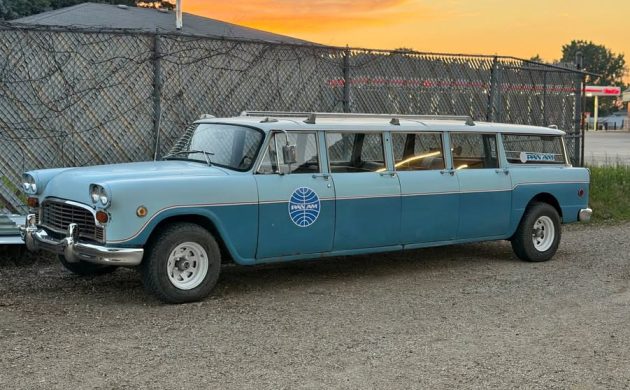
Checker Motors was well known for its presence in the fleet car business, especially in taxicabs. Back in the day, you couldn’t visit a major metropolitan area without finding several yellow Checker cabs running around. One of Checker’s custom vehicles was the Aerobus, built from 1962 to 1977 to service airport limo shuttle businesses and those needing frill-free big transports. This 1972 edition (the seller also refers to it as a ’67) wears PanAm decals and can be found in Minneapolis, Minnesota (or maybe in Wisconsin). It’s available here on Facebook Marketplace for $10,900 (also quoted as $11,500).
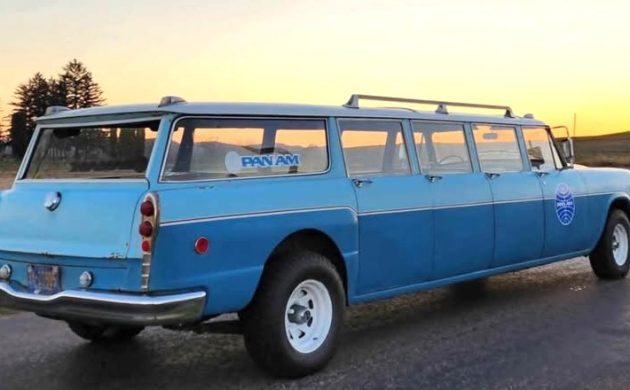
The Aerobus came in two wheelbase configurations, set up as six or eight-door wagons which could accommodate up to 12 folks and their luggage. About 3,500 of them were built over time, and the seller’s has four doors on each side (parking these things had to be a challenge). By 1972, the Aerobus was powered by a 350 cubic inch Chevrolet V8 and an automatic transmission (TH-350?).
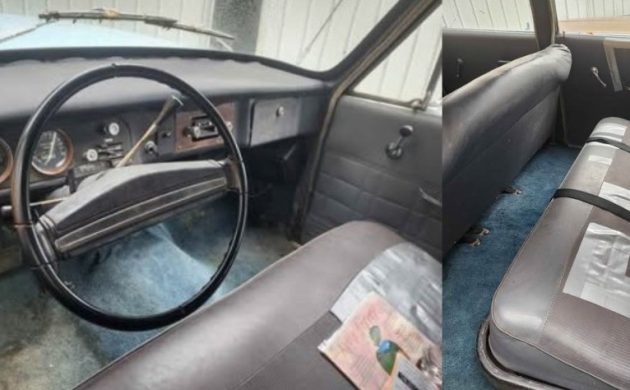
We’re told this barge runs, drives, and stops, but it currently runs off a separate fuel delivery source. That probably means the factory gas tank is either rusty or dirty. While the carburetor has recently been replaced, the bus is in need of a tune-up. The body is in fair shape, and the two-tone paint is past its prime but still interesting. The interior is starting to rough up with some duct tape in place on multiple seats.
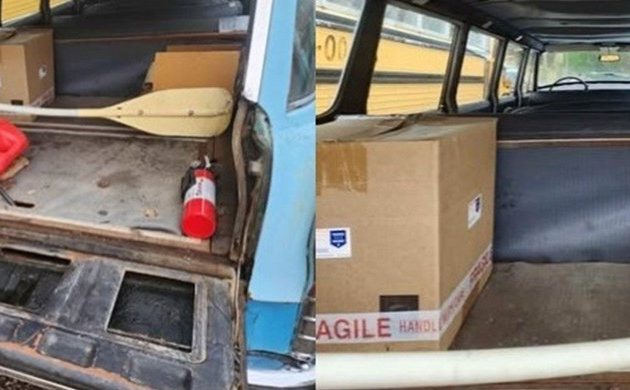
This looks like a way-cool vehicle that you don’t see running around anymore. If you were to buy it, what would you do with it? Shuttle folks around for parties, weddings, or in parades where something different is the order of business? The seller is reluctant to sell, but a “dream vehicle” has come to his attention, so this limo must go. Another tip from the master, “Zappenduster”.

I don’t know why I love these things, especially the older ones. This one needs 12 surfboards on the roof.
Utility at it’s best. These were a beast and those rear wheel openings weren’t cut away because of rust, they came that way from the factory. They weren’t made for show. Other companies, such as Stageway, made stretched wagons from cars supplied by the big 3. It seems Chryslers, Pontiacs and Chevys were favorites for this, but the Checker was the only one that was factory made. When the big 3 came out with 12 and 15 passenger vans in the 70’s it was probably a cheaper way to go.
More duct tape, please, “give me 40 acres and I’ll turn this rig around”,,PanAm, boy, if that doesn’t stir up images of only a tail remaining. Pan Am didn’t really have any worse of a record than any other airline, it’s just when it came to any global transport, PanAm was the one, and the crashes were in other lands and highly publicized. Not too sure about for the public, but more likely for the crews and pilots transport to a motel. It’s a great piece of Pan Am memorabilia, which I read can be very valuable today. Just not sure what in ‘tarnation you’d do with it.
For the record, Onalaska, is near LaCrosse, but the Cities are the closest bigger areas. Pan Am wasn’t very big in the Twin Cities, more of an eastern US and global, and with so few made, it’s an unusual find for sure.
Seldom see one if these anymore (or any Checker for that matter). I sure hope whoever ends up with thiscdoes a full restoration. Its truly a part of automotive and aviation history!
Our family did a lot travel to downhill skiing all over the US during the 70s. I remember riding in these big Checkers to and from resorts. They usually had massive roof-racks to carry ski-bags & luggage.
I could see the one for sale here restored and updated for use as a shuttle for a boutique hotel/resort.
I would likely use a modern Silverado as a donor for the drivetrain.
Would make a great band car for
playing one nighters. And if you need more room for your equipment, just add a trailer hitch
and tow a 2-axle utility trailer behind it. That’s what we did because we had a Yamaha EM 150 II B sound system in those days. It was very large and had a
10 channel layout with an EQ unit
that just wouldn’t quit. And along
with miles of cords and other things, you got a pair of 4115 speaker cabinets (We had four of
them). You know, the kind they are so heavy it took 6 men and a
boy to move them and set them
up. And depending on the venue,
we would stack ’em two each side of the stage. If the place was smaller, we only used one
pair. We wired everything into the
sound board, set the bass and treble for each channel to mid range, and ran it all from the main
volume control on the board itself. The only other group we knew running a system like ours
was Boston and their system was
waaay bigger than ours was. That’s why we had that big trailer!
We really liked it when a show would use our system as the house PA. We not only got paid
extra for it but at the end of the
show, we had roadies from other
bands help us tear down when the show was finished as a way of saying thank you to us for not
having to set up their own stuff!
There might’ve been 15 maybe 20
guys helping with the teardown so that ALL of us could get to their respective shows on time. After that, we’d have breakfast at
a truck stop and either drove on to the next town or went to see if
Tom Bodett left the light on for us
at Motel 6. Depended on how worn out (or horny) we were after
the show. And the song that Howard is referring to is Gimme 40 Acres by the Willis Brothers.
First heard that tune in ’67 or’68.
The chorus went:
🎵. Gimme 40 Acres and
I’ll turn this rig around.
It’s the easiest way that
I’ve found.
Some guys can turn ’em
on a dime or run ’em
back downtown.
But I need 40 acres to
turn this rig around. 🎵
Four years later, we worked a package show with them in
Louisville Kentucky. (’71, ’72?)
And they played that song there.
too. The whole place went batsh*t crazy when the they sang
the last line of the last verse which reads: “Gimme 40 sticks of dynamite and I’ll blow this to…”
The whole crowd was hooting,
whistling, and cheering enough to
blow the roof off that place! Such wonderful memories.
That all would probably make a very good read!
I am sure that there was a lot of mayhem and madness and misfortune of all manner.
What was the band and where did you play?
And bar owners still want to pay $500 a night in 2026.
I went to a private school, Bullis, in Potomac Maryland for a year in 1970. I lived in the dorm in Silver Spring, some miles distant. The dorm was a strange old asylum dating back to about 1914. Only a handful of us boarded there. Part of our transportation was a Checker Aerobus just like this……driven daily by one of the students! It was a wild ride under any circumstances, but more so with a kid driving. I called that strange year my “Holden Caulfield Year”.
Now kids behave or I will turn around and go back home!
PLEASE DON’T MAKE ME TURN AROUND!
I wonder what the overall length is? While in my teenage years our family had a 1959 Caddy limo that Dad bought for vacations. (Always had more than just the family)
So driving that boat was part of my driver’s education/ learning process. Backing up was the hard part.
A 1972 Checker Aerobus 12-passenger wagon is exactly 270 inches (22.5 feet or 6.85 meters) long. It rides on a massive 189-inch wheelbase. To make this giant size easy to picture, it is roughly the same length as an entire mid-sized delivery truck. It is also more than 4 feet longer than a standard extended-length SUV (such as a modern Chevrolet Suburban).
It tipped the scales at 5,305 pounds empty, and it required a massive 66-foot circle just to make a U-turn.
While the 12-passenger Aerobus is huge, Checker also made a slightly smaller 9-passenger version. That version sat on a shorter 154.5-inch wheelbase and measured “only” 235.5 inches (about 19.6 feet) in total length.
Source: Das Internet
The ultimate limo!
Don’t bring this to compete in your local gymkhana. On second thought, this might be fun to enter in the 24 Hours of Lemons.
Talk about straightening out the corners! Trying to stay “completely on the coarse” would be difficult. You get penalized for a wheel (s) off the pavement. Ask me how I know!
One of the few cars that is so long, it could lap itself. Or be in two corners at the same time. Would need its own pit lane, not just a stop.
Wow, this is an Uber drivers dream!
When I was a kid, there was a family in our town with about 12 kids and they had an early ’60’s Chevy version of this shuttle. The only thing with enough room to haul the whole family around.
You’re right Bluesman, there was a lot of madness and mayhem in
the music business back then no
matter how far you went up the ladder. I was 14 when I started out in 1969. I worked for a fellow
named Marty Olmsted playing at
the Bolero Lounge at the Oakland
Bowl in Bloomington Illinois. When my Mom bowled for the
Eureka bowling team in league play, I’d bring my schoolbooks and a small typewriter to do my
homework and watch the bands
play. I’d get set up and order something to eat and just listened to how they played music. And of course, I did my
homework too. Then one night,
Mr. Olmsted asked me if I wanted
to try singing with his band. And as you could imagine, I jumped at the chance. I sang an old Hank
Williams Sr song called “Why Should We Try Anymore” and brought the house down. That was it! I was hooked! Marty made arrangements with my Mom to bring me to the bowling
alley every Wednesday night provided I kept my grades up. I’d
sing one or two songs and he’d
slip me $5 or $10 (quite a bit of money for a kid my age) a week
to sing with him. After that, I joined the Breakfast Jamboree, a
semi live radio show on WHOW out of Clinton Illinois later that year. In 1970, I did my first summer tour with Midwest Entertainment out of Champaign
Illinois. The man who owned the
radio station owned that company too. All you did was go
to the small cities and towns and bring them live music as the major record labels only held concerts in the bigger cities like
Chicago, Peoria, and St.Louis. the band I was assigned to opened for a lot of up and coming acts that were recording
for Illini Records back then. Folks
like Guy Drake, Mark Dalton, and
Linda Cassady to name a few. Your tour started as soon as school let out for the summer and it would end just after Labor
Day depending on the school you
went to. You played 7 days a week and got paid $350 a week.
And for a skinny blind kid like me,
I thought that was a fortune! I made enough money to buy my
Own school clothes, help Mom and Dad pay down the mortgage
on our house, and even managed
to save a bit to tide me over til
next summer. I would do 3 tours for them from 1970-73 and still do the Breakfast Jamboree during the fall and winter months
while school was in session. And to cap it all off, I started playing one nighters with some kids I knew in school. We used to take
our guitars and jam out after lunch! Even Mr. Schuler, would
come down when he could to jam
Along with us! It was really something to have your principal
playing with you! We formed a group called Rocky Mountain Express and played places like the American Legion, the VFW,
The Moose, Elks, and Eagles lodges, and The Knights Of Columbus. For those shows, we
made $200 a show. Split that 5
ways, and we got $40 each. Still
a lot of money for a teen ager back then. And we were busy most every weekend. After I
graduated highschool, I went to work with a warm up band that opened for Marty Robbins til early
’74 when I signed a 5 year contract with Midwest Entertainment. They offered their
musicians things like a 2 week
vacation and being home for
Thanksgiving and Christmas. So
There you have it. My life in the
music business. I retired in 1991
after nearly 22 years in the business. In the end, I had a day
job that paid well for the time and
my wife and I ran a paper route for 16 years til I lost her to a stroke in 2003. And do I still play? When I can but not so much anymore. Do I miss it?
Almost every day. But that’s what
Happens when you have a family
to take care of.
Thanks Ken. That’s great stuff.
The right time and place with the right skills. It’s hard work.
It takes a big toll on a lot of people, physically, emotionally, financially. Glad you did well with it and knew when to quit.
Wow! $350wk back then for a school kid was darn, darn good money.
Cool story.
And Ken would come to the town I grew up in! (Crete Illinois) Although I doubt I ever heard him. Since I dated a gal in Oak Park for three years and spent all my time off driving up there to see her or go to Williams Bay to her grandparents cabin on Lake Geneva WI. Hey Ken, I just pulled up Hank Williams Sr. Singing Why should we try anymore. Great song!
Thanks Wayne! Our version sounded more like the one sung by Jake Penrod, a Hank Williams
impersonator on YouTube. The difference between our version and his was the steel guitar intro
and solo as opposed to Penrod’s
use of a fiddle in those spots. Ours was still good enough to make Bert Yates cry like a baby.
Bert (short for Bertha) Yates was
a woman in her late 40s to early
50s with blonde hair stacked on
top of her head and cleavage that
got there before she did. I got my
first booby hug that might from her not long after I finished singing. She told me that everything would be okay. I think
that’s when I discovered older
women! And I gotta take my hat off to you Wayne. You made that
long distance romance work for
3 years?!!! She must’ve been really something for you to make it work that long. And yeah, we did stop and play in Crete at least
once a year. It was usually a package show with a lot of good
entertainment in it. And yes Crown, that was a LOT of money
for a teenager to be making back
then. Considering many of the kids I knew worked for some fast
food joint around town making
maybe $30 a week at best. And I
put that cash to good use helping
my parents pay down the mortgage faster by paying double
payments each month. But all this came with the understanding
that I had to keep a solid B average in school in order to keep
touring. It’s not that much different from being a student athlete as they had the same standards too. After I graduated,
I made a lot more money and still
helped my family with whatever
they needed. And it wasn’t just the big stars that made huge amounts of cash back then. If you were a good support person,
you could make maybe 3 times what a union factory worker made in a week. So yeah, I wasn’t doing bad at all for a skinny blind kid. And by support
people, I meant warm up bands,
pick up musicians and the like.
And everything was going fine until I found alcohol. That’s when
things went south in a hurry. I’d
be so hammered I didn’t even know what town we were playing in. But I still got up and played.
And yes, Bluesman, I knew when
it was time to quit touring and walk away. It took me 18 months
to go from stone ass drunk to stone cold sober, and by the grace of God I made it! Been sober for nearly 50 years now
and haven’t regretted it since.
Do I miss touring? Yeah, I wouldn’t mind trying it now.
Do I still play? Not that much
anymore. But that’s what you
do when you’re a professional
family guy.