
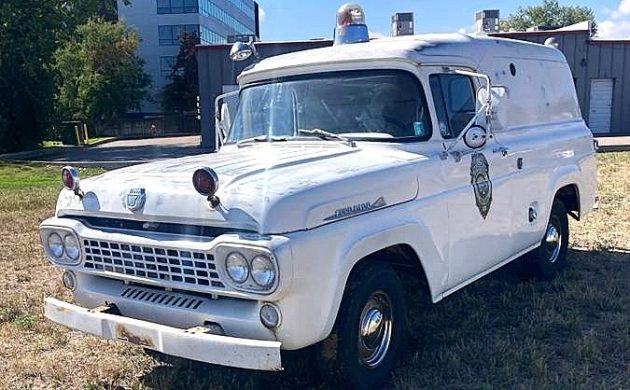
When it comes to fire department autos, it’s typically those that have to get to the scene of an emergency quickly that come to my mind. However, once the blaze is extinguished, there’s often more work to be done, especially if the cause appears suspicious. This 1958 Ford F-100 Panel Truck here on Craigslist served for many years at the Wheatridge FD, not as a fire-fighting unit, but for transporting personnel to burn scene locations requiring further investigation. It’s been retired from active duty and is now located in Golden, Colorado, so if you’ve been seeking an enclosed hauler with an interesting background, this one may be worth checking out. It’s priced at $10,500, and our thanks go out to reader Mike F. for providing the tip here!
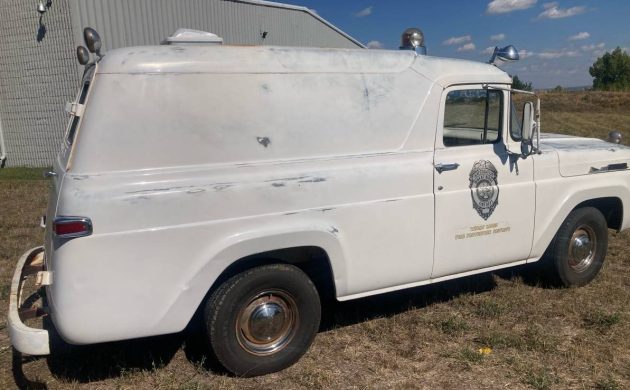
There are several possibilities for this one, including leaving all the lights, sirens, and decals intact and just allowing this truck to continue serving as a fun relic to the City of Wheatridge. The seller had other ideas, as his plans were originally to use it for a snow cone business, but he’s decided instead to stick with his original van. Whatever you’ve got in mind, the sheet metal appears to be in very good condition, so it won’t take much effort before the exterior is ready for a fresh coat of paint. I might have to consider removing those mirrors first and going with something less industrial-looking, but other than that, I’m a fan of how this one presents outside.
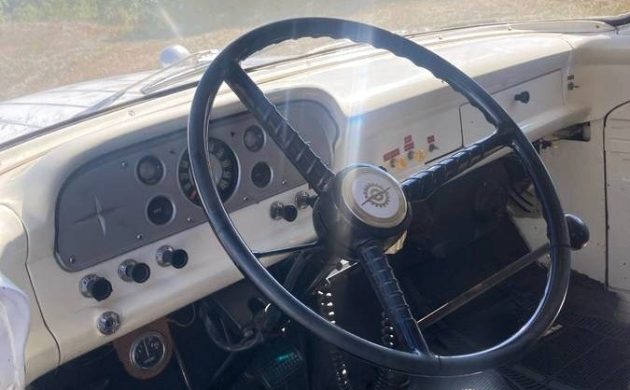
The dashboard is still in nice shape overall, and the driver’s seat is from an era where a few strips of duct tape were a quick-fix for just about anything. Wheatridge is a rather small area, with just over 30,000 residents even now, so this one never had to travel far and has only been driven 14,128 miles. It’s also likely not had all the hard use that water and hose firefighting trucks receive, but the rear section is no stranger to hauling equipment around, although the marks back here appear to be mostly cosmetic in nature.
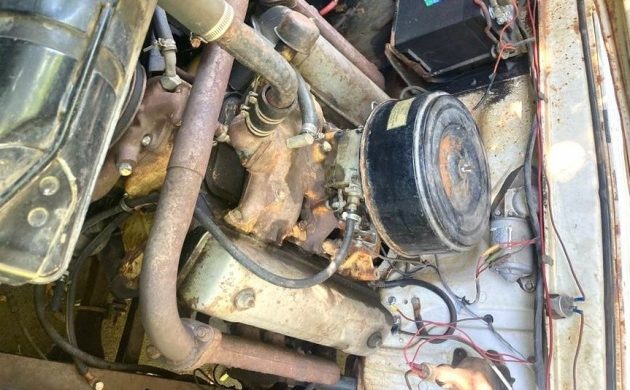
An inline six was the standard engine here, but the department opted for a V8 and a 4-speed manual transmission, so this would be considered a decent performer for the period. There’s no information provided to suggest that the motor has ever been rebuilt, but with the low mileage and all the downtime this one’s had, maybe there were enough hours left in the day to keep the mechanicals properly maintained over the years. I might choose to keep this one as-is for a while, then do something different later when the right idea comes to mind. What would you do with this 1958 Ford Panel Truck?



This truck missed out on one of the most devastating wildfires in Colorados history. On Dec. 30, 2021, a small fire supposedly started by downed XCEL wires and a small brush fire in high winds, 45 mph with hurricaine force gusts, on a relatively snowless winter, whipped the fire into nearby Marshall, NW of Denver, in a matter of hours, destroyed 1084 homes and businesses. It was so hot, it created it’s own weather. This truck would have covered that after the fire was out. Amazingly, I found some archives on the Wheat ridge Frie Dept. This truck was also used in arson cases, if any, and led a peaceful life. I’m including a link that will surely send this comment to #ell, but it shows pictures of this truck and worth the views and here goes,,,
https://5280fire.com/home/colorado-fire-apparatus-stations/jefferson-county/west-metro-fire-rescue/wheat-ridge-fire-protection-district/prospect-valley-fire-department/prospect-valley-station-1/
That is a great link Howard. Seeing all the old Fords and Internationals is a huge treat, back in the day when they were new. Thank you for posting that.
And Mike, great write up, Im really happy to see more “Profesional ” vehicles here on Barnfinds lately, they are a part of our history and I strongly believe in them being restored and
preserved.
Hey Dave, I’ve found fire ( not frie,,) fighters have a rich connection with their past. Our little town restored their 1911 Kissel fire engine, the city’s 1st motorized fire engine, and was used in parades, if anyone can start and drive it, that is. The long time curator of the fire engine retired, and it now adorns/sits a special glass enclosed area in our brand new state of the art $16.6 million dollar fire station, that was well needed. Now they are saying they need a new fire engine( another $million) that is 30 years old. In a small town, how worn out could it possibly be? It goes on 2 calls a year and usually only “save” the basement. I know new fire engines have state of the art equipment, but how did we ever get along with the old IH R190?
The other thing I wanted to say, is the white color. The standard color was obviously red, and not sure why white was used.( anyone?) In my 2nd home in Wis., Hustisford, ( Lothar might have heard of it, whoever you are), growing up we’d take the boat into Husty for an ice cream ( the old man wasn’t all bad), and we walked past the fire station for years. Inside was a ’55 or ’56 Chevy, in perfect condition, and was white. One day many years later,( 80s) it was parked outside, and I took a look. It had about 5,000 miles and was in brand new condition. I believe a city official ended up buying it.
Hey Howard, I hope this comes out, the town we lived in that had the old gas station I worked at had its original 1940 Seagrave fire engine. It was white as well. I’m trying to remember what gas engine it had under the hood. I want to say a large gas V12. But just dont remember now. ( I’m sure someone on here will know) but it was HEALTHY sounding. Used to love hearing it run going by at the parades. Great memories!!!
-Dave
Howard- what kills many older fire apparatus primarily are two things (I’m sure that there are more that I am forgetting):
1.) Lack of replacement parts. California’s Office of Emergency Services had a large fleet of apparatus based on International Loadstar chassis. As some parts became unavailable, it became more difficult to keep them in service. I had an apparatus in the shop once with a dangerously worn drag link- a proprietary part no longer available. It was retired. Replacement windshields, many of which were custom made, were a problem as well.
2.) Liability. The NFPA (National Fire Protection Association), which sets standards for all aspects of fire fighting, recommends putting an apparatus into “reserve” status after 15 years, with full retirement after 25 years. A department that fails to meet this standard (or many others) that finds itself in court (employee death, accident, etc) is at great risk legally for not meeting the prevailing standards at the time of an incident. Case in point- when open rear facing jump seats were common, an unbelted firefighter (also common) fell out of their seat and was run over by the rear tires. There was a successful lawsuit and the manufacturer went out of business. Thus, fully enclosed cabs (that are now certified through crush testing, due to rollovers)- everyone inside. Many firefighters that used to ride on the back (tailboard) were injured or killed when they were rear ended. No more riding there. Seatbelt use was a problem. Now a display on the dashboard indicates any occupied seat that isn’t belted. Stability control, ABS, etc. and on and on- hundreds of small aspects that often make purchasing a new, fully compliant apparatus appealing to local governments. Also, as a repair facility, we took on major liability exposure every time we touched an apparatus. My technicians were fully emergency vehicle certified- specifically trained at academies on emergency vehicle systems. We refused to do anything substandard or questionable in our work- too much was on the line. If you wanted a bandaid for your apparatus, go somewhere else. Sorry to be so wordy.
Thanks ‘zilla, the argument is strong, and police don’t use ’61 Plymouths anymore either. Police cruisers are highly sophistimacated machines, and fire engines are no different. I guess my problem is, these departments are great at spending taxpayers money, that could go for something else, like affordable senior housing, and don’t care how much it costs. It’s not their concern. Like a doctor, is more concerned about the diagnosis than the cost. If it saves one life, it was worth it. It’s ironic, years ago when there were house fires regularly, we had R190 IHs and yes, fire fighters rode on the back, and unrestrained in the cab, I don’t recall too many fire fighters falling off , or rear ended by another motorist. It’s the fire that’s the dangerous part. I think incidents like you mention are rare. I think LEOs on a highway stop are much more at risk for injury.
I have the utmost respect for fire fighters, they run in when I run out. No different than police or military. If that proposed shuffleboard project gets delayed( again) for a new fire engine, I’m all for it.
Howard- you are incorrect. The #1 cause of firefighter fatalities is cardiac related events. In fact, NFPA requires defibrillators on fire apparatus, primarily for the crew. Vehicle accidents are #2, with fire deaths following. Excited, likely younger and lesser-trained volunteers suffer the most (water tender rollovers are a problem- thus stability control). For 2023, NFPA estimates that 19,225 fire department vehicles were involved in traffic accidents which resulted in 1,450 firefighter injuries. In 2022, an estimated 2,800 to 3,000 firetrucks were struck while blocking (14-15% of all firetruck collisions are estimated to occur while blocking near recent/previous crash scenes or while stopped in the roadway). Sixteen Teslas alone have plowed into parked emergency vehicles. And then there are collisions caused by firefighters themselves. Google “Two Fire Trucks Collide in St. Louis Firetrucks bulletinboardforum”, posted on YouTube by “sukisuki2005” to get an idea. Watch the guy on the sidewalk on the right.
Howard thank you for that link i loved seeing those old fire trucks.
Thanks for those Howard. As a retired firefighter and history buff, my career was my also a hobby that led to an interest in old apparatus. This one is cool cause you could drive it around town a lot easier that a 100′ aerial!
That was a great link to share. Thanks for that. The history is a best thing to read and to see the evolution of decades of fire apparatus change in mere moments was worth not seeing the actual vehicles come and go
Thanks, you are obviously well versed on the subject. I’m surprised to hear cardiac events, as you’d think a firefighter would have to pass some sort of health testing, much like truck drivers. I think that’s the ultimate kick in the bum, dying while trying to save another life. I’m not going to look at the video, I don’t need to see that, and distracted driving has replaced DUI as the biggest culprit in accidents today.
At that price, with those low miles, it looks like a smokin’ hot deal. I still think you need to investivate further so you don’t get burned. We don’t think our daughter wants it, but it would be great for our son.
I think this would be a fun toy to have, other than just to cruise and use it for trips to the hardware store I’m not sure what I would use it for
I’d check it out-brake system, cooling, tires, etc. and then drive the heck out of it!
I’m waiting back from the seller regarding the siren set-up from a former Chief who may remember. The PA unit looks way to new and why would they have. I would think a mechanical type of growler would have been used in the day since it was emergency outfitted. Never seen the steady red lights stating FIRE within the bulb. Built in Kansas City, the DSO # of 0992 on the VIN indicates (EXPORT). Could have been built for another country and then found it’s way back to the states? The vehicle apparently was used by the Pleasant Valley Volunteer Fire Dept. in the day who then merged with Wheat Ridge FD in 1971. Trying to figure this all out. Cool rig though.
Glen can’t seem to get any pics to you. Haven’t got ahold of the old fire chief. Went By wheatridge grange, and wheatridge Historical Society, only open on Friday. Here’s some pictures you requested. Can’t load here either.
You need a membership in order to upload images. That’s the only way we can do it securely.
Howard, thanks for the link.. BY looking at the R model IH’s I am surprised they bought a Ford instead of an IH?? I would leave it like it is other than touch up the white. Which in its era was a common, as well as VW yellow, color for emergency vehicles. And enjoy driving it to cars and coffee.
Mike: Those larger west coast style mirrors are a MUST where you can NOT turn your head and look out the side windows!!!!
These older support vehicles are really cool,and used to have
extremely low mileage on them.
The 60 Chevy Apache 30 in my avatar was one of those.I bought
for a steal at $1750,then was told that it had 5100 miles on it.It was
the coolest rig I’ve ever owned.I got waves & smiles all the time.
I ended up selling it,as it was too nice to sit outside in the Winter.
It was also 20 feet long,& had a vent on the top,so that meant I couldn’t
park it in the garage.
Cool. It reminds me of the 1955 Chevy panel truck I once had. Foolishly, I traded that truck for a flat bottom go fast boat that damn near killed me.
I enjoyed checking this 58 panel delivery truck. I mentioned the other day that I owned a 53 panel truck for 30 years before selling it for a 66 F-100 pickup. The back floor with 1″ plywood and steel strips looks the same, protected like a covered wagon from the elements. I sold my truck for $6500 in 2019 with more miles so this looks like a deal. I did think it funny that the owner was selling because he decided against using it for his water ice business. I know it gets HOT inside these!
Back in 78 I lived in Adirondack State Park. The volunteer fire department had a 46-48 military fire truck that was garage kept, mint condition. It had a huge screen filter on the bottom so you could drive it into a stream/lake and suck up the water to fill the tank. It was diesel, and had like 2000 miles on it. Sold at auction the next year for 750 bucks….
‘70s VT housemate/college friend had the Dodge, I believe, a big hulkin truck.
I like the idea simply due to motor accessibility compared to the ’67/96
vans so used by tradesmen and some ‘bus companies” (all Big 3 made). These had ‘a hood’. Easier to work on. I had the slightly earlier, same design but forward control (motor all the way inside/behind axel). I favor the Cheb 1st gen ’64/6 (for looks’n 90 inch WB). Love the front view. No window & 8 door? perfect~
I even prefer the “Sedan Delivery’ rather than the “Panel Van” (all same era) as it is all I need for combo daily/work. No (to me) big monster needed. The SD is a ‘no window’ wagon. That 1st gen Cheb van’d be nice w/turtle top for a camper – i6, 292 / Rochester monojet, some cheb 4 speed slush bx (ie OD auto) or when needed (not sure when that would be) @ work…
The first thing a potential new owner should do is question the use of the selenium rectifier in what should be a DC circuit. The second thing to question is the condition of the driver’s seat with less than 15k miles. The claimed mileage averages ~211 miles per year. The vehicle’s condition looks more like it’s averaged ~1.7K annually for a total of ~114K miles.
Owner dropped the the BIN price by $700.00. Still haven’t heard back from him regarding my question since Sunday. Have interest but the shipping isn’t cheap.
Owner is now up to $11K or BO. Apparently cannot make up his mind.