

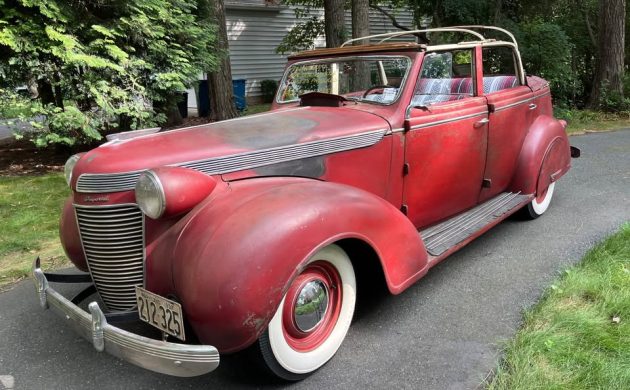
As we continue to see prices for prewar automobiles plummet, insult is added to injury when yet another rare car emerges after decades in hiding. Cars that once would have had enthusiasts fighting for a chance at now garner little attention and even less money from the shrinking collector car market. This 1937 Chrysler Imperial convertible sedan for sale on Facebook Marketplace in Califton, New Jersey, is a typical example of this very depressing mess. Despite being a CCCA full classic and boasting one of the smoothest prewar powertrains under the hood, the asking price for this solid but somewhat needy Chrysler convertible is somewhat optimistic at $27,000 after seven weeks on the market and a trip to a major Chrysler show. Would you be willing to overlook market trends for the chance to put such a wonderful travelling car in your garage? Thanks again to T.J. for yet another intriguing find!
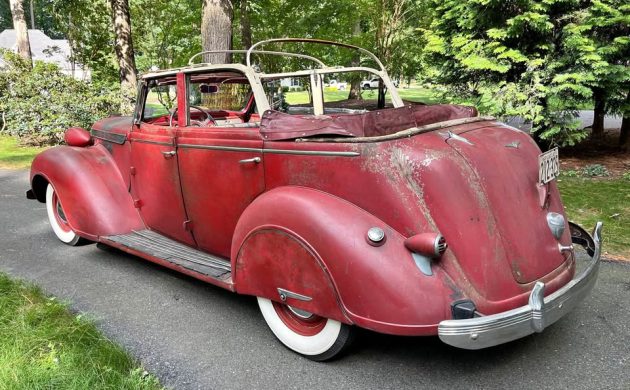
In 1937, Chrysler was emerging from the turbulent era of the Airflow. This radical car pushed the company back to more conventional designs. However, much of what was learned engineering-wise was transferred over to the new 1937 line. These were solid, all-metal cars with better motor mounts, a safer dashboard, and various other improvements that outclassed much of their competition. Chrysler also managed to garner some high-profile publicity for their new car along the way. To celebrate the 25th anniversary of the Indianapolis Motor Speedway, the famous race was paced by a silver and black Imperial convertible sedan like the one you see here.
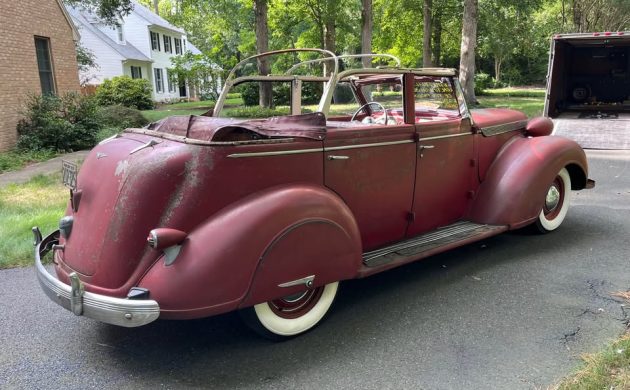
Chrysler contracted with the Murray Body Corporation to produce these expensive bodies despite sales trends clearly showing the convertible sedan body style becoming less popular each model year. Chrysler, DeSoto, and Dodge all offered their versions in 1937 and 1938, while the leftover bodies were sent to Plymouth only for 1939. Chrysler offered both a straight-eight-powered Imperial model and a lower-line Royal version with an inline six under the hood. The Imperial’s powertrain put out 130 horsepower and a seemingly endless river of low-end torque. Perhaps the best part is that this silky smooth engine was mated to an electronic overdrive to allow for more speed or even less engine effort.
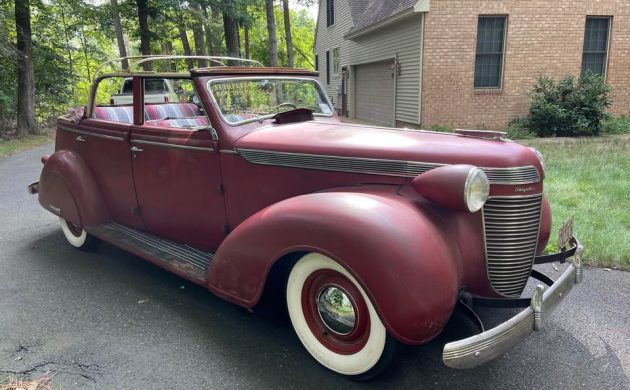
It is this particular engine and transmission combination that makes this car so wonderful. Most prewar cars struggle to maintain highway speeds due to being designed for a much more sedate world, far in our rearview mirror. Not so for this car. Highway speeds are possible as long as one pays heed to the suspension and braking limitations of the car. If you were looking for a classic car that is capable of handling multi-day tours and automotive events, along with getting you there and back without the services of a truck and trailer, this is the one.
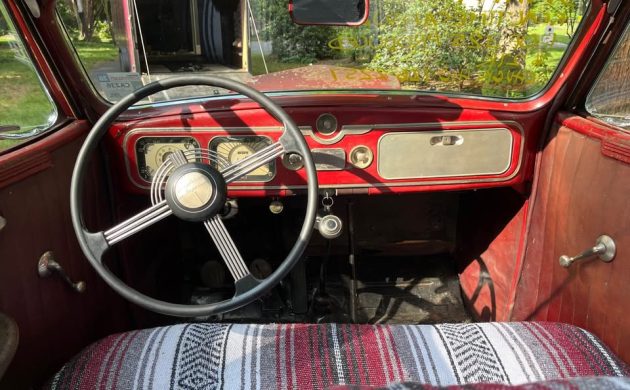
According to the seller, this is one of only 325 Imperial convertible sedans built for that year. Lesser Chrysler, DeSoto, and Dodge variations were produced in nominally larger numbers but are still very rare as well. This one is said to wear the original paint and leather seats. They are obviously not in great condition and will need to be dealt with, along with crafting a replacement for the expansive convertible top.
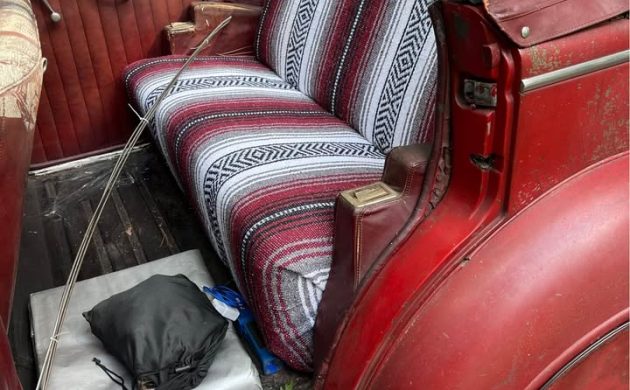
The good news is that all of the impossible-to-find parts and pieces, like the center pillars, top bows, and sill plates, are all there. The body also seems to be free from rust, and the floorpans are shown to be in great shape as well. A bonus is that the car is also said to run, drive, and stop. We are told that the car was taken to the Chryslers at Carslisle event over the past weekend. The fact that the car is still listed today is a sign that the demand for such a car, even one as capable as this, is low.
This Chrysler is a reminder that we are fast approaching a point where cars like this are in the financial reach of people who never thought that they could afford such a classic. With that comes a certainty that a majority of the folding money thrown into it will never be recovered. It has to be for the love of the hobby and of the car itself. I can live with that, but it is a heck of a reminder that there are truly no free lunches in this hobby anymore.
What do you think is a fair price for this car? Could you justify the cost of restoration, knowing that the chances for a return on your investment are small? Please share your thoughts in the comments.

Nice writeup Jeff on a very interesting car. Certainly, the average classic car guy out there won’t pay 27K for this car and then pour another 75K into a restoration.
But there are enthusiasts out there who could drop 100K and bring this car to concours condition, without worrying about breaking even. I have to believe that guy is out there somewhere.
My wife and I like to travel, and we know that not one dime spent on travel gets refunded. With my old cars (oddballs that they are) at least I know that probably 50% of my investment is still sitting out there in the shop.
Great write up – thank you for that. It validates what many have stated (myself included) about the market for cars like this. The market is drying up quickly. I’d be surprised if this moved at a fraction of the cost.
I’m willing to bet that the previous owner was part of that demographic, eas planning to restore it someday and the car is now being offered by his heirs.
A absolute certified classic if there ever was one. And I agree–the buyer for this is out there somewhere. Yes, it would be expensive to restore, but the end result (if done right) would be a TON of trophys! Can’t speak on the price–try to find another one. This Imperial deserves TLC! GLWTA!
Lovely rare car, but I agree, the $27K entry price is a bit optimistic IMHO. I have a 39 Imperial, and that drive train is a wonderful power plant. Mine is capable of 70+ mph all day long with the overdrive engaged. A 4 door convertible is a great way to enjoy the old car hobby! Too bad there are not more pictures! I’d expect some under hood, trunk and chassis pics for that price!
From a styling perspective, late 1930s cars suffer from the dilemma that they are not the earlier (and very classic looking) 1930s cars.
As a project base, this might be a good one, but there are also an endless supply of others out there that are much better starting points.
Especially two door convertible coupes and roadsters, where you have a much better chance of getting something back.
The 1936 500 was paced by a Packhard, which was driven by 2 time winner Tommy Milton. It also marked the first year where the winner received the car as part of the purse.
Well, if the car is that complete that it runs, drives, and stops, then just fix it ‘s immediate needs
and enjoy it for what it’s maker intended– to be driven and enjoyed for what it is– a great car
that will get you looks anywhere
you go. Sure, it may be a full AACA classic, but why not drive and enjoy it especially if you spent $27K to buy it! After all, isn’t what the old car hobby is all
about?
Fair point, and agree that they need to be driven, but here the car is useless until you put another $5k into the the canvas, a new boot, and frame rework just to make it operational.
No photos of the engine, where replacing “everything soft” is in order, just for safety and reliability. It also might need brakes to be road worthy.
No word on the tire condition, but cracked and dry is probably a good guess. Break out another couple thousand.
Add in a lot of DIY buffing of what’s left of the paint and trim. That’s a lot of real estate, so maybe pay someone?
Now you’re in for at least $37K with a basic driver that has some old car character but probably no takers at anywhere near that price because you are competing with other ones that are far better off for the same or less money.
This car needs to be less than $10k in it’s current condition to justify the cost to make it safely and reliably operational, let alone spending the big money in “restoration”.
That’s what depresses a car like this the most. There are viable drivers out there that are not pristine, but are way better starting points for the same money.
Well said Bluesman.
I also like Ken’s thought of just getting the old buggy back on the road to enjoy it. No need for a full restoration just to enjoy it. Unfortunate though the steep buy-in to get there.
Well Ken,
Where you been? I was getting worried. We haven’t seen you at the Barn for awhile. I was about to email you to make sure you were ok.
I love the style of both of my 37 and 38 Terraplanes!
Maybe Ken Carney is on to something. Just fix what may be needed for roadworthy operation and drive it. Most collectors don’t drive their vehicles during inclement weather so remove the top supports and enjoy top down driving. Let the cosmetics be what they are. The reality today is that not so slowly and ever surely, the future for cars and even full AACA classics like this; are approaching the downward spiral of a perfect storm of disinterest in the older stuff and the ever increasing price for restoration. Even with a money is no object attitude you will still be required to put in the effort to actually find a shop that can restore this that isn’t already backed up with a waiting list of other projects. Maybe someone like Jay Leno will come to the rescue. I hope so. I’m getting nostalgic that even fifteen-twenty years ago that this would have at least several interested people vying for the acquisition of this great example of Chrysler design and engineering during the Art Deco period. GLWTS.
These are indeed interesting cars and with the overdrive, make modern motoring a viable option. However, this is a C14 and as such, is not a full Classic. Only the Custom Imperial C-15, CW Airflow and the C-17 Airflow are considered full Classics in the Chrysler lineup for 1937. These 4 dr sedan convert bodies were all the same or very similar across all Chrysler products from 34 to 38 with Plymouth being the only one remaining for the final year of the body in 39. Imperial was just another 8 cyl model in 37 and 38 with it being the low level 8 in 39 for some reason. Custom Imperial was a different animal all together and are indeed full Classics. The Crown Imperial started in 40 and up and is also a full classic as it had its own chassis.
Bill, Thanks for the arcane information. It’s fascinating for those of us who care and useless for most everyone else and it’s the kind of information that is in danger of just disappearing from history. At the end of the universe such distinctions won’t matter a damn but until then I see no need to hurry our rate of discarding of our great wealth of industrial knowledge and forgetting how things were once done and came to be. Thank you again for taking time to share this.
I have never seen one of these and I don’t feel like I have missed much. Regardless ,it is a rare car and it looks like the restoration would not be terriable, most or it is there. It is going to take the right person to do it. I think it would be very dificult to do a proper restoration and even break even on all the work involved.
With regards to the second last paragraph. Whether it was restored today or restored 30 years ago. Rarely does anyone ever get their full money back. So investing money into this car (or any car) is something most people do for the love of the hobby. I’ve read numerous stories over the last 20 years about the pre war cars dropping in price and even the ones in 50s. I wish I knew where these cars are because they sure aren’t depreciating in my neck of the woods. The other factor that might be turning younger enthusiasts away is just the overall cost for parts, repairs, labour, etc. Lots of classics still on the road and in fields. Just out of reach financially
Not a highly sought after vehicle today, but tomorrow? I do see a concourse level restoration being the only possibly financially sound way to go. If I had an extra100k laying around, I’d do it.
Not a highly sought after vehicle today, but tomorrow? I do see a concourse level restoration being the only possible financially sound way to go. If I had an extra100k laying around, I’d do it.
Look up pictures of these. Include the word sedan for thr 4 door. They look incredibly stately similar to a Packard. This is an ideal two year project. Offer $20K, put in another $25K for paint, top and parts and do the work yourself.
The entire hobby of preserving and restoring old and classic cars was never, ever based on sound financial investing. It was originally based on the love of old machinery, the pride of ownership and the skills that are needed to keep them running, driving and enjoyed for what they are. The whole speculation and “return on investment” came later in the 1970s with the $100,000 Duesenburg sales at the Cruse auctions in Indiana and has continued today as people continue to try and cram a hobby into the modern statistics driven monetization of every aspect of our lives. Don’t be an idiot. Everyone saw some people make money at auctions or by hustling their time and labor into car show fame and they decided they deserved a piece of that too.
Get lost. Stick to your CDs and S&P Stock index funds if you want some positive return on your “investments”. The old car hobby isn’t for you.
Hi honey 🍯! I’m okay. It’s been a
little crazy over here. We have a snot nosed young manager trying
to get rid of all the elderly and disabled people because she doesn’t like us schlepping around
the store doing our jobs the way
they should be. But enough of that. As I said earlier, I would definitely drive this car any chance I could. So what if it looks like a hung over drunk coming off a bad weekend. When’s the last time you saw one? Last time for me was at the
first annual Street Rod Nationals
in Peoria Illinois. The car I saw there was an extended sedan with dual side mounts and packing a 383 V-8 with 440 heads
backed by a 727 Torque Flight automatic from a wrecked police
car. It looked dead stock outside
until you hit the GO pedal and it
shot right by you. No, it wasn’t
perfect. It had a few love taps on
both front fenders and grey primer splotched here and there
on an original body still clad in it’s
factory finish. The seats and door cards were done and looked
nice. The headliner needed some
love, and the dashboard had a Thermo King TK2 A/C unit under
the dash next to a Craig AM/FM
8-track player. And everything you saw worked. And that, folks,
is how I would do this car–only
using the original engine and tranny to move it. And being an
old horse trader, I can almost trade for anything the car might need. A new top and interior might cost me a few months of
cleaning the man’s upholstery shop. Same with the paint. A few months of helping the guy prep cars for painting along with
one of my prints just might fill the
bill for him. You don’t really need
a $25K interior or top UNLESS you plan to show the car somewhere. Same with the paint
too. Unless you’re gonna show your car at Amelia Island, you don’t really need a 10 foot deep
paint job do you? Just something
nice is really all you need in the way of paint. And though there are many in this hobby that would
most likely burn me at the stake
for being some kind of heratic, it
doesn’t matter what they think anyway. They didn’t shell out the
big bucks to buy this beauty, you
did! And so what if you’re as poor
as a church mouse? You have all
the time in the world to make things perfect if you like. So go
out there and enjoy your rides before you state tries to outlaw the fruits of your labor.
I never thought much about making any money with my old car hobby. My business model is to loose money on each car but make it up,in volume
It’s the old “Sell below cost, we’ll make up for it in volume” strategy that has made me the successful king of industry I am today.
I agree 100 % that the investment mindset has ruined the hobby in the long run.
Investments return money, from income. Like real-estate. Business equity. Gold is supposed to be a hedge. Bitcoin is, well who friggin knows.
Cars are a cost center. You pay sales tax on the way in, just for starters.
Restoring old cars was just a hobby once. You started with a decent driver, not a heap. Parts cars were cheap and everywhere. Local body and mechanic shops who were capable would do the work for some side cash and to help you out. Other than ACCA judges, not many people cared if the fasteners were not factory stock.
You could get something presentable together for $20k, enjoy it, and sell it for close to what you had in it.
That’s all gone. The salvage yards are gone. The decent drivers have been bought up. The parts cars are hard to find. The mechanics and body shops and upholstery shops are gone or are now pricey specialty houses.
The guy with a shop out back and a welder and other necessary tools (and desire) for DIY work have faded away.
With a few exceptions, ‘merican iron will never keep pace with Italian and other Euro exotica, where million dollar cars are now common. Not even close.
Instead, prices follow the 60 year old rule. Take the year the car was made, add 60 years, and thats when the values begin to plummet, because the interested audience is now 70 years old and not in the market anymore.
Then they begin to get cheap again, with some exceptions, like A-C-D, 16 cylinder Caddy, 12 cylinder Packard, and genuine race cars or specific hot rods.
Cars are generally not investment vehicles. Not even close. That’s a concept promoted by the auction houses and insurance vendors, and it worked for a while.
Would love to buy, but in a quick search found what looks to be fully restored for $47,500 https://ragtopspalmbeach.com/cars-for-sale/1937-chrysler-imperial/
Given the cost and time to get this one in good shape… I agree it’s a 12-10K car.