
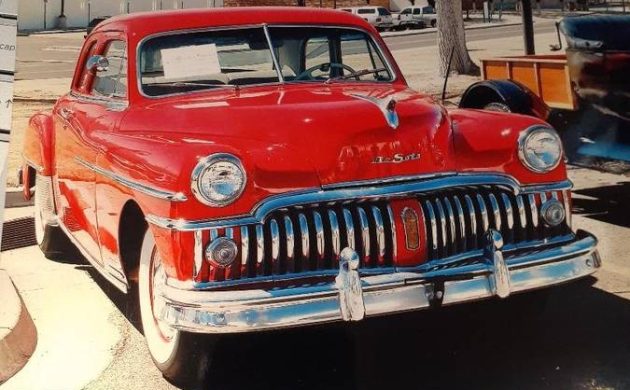
I always find discontinued auto marques an interesting study. In my time on earth, I’ve counted fourteen U.S. brands that are no longer with us, compared to, by my count, only ten domestics that are still with us (eleven if you include trying-to-hang-on Rivian). The reasons for disappearances are many and varied, and today, I’d like to focus on DeSoto via this 1950 Custom Coupe. DeSoto had some good sales years until it didn’t, and then it was ultimately crowded out. That being the case, I was pleased to find the listing, courtesy of Jack M., for this restored coupe. It calls Farmington, New Mexico, home, and it’s available here on craigslist for $14,000.
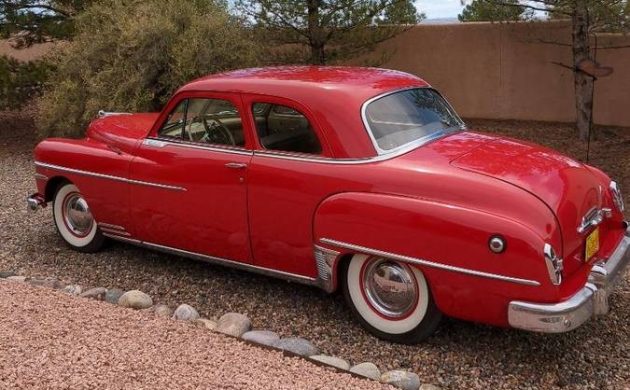
We’ve covered DeSoto’s history here on BF many times before, so I won’t belabor that matter today. Instead, let’s take a look at where DeSoto was in 1950 and what caused it to founder in 1961. DeSotos came in two trim levels in ’50, Deluxe and Custom, and Chrysler Corp. had DeSoto wedged in between Dodge and the Chrysler brand at this point. Two and four-door sedans made up the bulk of sales, but there were station wagons, an eight-passenger Custom sedan, featuring reverse-opening rear doors, a Custom convertible, and a Custom two-door hardtop known as the Sportsman. All of these variations accounted for 136K vehicles in ’50, putting it in twelfth place in the domestic production race, and our Custom Coupe was responsible for about 23K copies of that total. For perspective, number one Chevrolet was just shy of 1.5 M units that year.
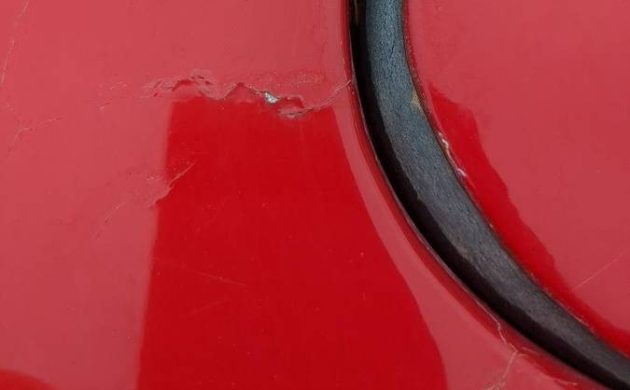
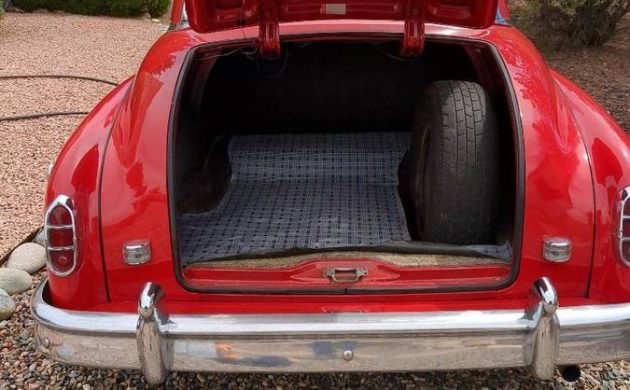
The listing for this car states, “Restored 1950 Desoto (Southwest car)…paint from ten years ago, some minor chips.” The listing images are limited, so it’s difficult to make a visual assessment other than to say it looks good, a brilliant red hue with very strong chrome and no sign of rust or body panel damage. There is some documented paint damage, but it’s minor.
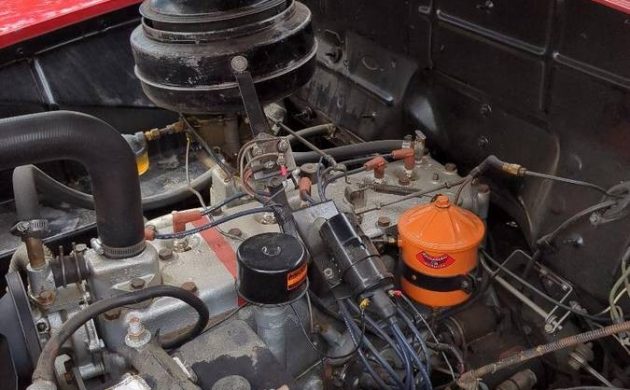
There’s a point of confusion in the listing where the seller refers to the engine as a “226 flathead six“, when in reality, it’s a 236 CI, flathead six. Regardless, the 112 gross HP powerplant has been rebuilt with a .040” overbore and a shaved head. The motor has only experienced 500 miles of use since the redo, but nothing is said regarding running and driving characteristics. A “Tip-Toe Hydraulic” transmission, a sort of semiautomatic unit, makes the rear wheel connection.
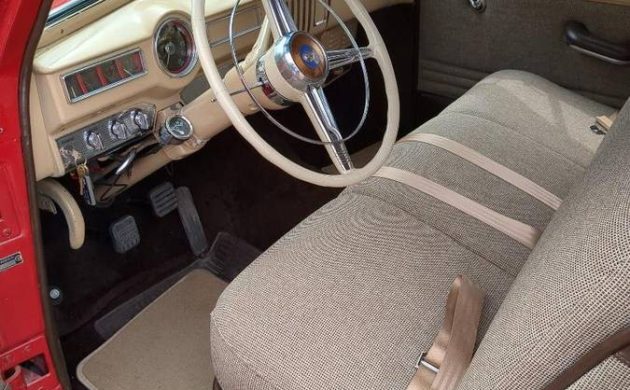
The interior has been reupholstered in a very smart-looking checked woven material and is, as the seller states, “in excellent condition.” I’d venture that the dash and interior parts of the door and upholstery panels have been repainted, too – it all adds up to a clean and bright environment. It’s always good to see the addition of front seat belts in cars from this era.
While DeSoto was doing well in ’50, its 136K units of production was a post-war high-water mark; things slowed in the later fifties. Competition, the ’58 recession, and ChryCo’s dealership and brand alignment strategy proved to be DeSoto’s death knell. Only 3K 1961 DeSotos were assembled in their final and very abbreviated model year. I’d suggest this DeSoto Custom Coupe has a sort of generic look about itself; many 1950 coupes had very similar lines and dimensions. This car, however, being a member of a valued brand that just wasn’t able to survive auto evolution, makes it all that much more attractive in my estimation. Let’s talk price. At an ask of $14,000, is it priced right or not quite?




It’s a beautiful rare car with a rebuilt motor in decent shape I’d say it’s worth what their asking.
Nice enough car, though that paint “damage” tells me there may be bondo lurking. A close visual inspection is needed. I believe that the hydraulic transmission only used the clutch pedal to shift. The car didn’t need the clutch to get under way, meaning they were great for starting out on hills.
We called the transmission a “fluid drive”.
I had a ’51 custon 4 door with that transmission. Fun to drive.
Yes, “Fluid Drive.” I recall the words appearing on the trunk lids of Chrysler products of this era. I drove a few, too–and they were indeed fun.
You are correct regarding the “Fluid Drive” name. The “Tip Toe” reference comes from the attached DeSoto brochure – different name for the same thing.
JO
I drove a 1950 4-door DeSoto Deluxe in H.S. when the rest of the guys were driving mid-’60s muscle cars. The cello in the back seat didn’t help my image at all.
These are big, bulky cars and that tranny defines the word slush box. Yes, you needed the clutch to get under way and the hills of Seattle made that a tricky proposition.
I’m surprised someone invested this much money in a car that will never bring a ROI, but it’s about the journey, not the destination.
Jim-
Nice coverage. I had a ’50 Custom, 4-door version, in a medium blue ‘tween ’55 and ’57. Looks like this one’s dash has been “restored” to far from original. Mine was all a medium dark silver and the instruments were “black lighted;” the ground was black and markers a watch-radium-dial green. Easy to read in daylight and really gangbusters cool when using the lights at night… just these green-glowing numbers and needles on a dark dash. SUPER cool. Oh, and they continued to glow, watch-like, after the lights were shut off, not too cool when “parking,” if you get my drift.
Once familiar with the gearbox, it could perform “reasonably well.” If in a hurry, start out in “lo” (normal 2nd gear position), wind it out (what, 4K RPM?), briefly depress clutch to hasten g’box shift, wind it out again, depress clutch, shift to “hi.” Now we’re up to maybe 50 MPH and the torquey big ol’ six can do its thing. Overall, not too bad. Not a hotrod, but, hey, it’s got class!
PS: This was my second car. I paid 800 bucks for it in near-new condition and traded in my ’46 Olds 66 Club Coupe. And, yes, as CarBob mentions below, they were great, comfortable highway cruisers.
I once drove mine 500 miles in ten hours and got 19 MPG. That was back in the day (’57) when someone pumped gas for you, I didn’t have to make potty stops as often, and I didn’t have to move out of my seat… I had a bad sunburn on my back and once in place, I just stayed there! Just me, my No Doz and my big, honkin’ DeSoto.
Ah, to be young again. Well, maybe not…
My Chrys history. Learned on 37 Plymouth. Lic on 51 ply. High school on 55 Desoto fireflite. And later. 5 Plymouth Mini vans and 1 Dodge mini van. Also had a 47 Dodge 4 dr from 1982 to 1986. Original cond with 75000 miles.
I’ve replied several times before about these as I owned a 1950 sedan from the late eighties until the late nineties. They are solid comfortable road cars and are still capable of modern freeway speeds because the fluid drive top gear is essentially equivalent to an overdrive. Mine would cruise at 75-80 all day. Granted the car took some time to get there. Fluid Drive was not exactly quick off the line. The transmission design eliminated the need for a clutch once initially underway unless for instance you needed to shift into reverse. Believe it or not I almost got the chance to buy my old DeSoto back this past summer. The fellow who I sold it to in 1997 passed. I found out about it through my local DeSoto club. But another guy beat me to it and I was told that he joined the club. So I’m looking forward to reconnecting. The featured car is nice but for some reason the red color doesn’t appeal to me. GLWTS.
Unfortunate color choice, in my opinion. I would much prefer a factory color like Royal Maroon or Pacific Blue. I guess the guy wanted a car that “stands out”?
I agree about the choice of color. That screechy red doesent suit the car at all.
I’m confused. The car is described as “fully restored.” But it seems that phrase means different things to different people. A “fully restored” vehicle means, to me, that it underwent renewal or replacement of all worn or unsightly components so that it looks as it did when new. Apparently, I’m being naive to expect a vehicle billed as “fully restored” to wear the same paint color that it did when it emerged from the factory.
Right on all respects, Arfeeto! I can recall seeing my very first “restored” vehicle, a Model T Phaeton. Everything was spit polished to the nth degree and all the bolt/nut heads were perfectly aligned. I don’t think ol’ Henry called for that degree of precision in his products. Actually, I believe that the opposite was true- “If it fits, bolt it up!” And it paid off.
In fact, I recall a study done back in the ’50s to see why Studebakers had such a bad rep concerning time before overhaul. Two were pulled from the line, torn down and specs of each and every engine part were recorded. One Studie was given to an “average” American family to use as their one and only. After a period of time, the other was pulled from storage and continuously- 24/7- run up to meet the other car’s miles. Oil changes were done hot without shutting down, sort of suck ‘n fill through the dipstick port. Then both engines were torn down and re-mic’d. The family car’s mill was worn beyond limits while the other showed barely any wear. They both had about 10K miles on them. Just goes to show that MILES don’t kill an engine, Start and stop SHORT RUNS do! ‘Course straight mineral oil back then didn’t help much to cut down on corrosion and wear.
A repaint and/or change of color would disqualify a car from “survivor” status, at least how we use the term here on BF. As for a complete restoration, colors change all the time. Often the car being restored isn’t, at that point, the same color it was when it was new – and that’s assuming one actually knows what the original hue was.
JO
Another factor leading to the demise of DeSoto was discontinuing six cylinder cars after 1954. Once the entire line became all V-8s, they were near Chrysler clones.
Though “Fluid Drive” has become a generic term for semi-automatic transmission equipped MoPars like this DeSoto, technically it was just a fluid coupling that replaced the conventional flywheel. The semi-automatic transmission (hydraulically shifted M6 or Tip Toe Shift in this case) was paired with the Fluid Drive coupling. Even the brochure page pictured here mentions both.
You could get Fluid Drive without the semi-auto in some cars. My aunt had a ’48 Dodge with Fluid Drive and a conventional 3-speed manual while my parents had a ’48 Chrysler with Fluid Drive and the semi-auto. (Dodge did not offer the semi-auto in ’48).
Too bad DeSoto didn’t bring back the hidden headlights of the ’42 model after WWII. The toothy grilles of the postwar cars like this ’50 weren’t nearly as cool.
I find it a little odd that there are no pictures of the suspension? If the owner has the receipts to prove some of the things stated? Motor, transmission, clutch, suspension etc… the price seems to be in the right ballpark but for the serious buyer must be checked out thoroughly. Would recommend that they would pay one of those outfits who check out cars pretty good pictures can be misleading and we must be wise because of the age of the car?