

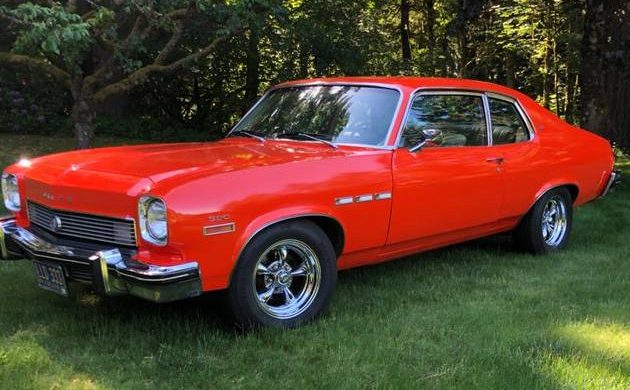
The Chevrolet Nova was not only popular with buyers, but also with other General Motors divisions. When it came time for Pontiac, Buick, and Oldsmobile to all field a compact car in the 1970s, they all chose to clone the Chevy Nova. The front clips were different, and they had divisional engines, but the Ventura, Apollo, and Omega were all Nova under the skin. The seller has a nice 1973 Buick Apollo with the hatchback body style. Needing nothing more than a new home, it can be found near Portland, Oregon, and is available here on craigslist for $19,500.
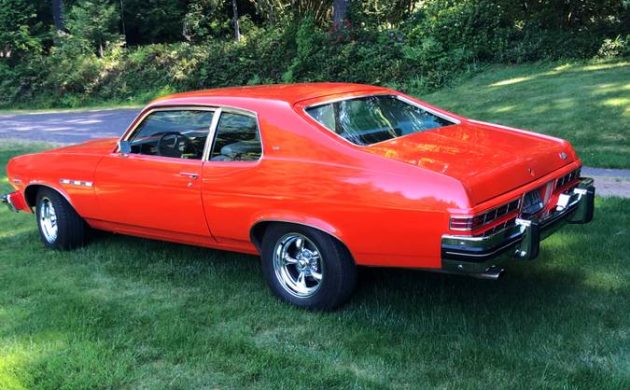
Cloning of the Nova started with the Pontiac Ventura II in 1971, then both Buick and Oldsmobile got on board in 1973. None of the three copycats had sales that came close to mirroring the success of the Nova. The Buick used a Chevy 250 cubic inch inline-6 as the standard engine, but a lot of folks opted for the 350 CI Buick V8 (that was before engine sharing between divisions started). Because it was a Buick, the Apollo was a bit fancier than the Nova.
This car has the hatchback body style, which was new in ’73 to the Nova family. The same X-body platform was used, but the Nova looked beefier than before, and those traits carried over to the others, including the Apollo. We’re told this Buick has 86,000 miles, and it appears to have been well-cared for in its 53 years.
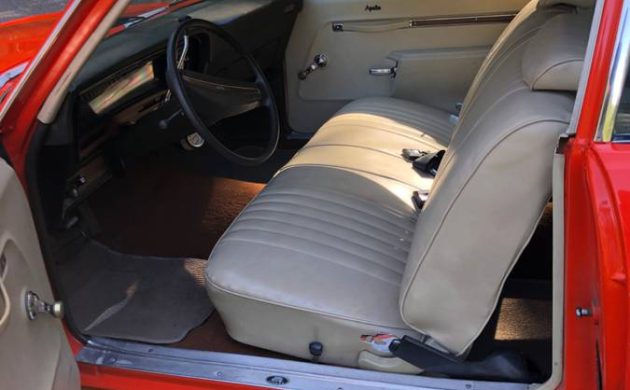
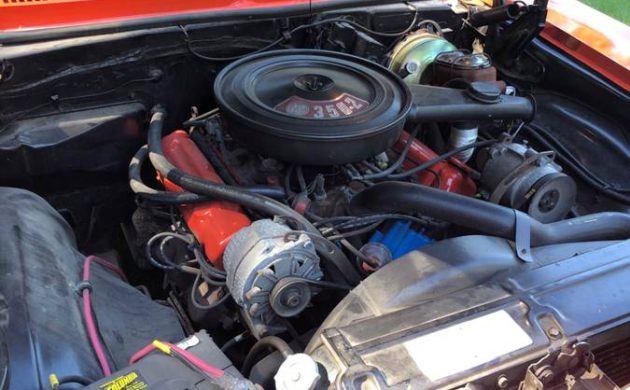
Besides the 350 motor, this car has a TH-350 automatic transmission and front brakes that were converted after-the-fact from drums to discs. The automobile has air shocks and a dual exhaust, likely additions by the seller or a prior owner. The body, orange paint, and white/black bench seat interior all look solid. We’re told the Buick is a great runner and should appeal to Nova fans in search of one. Rocco B. comes through again with great tips like this!

Had an Apollo like this one through high school, except mine was piss yellow/puke green. Horrible color, not sure what it was called but it was ugly. The back hatch was nice but very heavy. Bench seat was nice because the girl friend could sit nice and close to you as you drove. Lol. Had a V8, nothing special but ran well and had no problems with the car. Traded it in on a new 1980 Pontiac Sunbird with aV6 and 4 speed.
My grandparents originally had a Nova and then an Apollo in light blue – it was the same as this car which is what I took my drivers test on. They were solid cars and being RWD I learned to “drift” properly in the snow covered parking lots of New England in it as the V-8 would get away from you very quickly.
This seems like a nice ride for someone looking to relive their childhood memories.
Nice, but overpriced.
Steve R
If its as solid as it looks, it’s in great shape. Well worth the ask! Find as nice a Nova anywhere and you’ll pay at least that much.
It’s not a Nova, it’s also a 1973, with big bumpers, which reduced its desirability. There are a lot more people searching for a Nova than a Buick Apollo. You might be right and sell quickly for close to the asking price, but I’d be surprised, there is a lot of competition at that price level.
Steve R
A mint condition, highly original 1973 Buick Apollo typically values between $15,000 and $25,000. Values heavily depend on engine size (the optional Buick 350 V8 commands a premium over the inline-six) and body style, with the 2-door hatchback and coupe models being the most desirable.
Low Retail / Driver Quality: $9,000 – $14,000 (Cars with minor flaws, faded paint, or higher mileage)
Average Retail: $15,000 – $18,000 (Highly original, clean, well-maintained driver in factory colors)
High Retail / Mint Condition: $19,000 – $25,000+ (Concours-quality, numbers-matching, or very low original mileage)
If the BarnFinds writers only posted stories about fairly priced vehicles, it would probably cut the features down by at least 50%. I still enjoy reading about vehicles from my past, that I rarely see on the road anymore.
Who said anything about not featuring overpriced cars, especially if it’s listed by the owner. Though I’m not a fan of repeatedly featuring overpriced cars from certain dealers. You are right, if you got rid of featuring overpriced cars, there wouldn’t be much to write about, but it shouldn’t be an issue to call out pricing either.
Steve R
I’m just glad to see a plethora of cars from across the country (and globe) that people are parting with AND what they think they can get for them.
Oh my gosh, I wish this weren’t on the opposite coast! I love this! And I love how they’ve resisted the urge to tart it up with aftermarket nonsense like chrome valve covers or wood steering wheels. Well worth their asking price if it’s as solid and rust free as it looks.
The beefier frontal styling helped to tame the govt issued bumpers just a tad. As usual GM did a good job of incorporating brand character into the front and rear grille and lighting elements so that each were distinctive.
Chevrolet divisional management liked the Buick face enough that they used it on Novas destined for at least some of the export markets where Chevy was the only GM brand used.
nice Buick but not seeing 20k. worth putting a 455 in, but the wheels need to go
Nice Apollo, but definitely priced high for the market for this car. Yes, the Buick 350 still packed a torque punch, but for 20k, you really have to want one.
Nice Buick Apollo. Like hairyolds68 says 455 it…
It’s simple economics, folks. Inflation, combined with rarity, will result in higher prices. They’re not making any more of these, so as the supply dwindles, clean, solid examples like this one will command higher prices in the marketplace. The Good: Hatchback, white interior, Hugger Orange, a.k.a. Carousel Red exterior, 350 V8. The Bad: No bucket seats or console, although some might consider that a plus! The Ugly: Nothing, worth whatever the buyer and seller agree upon for a price. The Verdict: A fine example of a car and a platform that has endless options for customization. One of GM’s better ideas, and the non-Chevy examples can often be had for a slight discount over the Chevy versions, thanks to the the slightly lower popularity of the non-Chevy versions. OTOH, the relative rarity of the Buick, Olds and Pontiac (BOP) examples may command a price premium, who knows? The Cadillac version, the Cimarron, was notable for the use of EFI on an Olds 350 V8 in 1975, a first for GM, as the other EFI car GM made in 1975 was the Cosworth Vega! If I had the money and the space in my garage for it, it would be in my driveway! GLWTS!
Seville
Oops! Caught me! My Bad! Mea Culpa, Mea Culpa, Mea Maxima Culpa! To be fair, GM had so many badly engineered badge engineered cars back then, they all start to run together inside my head! The Cimarron, a Cadillac version of the GM J-Cars, was poor attempt to make a Chevy Cavalier into a Cadillac, which also failed miserably in the marketplace. The Seville was much more successful, at least until it got big, fat and ugly with the “Bustle back” trunk that was GM designer Bill Mitchell’s swan song as he retired.
It’s okay Robert. The Cimmaron was a bridge too far but there are reports of those being a decent car when equipped with the V6. OTOH, the Seville disguised it’s X-car roots quite well. Good thing, as it was about the most expensive Cadillac you could buy at its introduction.
The Caddy Seville is not a Nova clone like the BOP versions are.
Technically true, as GM called the Seville a K-Body, but they have enough parts in common to be sisters. The floorpan was lengthened for the Seville, and a new roof panel was fabricated for the Seville, but they also shared steering gear and rear suspension parts (see links below).
https://en.wikipedia.org/wiki/General_Motors_X_platform_(RWD)
https://en.wikipedia.org/wiki/General_Motors_K_platform_(RWD)
Wouldn’t you really rather have a Buick?
Oops, I think he headrests are installed backwards. An easy fix on an otherwise nice looking ride
Good Catch! I missed that one! It will take about ten seconds per headrest to fix, they pull completely out, so just pull them out and turn them around, job done!