

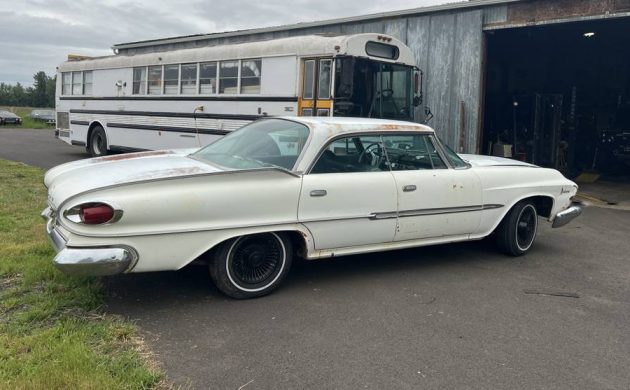
If you thought the styling of the 1957-60 Chrysler products was wild, the looks of the 1961 Dodges and Plymouths were just plain weird. Virgil Exner threw caution to the wind, and the Dodge Polara had reverse tailfins with the lights built into the rear quarter panels. Buyers were not pleased with the outcome, and Dodge dropped from sixth to ninth place in the 1961 sales race. This 1961 Polara has appeared here on Barn Finds in the past, but not before it moved from Nevada to north of Portland, Oregon, and has since received an engine swap. It’s available here on craigslist for $4,900.
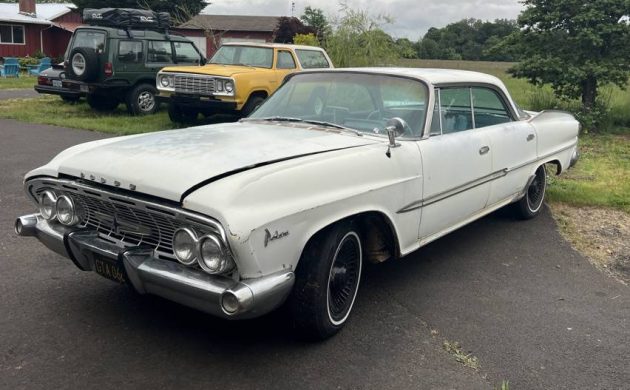
Though still futuristic in appearance, the new Dodges were awkward when compared to the competition, earning nicknames like “Old Elephant Ears” and “Toilet Seat.” Exner had a chance to fix that in 1962, but instead downsized the cars based on bad intelligence, and the 1962 Dodges and Plymouths became known as the “Plucked Chickens”. It would take years for Chrysler to recover. The only saving grace during that period was that the Dart and Valiant compacts sold well enough to partially carry the load.
When we last saw this ’61 Polara 2 ½ years ago, it was in Pahrump, Nevada, and had a possibly stricken 318 cubic inch V8. And was advertised for $3,900. Today’s seller is a Mopar fan, and he also bought a 1963 Imperial with a rebuilt 413 V8 and push-button automatic. Both of those were extracted and transplanted into the Polara, though he’s yet to hook everything up. But the setup was running in the Imperial, and the seller has a video of it doing so.
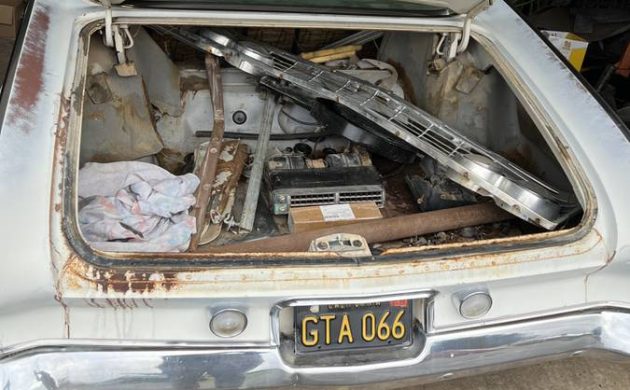
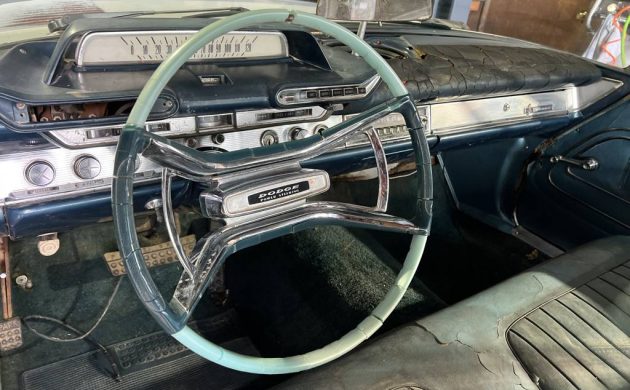
The body is said to be rust-free, so restoring the car may be focused on the final engine hookup, putting in a new interior as the desert sun has taken its toll on the latter, and the paint. The seller has some leftover parts to go with the car, and its black California license plates will be included, but only at the full price. Trades are a possibility, but very specific, like an old VW Beetle or a tow truck. Thanks for the tip, Barn Finder Barney!

William C. Newburg was who ordered the downsized ’62s.
It was done without Exner’s approval or knowledge as he was recovering from a heart attack.
It was he who called them “plucked chickens” when he saw the final results.
Poor Exner, Brooks took over the Stude designs and this other guy Mopars.
could never buy in on the design, the quarter panel/reversed fin concept just didn’t cut it. Bad then, bad now. The old bath tub in the background has better styling (IMO) than the Dodge. Luckily, Plymouth and Dodge did recover by 1963.
Unusual and experimental – I like such stuff
Exner did not downsize the cars in `62.
It was done without his knowledge or approval on orders from executive vice president, William C. Newberg.
Exner did however refer to them as “plucked chickens” after seeing the final results.
I knew I had the production numbers somewhere.
2,116 Polara 4 door hardtops built for `61 in the US only.
Canada did not get Polaras in `61, but did in `60.
Canada did get Dart Phoenix & Dart Pioneer models in `60 & `61, but 2 door hardtops only.
No Dart Senecas at all.
Thanks for your contributing resesarch!
This is how to curse a car, pull out its original equipment, put something bigger in, then don’t “hook everything up”. Turns a potential runner into a complex non runner. I’d be surprised if he got more than the original 3-handle asking price before he upended everything.
That was my first thought. It’s a pushbutton transmission and my first question would be “Does the pushbutton linkage match, or is that the reason it’s not all hooked up?” If it doesn’t match it will need custom linkage and it’ll be quite the nightmare getting it to work.
This thing looked goofy when I was a kid and still looks strange. What were they thinking?
Still an ugly car, but the prison bus in the background is interesting.
I had a 61 Seneca ….uglier twin sister …that we used to call Flea Biscuit. A beautiful flat swamp like pea green. Taillights the size of chiclets and barely visible.
To say the dodge Plymouth Chrysler where weird may be true but it did set them apart from the others. At least you could identify the older fifty sixties and seventy cars when you saw them coming. The cars you pay way to much for today all look the same plastic no real style and even the emblems if there are any are weird! Maybe the weirdness started back then but now ? And I digress. It’ll sell cause ya just don’t see em like that anymore! Peace!
Just one of the weirdest designs ever. From the grille to the dash to the steering wheel to the rear fins to the taillights to….well, you get the idea.
The only thing I like about this car is the taillights themselves (to be used in a custom car TBD), not the setting in which they sit. The hideous front end (which is only topped in horribleness by the rear fenders) looks like a whale shark….which is literally how whale sharks look….large wide open maw.
Yes, the tail lights are very weird. I still have my grandfathers that came off of his 61 Plymouth Belvedere. They were almost identical, except they were not set in anything. They were just bolted with some fancy metal housing to the side of the car.
What’s with the speedometer? Why did it have a clear plastic plate in the back of it to let light through?
Exner turded up the place. And finally got the boot !
I think I just watched a movie called
Dark Country featuring the same car but I’m not really a Dodge man so I couldn’t be positive. The one in the movie had a center console with what seemed to be a tach. but it never seemed to work and there was no gearshift in it, just an open spot for it. It had a push button gear selector on the dash instead.
Can anybody out there enlighten me, please.
so, if i understand correctly, this still does not run but has another motor in it. seller is asking 1k more than the previous listing price. unless you pay his price, he will start taking parts off it. what a loser. why would you say such stupid stuff in your ad?
the way I read it is that if you lowball him on the price, he will keep the extra parts and the plates. It may be a little difficult to fine the parts (what few he shows), but if you can knock several hundred off of it, he can keep ’em!
When the 1961 Dodge and Dodge Dart came out, I liked the tail-lights of both. The front of the Dodge was weird, however. But just LOOK at what they were up against! The DeSoto, a thinly-disguised Chrysler, was HIDEOUS for ’61 (and soon would vanish)! Ford and Mercury got whomped by the ugly stick in 1961. So did the Rambler American. It was just a WEIRD YEAR for styling. But there ARE exceptions. The 1961 Thunderbird and Lincoln were beautiful cars. Hated the ’61 Chevy almost as much as the ’59 — especially that “”bubble-top”.
Exner did know how to design perfecly ugly cars — beginning with his “Forward Look”, which everyone seemed to want to copy, for some reason.
But there was at least ONE styling high-mark in 1961 — and it wasn’t a car.
Ready for THIS? — it was a transistor radio. And nothing of its kind before or since has topped it in styling, reception (for its size) and sheer rich sound-quality! I speak of the Zenith Royal 500H, a thing of utter beauty if ever there was one. I bought one, new, in July of 1961 when they first came out, and when I carry it, people constantly admire it (those under thirty ask me what my “device” is, and once I demonstrate it, they enquire as to where THEY can get one!).
Pocket transister sets first appeared in time for Christmas of 1954. They were cute, VERY expensive, and had rather poor performance of both sound and reception, compared against any tube portable. So they did not exactly “catch on”, except as a wealthy man’s novelty.
But Zenith held back, until they could issue a SERIOUS pocket-sized radio which would hold its own in both sound and reception quality. The result was the Royal 500, a hand-wired set with seven transistors which could fill a room with full-toned sound. This was no ordinary pocket radio when it came out in 1955, and it still remains legendary to this day.
The Japanese began flooding the market with pocket transistor radios which folks actually could AFFORD. Never mind that they sounded thin and squawky and would only pick up the strong local stations: a kid could slip one into his shirt pocket, put the earphone into his ear, listen privately, and tell the teacher it was a hearing aid!
Top-40 radio would never be the same! At the picnic. At the beach. There was that tiny tinny transistor radio playing “The Wayward Wind”, “Don’t Be Cruel”, “Ivory Tower”, “Born To Be With You”, “Lisbon Antigua”, and “Hot Diggity (Dog Ziggity – Boom)”, complete with a hyper-energetic chatty disk-jockey at a rapid pace and ads for Wildroot Cream Oil, Charlie!
MEANwhile, Zenith engineers were quietly refining their expensive masterpiece, the Royal 500, which only well-heeled adults could afford. They stopped wiring it by hand, because the close proximity of its tiny parts made a printed circuit board more consistent and reliable. They added vernier tuning, to more accurately and nimbly select your station. Then in 1958 they added a convex-coned speaker for improved sound, and an eighth transistor to greatly enhance weak signal reception, adding “Long Distance” to the front face of the radio. But the look of the radio was little changed in three years, retaining that characteristic design nick-named “owl eyes”, which other American sets had since copied. In 1959, they added a chromed strip across and behind the controls to change the look a bit: unfortunately, it was plated over a cast piece of pot metal which erupted with “volcanos” of hideous grey corrosion in salty air; as a result, very few of this model can be found still looking nice to-day. They held it over for 1960 with no changes, because they were working on a total re-design for 1961, which would blow away any competition.
And “blow away” it SURE DID! The Royal 500H became THE ABSOLUTE STATEMENT in a pocket radio! And its retail price reflected that. Beautiful looking and wonderful sounding, with distant reception that could compete against far larger portables; the Royal 500H, regrettably, proved to be a product whose market had moved elsewhere. By 1961, the pocket transistor radio was no longer a novel and expensive toy for the very rich: the Japanese had turned it into a mass-market accessory primarily for teenagers — even had built a 2 transistor minimal and very cheap version for little children with strong stations nearby. There was simply very little demand in 1961 for “the last word” in a pocket transistor radio, for those who could afford one.
The 500H limped along to meagre sales, often deeply discounted by Zenith dealers looking to unload an excess stock of them. And Zenith made no effort to design an even better version. Neither did anyone else. They instead came out with a much lower grade chasses for remaindered 500H nylon cabinets, retaining MOST of what the 500H had offered, but which they could sell at the top end of the Japanese prices. It was too little and too late. Soon Zenith, too, would be slapping their own name on semi-generic imports from Japan.
I still have the Zenith Royal 500H that I bought in 1961, and I will gladly put it up against anything in the way of a pocket radio, with all that we have learned since in technology! It’s a relic of a long-gone era and culture. But it is MY relic, and I remain very fond of it.
When the 1961 Dodge and Dodge Dart came out, I liked the tail-lights of both. The front of the Dodge was weird, however. But just LOOK at what they were up against! The DeSoto, a thinly-disguised Chrysler, was HIDEOUS for ’61 (and soon would vanish)! Ford and Mercury got whomped by the ugly stick in 1961. So did the Rambler American. It was just a WEIRD YEAR for styling. But there ARE exceptions. The 1961 Thunderbird and Lincoln were beautiful cars. Hated the ’61 Chevy almost as much as the ’59 — especially that “”bubble-top”.
Exner did know how to design perfecly ugly cars — beginning with his “Forward Look”, which everyone seemed to want to copy, for some reason.
But there was at least ONE styling high-mark in 1961 — and it wasn’t a car.
Ready for THIS? — it was a transistor radio. And nothing of its kind before or since has topped it in styling, reception (for its size) and sheer rich sound-quality! I speak of the Zenith Royal 500H, a thing of utter beauty if ever there was one. I bought one, new, in July of 1961 when they first came out, and when I carry it, people constantly admire it (those under thirty ask me what my “device” is, and once I demonstrate it, they enquire as to where THEY can get one!).
Pocket transister sets first appeared in time for Christmas of 1954. They were cute, VERY expensive, and had rather poor performance of both sound and reception, compared against any tube portable. So they did not exactly “catch on”, except as a wealthy man’s novelty.
But Zenith held back, until they could issue a SERIOUS pocket-sized radio which would hold its own in both sound and reception quality. The result was the Royal 500, a hand-wired set with seven transistors which could fill a room with full-toned sound. This was no ordinary pocket radio when it came out in 1955, and it still remains legendary to this day.
The Japanese began flooding the market with pocket transistor radios which folks actually could AFFORD. Never mind that they sounded thin and squawky and would only pick up the strong local stations: a kid could slip one into his shirt pocket, put the earphone into his ear, listen privately, and tell the teacher it was a hearing aid!
Top-40 radio would never be the same! At the picnic. At the beach. There was that tiny tinny transistor radio playing “The Wayward Wind”, “Don’t Be Cruel”, “Ivory Tower”, “Born To Be With You”, “Lisbon Antigua”, and “Hot Diggity (Dog Ziggity – Boom)”, complete with a hyper-energetic chatty disk-jockey at a rapid pace and ads for Wildroot Cream Oil, Charlie!
MEANwhile, Zenith engineers were quietly refining their expensive masterpiece, the Royal 500, which only well-heeled adults could afford. They stopped wiring it by hand, because the close proximity of its tiny parts made a printed circuit board more consistent and reliable. They added vernier tuning, to more accurately and nimbly select your station. Then in 1958 they added a convex-coned speaker for improved sound, and an eighth transistor to greatly enhance weak signal reception, adding “Long Distance” to the front face of the radio. But the look of the radio was little changed in three years, retaining that characteristic design nick-named “owl eyes”, which other American sets had since copied. In 1959, they added a chromed strip across and behind the controls to change the look a bit: unfortunately, it was plated over a cast piece of pot metal which erupted with “volcanos” of hideous grey corrosion in salty air; as a result, very few of this model can be found still looking nice to-day. They held it over for 1960 with no changes, because they were working on a total re-design for 1961, which would blow away any competition.
And “blow away” it SURE DID! The Royal 500H became THE ABSOLUTE STATEMENT in a pocket radio! And its retail price reflected that. Beautiful looking and wonderful sounding, with distant reception that could compete against far larger portables; the Royal 500H, regrettably, proved to be a product whose market had moved elsewhere. By 1961, the pocket transistor radio was no longer a novel and expensive toy for the very rich: the Japanese had turned it into a mass-market accessory primarily for teenagers — even had built a 2 transistor minimal and very cheap version for little children with strong stations nearby. There was simply very little demand in 1961 for “the last word” in a pocket transistor radio, for those who could afford one.
The 500H limped along to meagre sales, often deeply discounted by Zenith dealers looking to unload an excess stock of them. And Zenith made no effort to design an even better version. Neither did anyone else. They instead came out with a much lower grade chassis for remaindered 500H nylon cabinets, retaining MOST of what the 500H had offered, but which they could sell at the top end of the Japanese prices. It was too little and too late. Soon Zenith, too, would be slapping their own name on semi-generic imports from Japan.
I still have the Zenith Royal 500H that I bought in 1961, and I will gladly put it up against anything in the way of a pocket radio, with all that we have learned since in technology! It’s a relic of a long-gone era and culture. But it is MY relic, and I remain very fond of it.
What in the world is going on with BF thumbs up icons?? I’ll click on it to give it “ONE” thumbs up, and the number will go from 3 to 15???!! This isn’t the first time it’s done this.
Or nothing. Click on it and no response.
Doesn’t seem to be a whole lot of love for the Polar Bear here. Being a true MoPar fan does require some DEI thinking for certain models. And what’s not to like about that dashboard and steering wheel?I’m curious as to why the seller doesn’t include any photos of the engine bay or underside. Or maybe I can dare to presume. The phrase “not hooked up” gives this guy pause. But if one is truly interested in getting this stylistic relic of the space age back on the road; simply calling the seller might be revealing. Now if only I had an old Volkswagen for trade.
love to see it completely restored with period correct white walls
This has been listed on eBay 4 times and hasn’t got any traction. I am in the minority it seems. I love the styling of the taillights. If I had the room or the budget, I would talk the wife into it.
https://www.ebay.com/itm/168544021128
Barn Finder Barney, you should mention this one as well. This is rare as hen’s teeth!
https://www.facebook.com/marketplace/item/2235476547267267/
Barn Finder Barney, you should write one up for this one too. It’s as rare as hen’s teeth!
https://www.facebook.com/marketplace/item/2235476547267267/
It’s a work of art –
Nice ride, hope all the original parts and engine trans come with it.