
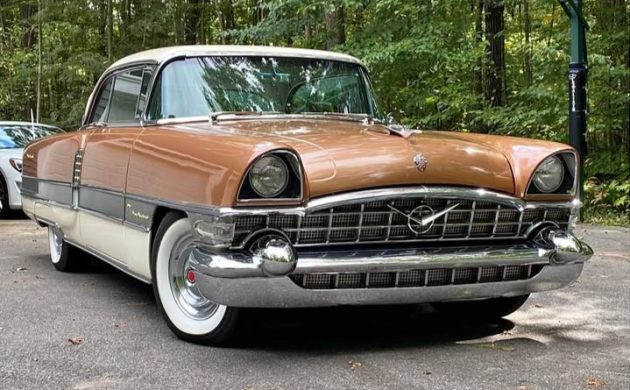
For most people, Packard died in 1956. Studebaker-based Packards were around for two more years, but dealers and customers weren’t impressed. After the 3,224 Packard Four Hundreds (aka 400s) rolled off the assembly line in ’56 (along with some more pedestrian Clippers), the Packard mystique essentially was over. The seller has one of these 1956 beauties, which is a cross between a daily driver and a garage queen. Located in Templeton, Massachusetts, this fine example of the days when chrome ruled is available here on Facebook Marketplace for $28,900 and is another fine tip from T.J.!
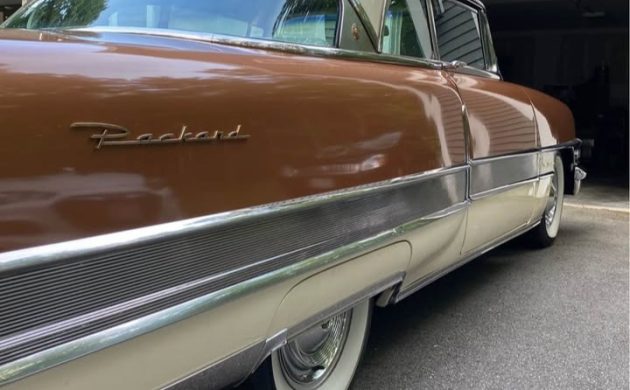
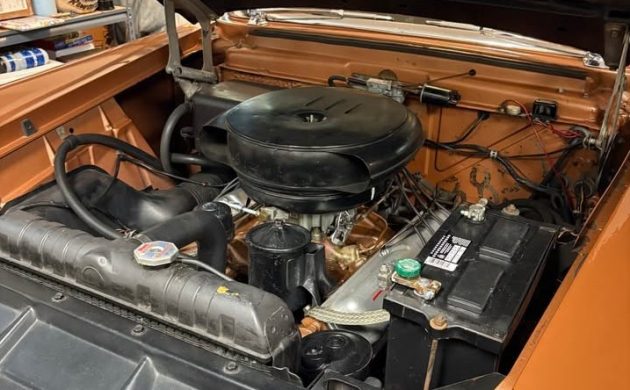
We don’t know if the Packard brand would have lasted beyond 1958 had the company not merged with Studebaker in 1954. But neither brand had another Bonafide sales success besides the 1959 Studebaker Lark compact (a far cry from the luxury Packards that competed against Cadillac and Lincoln). The Four Hundred was a two-year exercise (1955 and 1956). As a top-of-the-line product, the 400 was only offered as a 2-door hardtop. In 1956, the car was powered by a new 374 cubic inch V8, and had an optional electronic push-button Ultramatic automatic transmission with a pod-mounted stalk off the steering column (which proved troublesome).
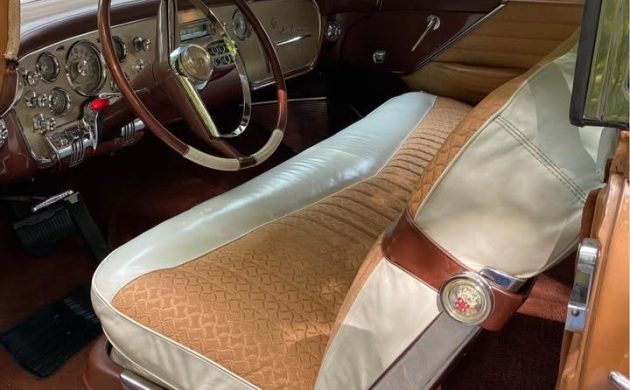
Having covered just 57,000 miles, this Packard has held up well after almost 70 years. It’s finished in Mojave Tan paint, which is an older redo with a few imperfections. But the yards and yards of chrome look to be flawless. The original interior is showing its age, but it is still good except for a few small holes in the headliner. Both the radio and clock work but are temperamental. If you want perfection, this is not your car, but it is a nice survivor-quality automobile.
The Four Hundred runs well and has received some recent work, including the brakes, carburetor, fuel pump, shock absorbers, and it was given a tune-up. The engine compartment has been refreshed, too, appearance-wise. The car has an adjustable torsion system, but it only rises and does not lower (easy or hard fix with owner-supplied parts?). An assortment of extra pieces comes along for the ride. Is this land yacht your cup of tea?



The Caribbean was the top of the line,also one of my all time favourite 50’s cars.Twin simulated hoodscoops..wild tri-tone paint,interior with reversable seat covers..They went out with a beautiful bang.
Packard hired a young golden boy engineer to help with this-John Delorean ! The 374 inch engine featured 10-1 compression, 2-4 barrel carbs, and cast aluminum scripted valve covers. All standard, not an option, as was the limited slip differential and self- leveling suspension. The reversible seat cushions were real leather on one side, and fabric on the other.
Packard didn’t have cast aluminum valve covers. Delorean also helped design Packard’s experimental fuel injection system.
Egad(s) — maybe my memory has a misfire. 30 years ago, I knew someone who owned a ’56 Caribbean convertible. He gave me the information I thought I knew, and I was there when he had the valve covers off. As I recall, for what that’s worth, they were cast aluminum and not pressed steel. Perhaps further incidents like this might preempt me from jury duty if called, lol.
My comments applied to the Caribbean.
Actually, Delorean’s main contribution- may- have been in helping with the design of Packard’s advanced automatic transmission at this time, but I’m not sure. Maybe someone can shed some light on this. Packard went all out to upstage the competition and reclaim their former glory, that much is certain.
One of the big automotive “what ifs” of the 1950’s was the plan by the presidents of Packard and Nash-Kelvinator to combine Studebaker-Packard with Nash-Kelvinator and Hudson, putting four makes under one corporate structure. That deal fell apart, but I don’t think that, or anything else, would have saved Packard.
The only thing that merger would have accomplished would be the early demise of Nash (AMC) . Packard, Hudson were doomed ,and Studebaker was circling the drain at that point .
@ bone,I think if the 4 makes had merged perhaps either Ford or Mopar would have been the “little guy”. Stude=Chevy, Hudson=Pontiac, Nash=Buick/Olds, and Packard at the top. I was never sure about the Buick and Olds in the GM world. To me they both seemed like upper priced cars with a different look
The 1955 Packard 400 was my first car, back in 1966. That was a great car, cost me $300 at the time. Same color as the one in photos. If I had the space I would like to buy another one. This is the second car I have found that is same color as mine. If you want a vintage car this would be the one. Only problem I can see with the car is the astronomical price the seller is asking !
We spiced one up a bit. Cool car.
Gross.
I believed in 1954, and I believe to this day, that Packard should have acquired the Briggs Coachworks responsible for assembling their bodies, before Chrysler did (and let Studebaker be): this would have prevented the South Bend last-minute quality-control issues in the early 1955s which proved fatal to the motto, “Ask the man who owns one”. Packard made another fatal mistake in making the Clipper so akin to a Packard in appearance, that Oldsmobile customers could own Packard prestige at a far lower cost than a senior Packard. The commonality was money-saving, but a terrible marketing move: the Clipper ought to have looked as much like a Packard, as a Buick resembled a Cadillac — same quality, but devoid of the “prestige” aspect. Packard was hit HARD by the recession of 1954, soldiering by with a three-year-old design (albeit quite advanced for 1951) which was quite unchanged and showing its age — in a time when Americans clearly wanted “the very latest of the latest”, not something brand-new which already looked “old” in style. Hudson Motors were even worse-off in that regard, with a six-year-old body at a time of rapid changes. What the senior Packards had for 1955 was about as perfectly elegant and worthy a restyle of their reliable old ’51, as probably was humanly possible — and one fabulous-looking luxury automobile! Those classic “cathedral” tail-lamps put Cadillac to shame and made the 1955 Cadillac look “common” by comparison. Only one serious problem: Cadillac had beat Packard to a new “crisp” look in 1954, replacing their dowdy 1953, and leaving Packard playing “catch-up”. That was fatal in the post-war “boom” years, and Packard could never catch Cadillac, despite Packard’s mechanical advances which no other car at that time yet had. I loved Packard. And I dearly miss Packard to this day. I prefer the 1955 to the 1956 “refresh” which degraded the look somewhat and made it more “trendy”, a thing Packard should have been distinctive enough to avoid. I’d love to own this beauty, except that I am too short from the waist to the shoulders to see out over the hood of any of the 1951-body Packards, without Webster’s Unabridged sitting under my hind end! Besides, the price here is too high for what these are now bringing and the work this one still needs. Too bad, too, because I could take care of that clock and that radio! And I would NOT ADD SEAT BELTS! But even if I could afford it, all bets would be off if the ash-tray and lighter had ever been used for smoking! (sorry)
I’m a huge fan of post-war Packards. Looks great. Optimistic price to be sure. GL.
John DeLorean was the impetus behind the Ultramatic’s design. One of my closest friends has a 1951 Packard convertible. The quality of these cars far surpasses any junk being built today. The mother of a former girlfriend bought a new Packard in 1956. I never saw it, but she told me it was the best car she and her husband ever owned. Sad what has happened to the American car industry, but they did it to themselves.
I left a comment, but it has vanished
I left a comment, but it has vanished. I attempted to leave another one, but was stopped by “Forbidden 403”.
Wonderful cars and certainly a driver, pulling hard left at gasoline stations. Thirsty… The only real downside is to rebuild the engine, the pistons are as Jay Leno so aptly notes, are “unobtanium”. Fun to drive. Load up the family, and the beast will automatically level itself…
Not this one–it only goes up, up up!