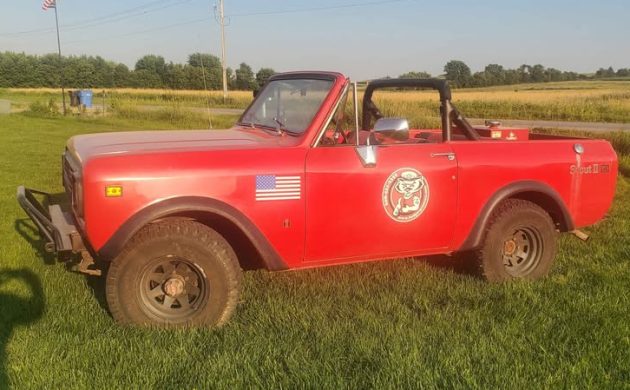
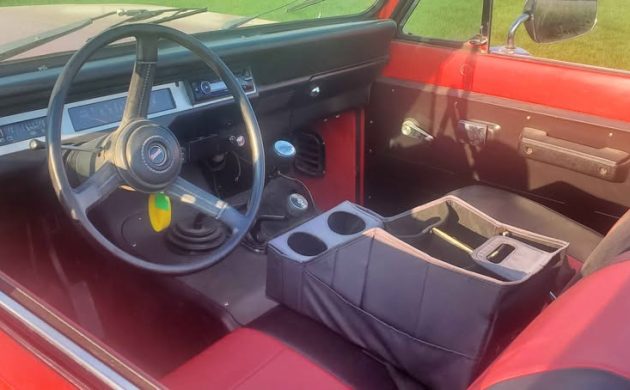
This 1980 International Harvester Scout II represents the last year of production for the International Harvester Scout II. This example is located in Waunakee, Wisconsin and has a reported odometer reading of 75,000 miles. International Harvester built approximately 532,000 Scout models across all series and variants before ending production in October 1980. This Scout II is listed for sale here on Facebook Marketplace. The seller is asking $18,500 and the ad has been up for over 6 months. We appreciate Hans H. for sending us this listing to review. The interior of this Scout II looks pretty stock except for the homemade console. You can readily see the stick shift for the manual transmission and the 4WD gear selector.
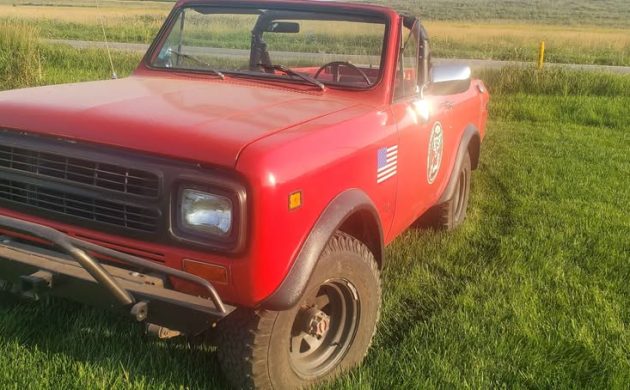
The Scout’s lineage began with the Scout 80 (1960–1965), featuring simple, boxy styling, a removable hardtop or soft top. It was basic but powered by a durable inline-four engine. In 1965, this initial model was succeeded by the Scout 800 series, which brought improvements including a fixed windshield, enhanced comfort options, and a wider array of engines. Over the succeeding years, International added larger four-cylinder, inline-six, and V8 engines to broaden appeal. Notable variants during this period included the 800A and 800B models, culminating in the introduction of the Scout II in 1971. The Scout II continued production through 1980. For 1980, the Scout II was available in several versions, including the base Scout II wagon/SUV, the Terra pickup, and the Traveler with a removable hardtop. Styling for the final year featured a distinctive one-piece grille with square headlights in either black or silver trim.
The Scout II retained the basic two-door body style but expanded the model range and capability. It offered improved durability, a conventional body-on-frame construction, and optional long-wheelbase versions such as the Scout Terra pickup and Scout Traveler wagon from 1976 onward. Special editions and packages, including the SSII soft-top model and dealers’ custom variants, broadened the appeal for enthusiasts throughout the 1970s. Under the hood, the base engine for 1980 was the 196 cubic inch inline 4 cylinder engine, which provided modest power and reliability. Optional engines included larger powerplants such as the 304 cubic inch V8 engine and the the more powerful 345 cubic inch V8 engine. An interesting fact is that in 1980, International Harvester offered the availability of the Nissan SD33T 3.2-liter turbocharged diesel inline-six, offering improved fuel economy at the cost of power.
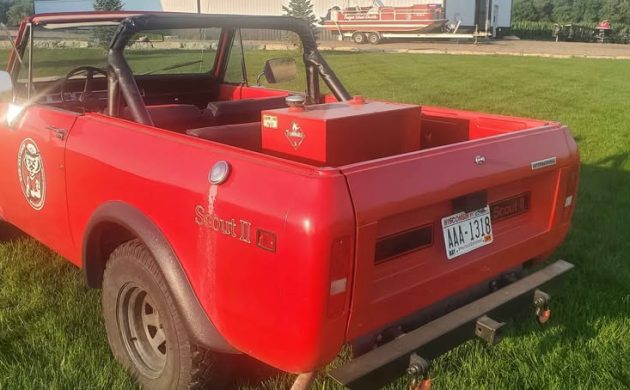
International Harvester offered the 1980 Scout II in a variety of exterior colors, including Saffron Yellow, Copper, Winter White, Black Canyon Black, Embassy Gray, Concord Blue, Dark Brown, Green Metallic, and Tahitian Red Metallic. Two-tone graphic appliques and interior trim choices such as black vinyl, russet, tan, or blue patterns further enabled personalization. This Scout II has a unique back bumper and some custom decals on the door. The paint is damaged by the fuel intake which looks like it is from overfilling the fuel tank. The ad states that this Scout II has had 2 owners. It appears that there is an aftermarket fuel cell in the back bed that takes up most of the room. The usual rust we see on Scouts is not present and the listing states that the vehicle has no significant damage or problems. Prices of International Harvester Scouts were increasing, is this driver priced about right for its condition?




These were good trucks back then, and are still good trucks today. As far as this one is concerned I would prefer the full SUV style; I prefer to be inside out of the elements unless I’m on a motorcycle.
It doesn’t say what engine is in this. I would guess a 304. I wouldn’t turn down any of the engines that were available in these.
I worked on a few diesel versions. Aside from a few small problems they were actually pretty good. Some timing advance issues but pretty much bulletproof.
Right on geo 👍
A neighbor up North had an older one with a half cab roof. Made it look like a little pick up truck.
I’ll maintain to the bitter end, the Scout was the “Rodney Dangerfield” of 4X4s, got no respect, except by the people that bought them. I believe the AMC sourced in line 6s( 258) were used as well, because IH didn’t have an in line 6 since the Diamond series(?).
Not mentioned enough, 1980 was a very important year for IH, and a sad one. The light truck line was being discontinued after 73 years of light trucks(1907) that got us through thick and thin, for a couple reasons that bother me to this day. 1st, the HD truck market was booming( anyone remember the 80s?) IH poured everything they had into the 9670, and a huge success, until Volvo killed that, and I’m sorry, but with the influx of imported light trucks, IH knew it needed a whole new vehicle, the pickups still had king pins for heavens sake, and the decision was made to pull the plug. Could the Scout have been a viable contender? Probably not, they were too far behind, and it had the 1 thing that was against it, people still thought of IH as a truck, when other “trucks” had gone far beyond that. Remember the ad, the guy takes his mom for a ride, “Sonny, why did you buy a truck? It’s not a truck,mom, it’s a Scout”,,fell on deaf ears, and sayonara to, what I feel, were the best all around trucks in the world, and have the credibility to say so. I drove more IHs in my career than any other.
IH toyed with a composite bodied replacement in the late 70s called the SSV. My cousin worked for IH at their headquarters in Chicago and took a few pictures of it for me. They made a few but by 1980 IH started hemorrhaging money and that was it.
In the 70’s I had a Scout, 196 slant 4, 3 speed 4X4. It was a tank!!! Everything from the wife grocery getting to me hauling firewood out of the woods. The only major problem was RUST OUT!!! It did not like Pennsylvania’s salt… I have to agree with Howard on all he said. It is too bad IH could not have kept up with the Big 3 in the small truck market.