

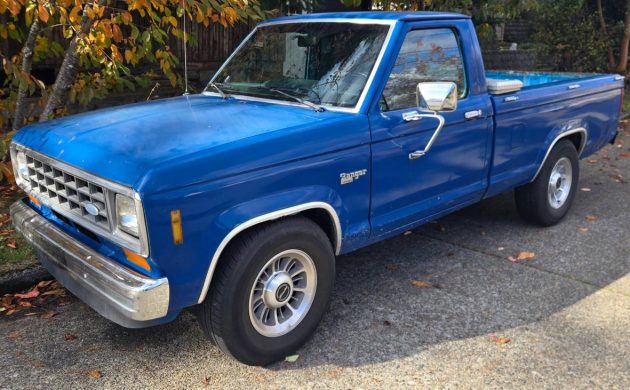
Throughout the 1970s, Ford relied on imports to fill the needs of the compact truck market in the U.S. Mazda supplied a Japanese truck badged as the Courier to compete against the likes of the Chevrolet LUV, also an import. But that changed in 1983 when a U.S.-built Ford small pickup was introduced, the Ranger. And for a few years, it could be ordered with a diesel engine, the first supplied by British manufacturer Perkins. The seller’s 1983 Ranger has this set-up, and we’re told it’s reliable, though it could probably be outrun by a turtle. Located in South Seattle, Washington, this little workhorse is available here on craigslist for $5,000. A bravo goes to “Curvette” for this latest tip!
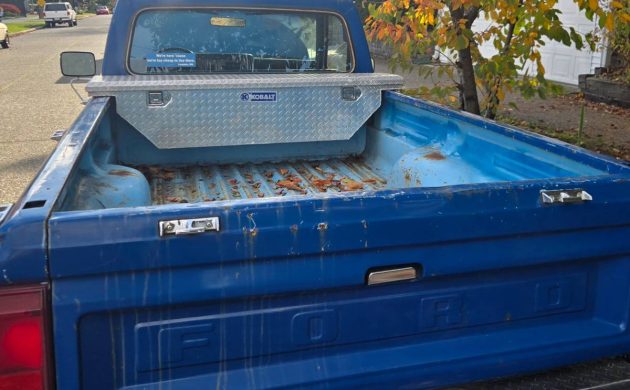
The Ranger would become quite successful and last through two generations and 2011. It would return in a larger package (mid-size) in 2019 to do battle with the Colorado, which itself had grown in size. Diesel engines in passenger vehicles were seen in the 1980s as a way to improve fuel economy amid rising prices. So, the Ranger became one of several U.S. machines that could be ordered with a diesel. In 1983-84, the oil burner was supplied by Perkins and displaced 2.2 liters. At less than 60 hp, these were hardly pocket rockets, especially when carrying a full load as they were designed to do. But fuel mileage topped 40 mpg in the days before hybrids were all the rage.
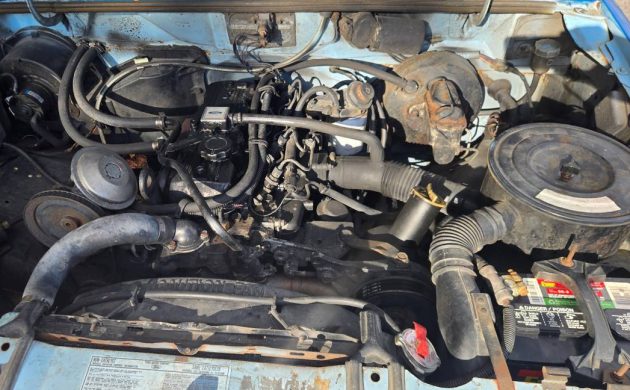
The Perkins diesel was used for only two years, to be replaced by a slightly larger but more sprightly one made by Mitsubishi. It, too, was gone after a couple of years as the great diesel experiment began to run out of gas. The seller’s truck has the Perkins diesel and at least 85,000 miles (the seller believes it could be higher). It’s a solid runner and has recently completed a road trip with flying colors. The wheels in the photos are from a 1998 Explorer, but the original ones with snow tires also come with the purchase.
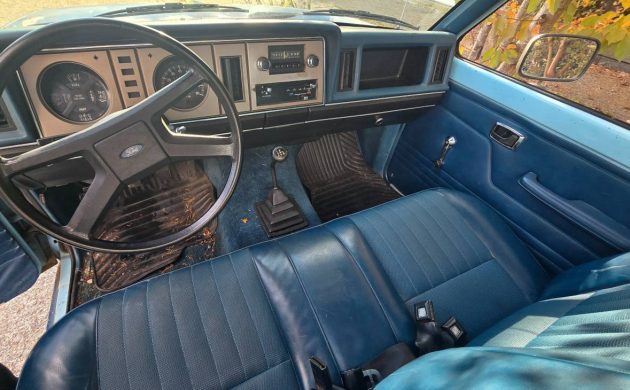
Parts replaced under the seller’s watch include the water pump, heater core, belts and hoses, clutch master cylinder, and the exhaust. The “glow plugs” will need to be changed more often than those in a gas-powered engine. The seller has new suspension parts on order, and if they arrive before the truck is sold, its price will go up. The paint is an older respray (color change, too?), and there is one rust hole that should be patched. It also needs a headliner, but can easily be driven without it. If you’re looking to do the quarter mile in under five minutes, this might be the truck for you!

I like it because it’s a diesel but the respray looks like a rattle can job and I believe the odometer has rolled once I think $5k is double it’s value good luck to the seller
Perkins, popular marine power as well. ⚓️
That’s the first thing I thought of Stan when I saw Perkins. I think they made a lot of sailboat diesels. Also I’ve seen Perkins small diesels in construction equipment as well.
Dang, that’s a nice one! I’d trade for my little orange Dodge D-50 in a heartbeat.
So … Ford used a British diesel motor. Ford has a huge presence in the UK, and the UK (like the rest of Europe) used a lot of diesels in passenger vehicles. As long as they were importing an engine from the UK, did Ford not have a diesel of their own?
Ahh, that Ranger club cab with the Mitsubishi turbodiesel that was listed a while back was the one to buy, not this rusty sister. I would have gone for that but I had tossed my spare parts and the hyrail gear I had for my 1986 years ago – too bad.
I drove 3 small truck diesels before buying a the Toyota diesel in ’82. This one was the slowest and barely faster as the base 4 cylinder Ranger. The VW had an upshift light that came on not a second after you were in gear for “efficiency”. The Toyo was the only one I’d drive in today’s traffic.
Well,,,,,normally not a fan of a diesel in any passenger vehicle, but I suppose in this case, it’s not a deal breaker. Not like you are pulling 40,000lbs., and to just pull this truck, and maybe a couple cinder blocks, it’s adequate. Obviously, not built for speed, at 59 HP. in a 2600lb. truck, won’t win any races. What this truck will do, is outlast that gas job 3 to 1. I read, these motors use timing gears, instead of a chain, and were extremely reliable. Mostly in an industrial settings, I remember a visit to Israel years ago, all the taxi cabs were old DeSotos with Perkins diesels. They smoked like a foundry, but never saw one stranded. Mileage was always over stated, and lofty claims of 45-50 mpg were advertised, with 30-35 more accurate. I read also, less than 1% of all Rangers had a Perkins diesel, and incredibly rare and those folks were probably not too happy. They were great trucks. Diesel does nothing for me. Finishing the “little engine that could”,,,”I think I can, I think I can” on that long uphill grind,,,
If you need a light hauler and aren’t in a hurry this could be your truck. At the time, 60 hp was 45 – 60% of a gas V6 or V8. Now the thing I ask is, why on earth do you slow this truck more with the weight of a toolbox and those big tires? Too many didn’t pay attention in science class.
mighty fine. AND… back then diesel was cheeper here~
The Perkins for this should be the 4.236, massively utilized’n popular. Sought out 1 to re-power my ’66 bronk (unsuccessfully) so used the ThriftPower 4.1.
“Yes” a lill over kill but not the 4BT turbo used in backhoe & swaped for manya these 2 rigs (really dumb).
The nissian SN (2 models) was in the last 2 scouts, mitsu & this – as ‘gas crisis specials’ (50 yrs ago). I like them for the low rev tq (like the i6) in the off rd gradients’n loose stuff, AND durabiity.
Too bad for the VW controversy (illegality) on the 2: -EA189 i4, 2L TDI (’09/15) & -3L bent6 (’14/16). Their NOx levels were 40X legal limit (& ‘cheated’ on usa entry tests/yrly inspection tests). The diesel advantage the rest of the world utilizes is not ‘for here’. I’d like it (well, ok, 2nd to the EV benies).
Can someone please interpret this post into English? Seriously, because it seems like he knows what he’s talking about
Ha! After a while, you can get the gist of their posts, I don’t think they are from around here, possibly Canada, eh? I think they contribute a lot to the site.