

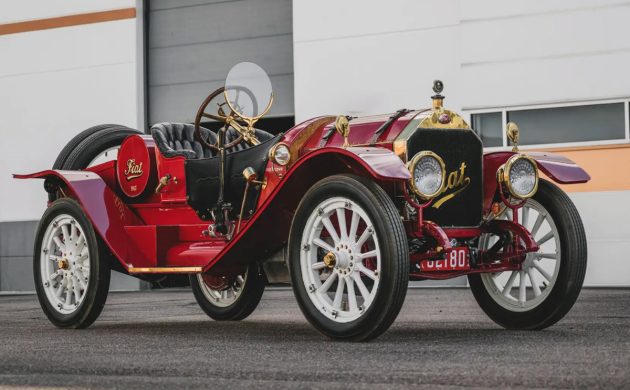
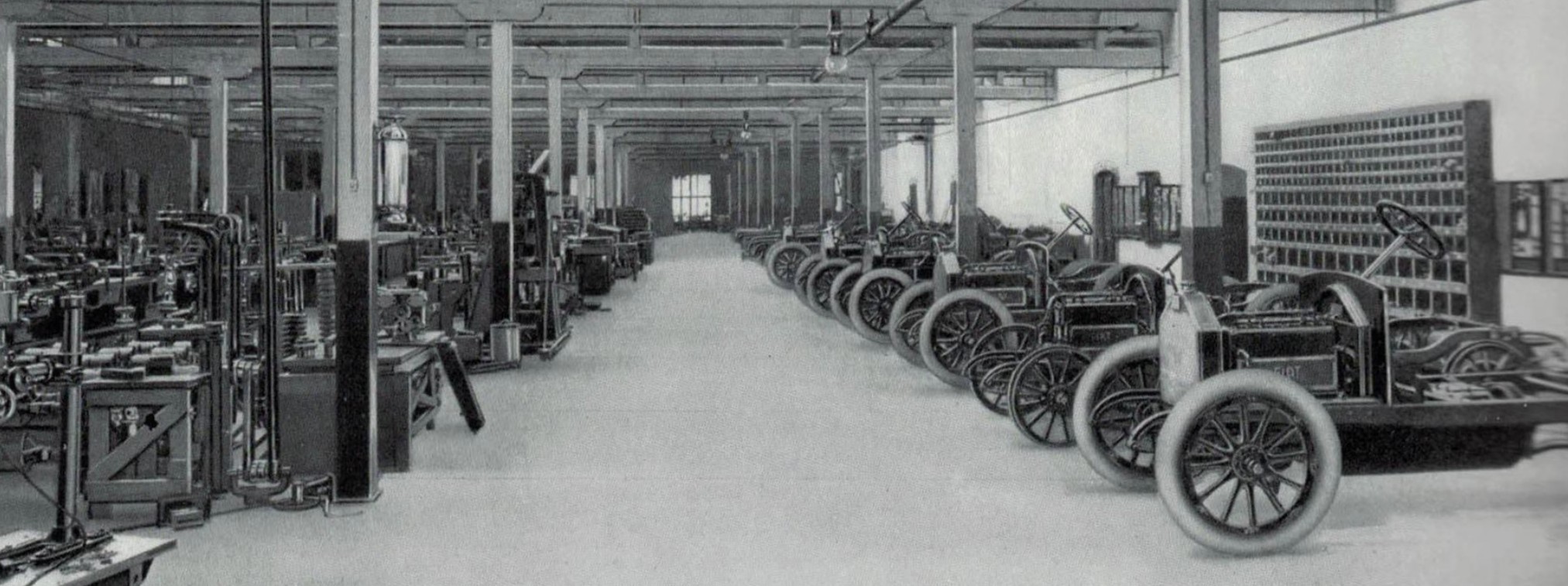
Strap in, Barn Finders, we’re about to encounter – wrapped in the history of the little Fiat above – an American Fiat plant as well as a Detroit-born stockbroker-turned-coachbuilder who has been turning out concours-quality creations for decades. Let’s start with the origin story: Poughkeepsie, New York, of all places, in 1909, when a group of local businessmen invited a delegation from FIAT to the area. The aim was to build a factory in the town to produce Italian cars for wealthy patrons. The Type 54 rolled off the line in 1910, followed by several other models, including the Type 55. At its peak, the factory made 350 cars a year. Today, these American-made FIATs are extremely rare. This example, a 1913 Type 55, will be offered by RM Sotheby’s on October 7th at its Hershey, Pennsylvania, auction. The estimate is $250,000 to $300,000. Thanks to Araknid78 for spotting this exceptional bit of automotive history.
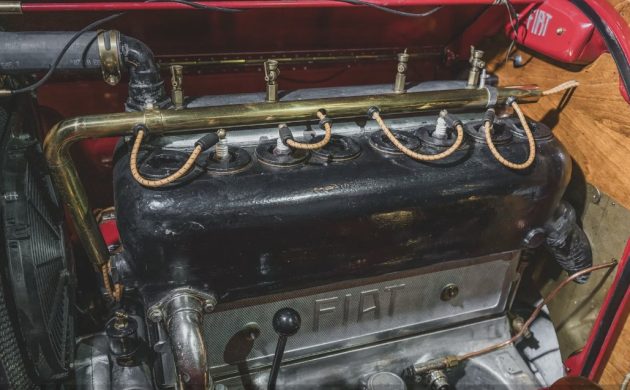
FIAT’s American-made cars were powered by big four- and six-cylinder engines, making around 25 to 60 hp. For comparison, the contemporary Model T generated about 20 hp. Not only was the FIAT a superior performer on the engine alone: it offered a traditional four-speed manual gearbox rather than the T’s odd arrangement of pedal and hand controls. The Type 55 engine was a 9.4-liter (not a misprint!) monobloc four, capable of 70 mph. The starting sequence includes a dozen steps – not uncommon in the pre-war era, both pre-war eras, in fact! A compression release valve was part of the routine, along with the usual timing retardation and throttle control. The engine never had a fan; instead, the flywheel was expected to supply air movement. Someone apparently decided the weak current wasn’t sufficient, so a modern fan is installed here between the engine and the radiator. Speaking of upgrades, the description at RM Sotheby’s is unusually vague, noting a restoration including a recast engine block with no details as to when this work was done. Little in the way of provenance is revealed, either.
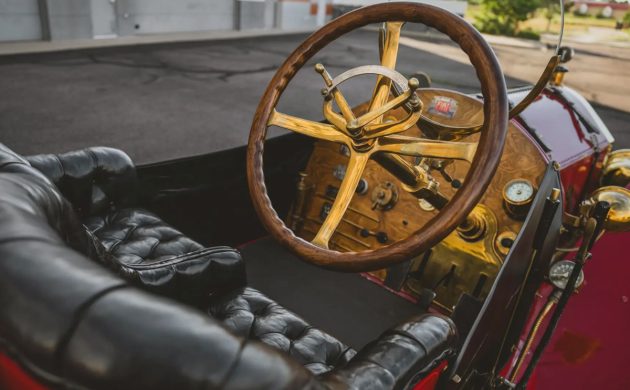
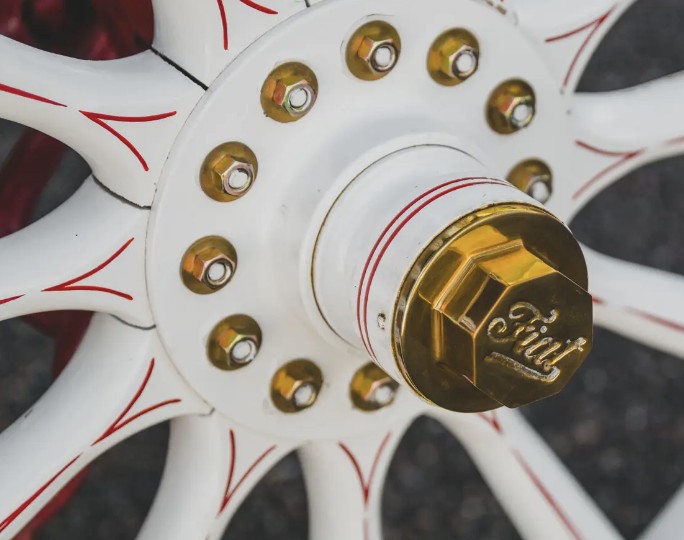
Historically, the first cars in America were steered from the right-hand seat. This tradition simply copied most horse and buggy arrangements at a time when oncoming traffic was not a serious concern. Henry Ford’s Model T established a left-hand drive protocol in 1908, and by about 1915, most cars produced here were left-hand drive. This car radiates elegance, justifying its premium pricing of $4000 to $6000 back in the day. The bonnet strap, the wheels, the monocle windshield, the brass trim – we’ll never again see anything come out of a factory looking like this.
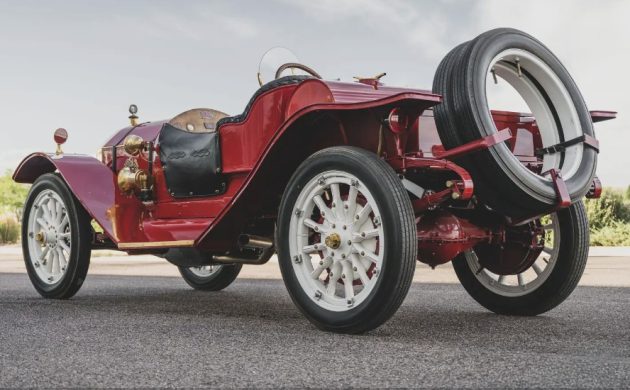
Buried in the description of the speedster is the restorer’s name – Gary Wales. Mr Wales was born in Detroit in about 1937, and after a stint in finance, he began restoring cars – but not just any cars. He specializes in the earliest and most elegant of vehicles. His restoration of a 1947 Bentley Mark VI Franay Drophead Coupe won its class at Pebble Beach. Wales also creates brand new cars – all variations on La Bestioni, a monstrous 1910 Fiat S76 built as a land speed-record car. This Type 55 was rebodied by Wales in a speedster style; whether chassis #211 started life with a similar body is unknown. Values are also in the “guessing” realm. Someone will want this car – but at what price?



I like the “windshields” on cars like these, though I can’t imagine they do much “windshielding.” I like just about everything else about this car, too.
That was the first thing that jumped out for me as well LOL. I guess as you rose to the upper speed limit of the car, you’d press your begoggled face in closer to the glass?
Love the armchairs integrated with the cockpit. Sir could enjoy a nice brandy in the infield, while observing the less privileged.
Back in the ’70s the FIAT logo was still visible on the long assembly plant showing through from beneath faded later-applied paint. It was part of Marist College.
Michelle – Pay attention now! You should be writing automotive history books. Or producing videos.
Righteous motoring, for sure.
Thanks, Michelle.
I know that this is Barn Finds and this car isn’t one, but I’d much prefer to see interesting vehicles like this here every day than the endless parade of useless, ridiculously overpriced, rusted-out 1950s and 60s hulks that were ignored by the seller for decades and stand no chance of ever finding a buyer, yet now they want big money for nothing. After a while, that’s all becomes just a blur of junk prn.
Hmmmmm…. it sounds like you might be reading the wrong column in that case, perhaps like hiking in the forest complaining about all the trees?
David, At least 50% or more of the vehicles listed here are not really barn finds at all. So there is already a lot of editorial discretion being applied to the daily selection.
So I was just tossing out a thought that might help shape the editorial angle going forward. And as a web developer/web marketing guy, the staff has exact numbers on what is clicked and what is not.
I’d be willing to bet that the more unusual stuff, decently presented stuff, and the truly rare and collectible stuff that BF posts far out pulls the daily parade of worthless iron oxide relics posted by sellers who are having bank account fantasies about the value of their neglected junk.
Decent condition, unusual cars, and truly decent barn finds are worth looking at. But whatever, I could be wrong.
It was once said to me that “One man’s junk is another man’s treasure” and I have certainly found that to be true in my life, and it’s one of the things I love about Barn Finds. Who knows what treasure you might find in a rusted out hulk? That was especially true for me with the recent Forest Mustang. I learned so much about Shelby Mustangs because of that rusted out old heap of a car that I never knew, and it was ALL because of BF and fellow car lovers weighing in with their knowledge and expertise. People who know cars far better than I do that on the worst of the worst and the best of the best on BF and I learn more about an amazing variety of cars every day than I could possibly get from any other website. And it’s also about community, BF gives us an opportunity not only to share knowledge and expertise but memories or admiration or distain for a particular vehicle that we may not have even known existed, which has happened to me multiple times. That’s why I love it here.. just the way it is.
Interesting! As a long time Fiat tractor guy, I had no idea of this history. Thanks Michelle…..
Thanks, I learned something new today: Fiat manufactured vehicles in the USA from 1913 to 1920. Who knew!
A 9.4 liter engine. Pistons like paint cans. Like someone said above, worth a lot to someone but not to me. The starting sequence alone is ridiculous.
I grew up in Poughkeepsie and never heard anything about this. Amazing.
Personally, I love Brass Era cars. They are the ultimate in simplicity and yet require a steady hand and mind to keep them pointed the right direction.
The Mercer Raceabout is one of the most famous in America. I’m sure it won’t outweigh the FIAT but I think it will outperform it in every way but fuel economy.
9.4 Liters! You would be hard-pressed to find that kind of displacement in a farm tractor. But I’m sure you’d have a difficult time stalling it.
I wouldn’t kick this out of my collection but I think there would be others getting in front of me to take this one home…
I wonder if it keeps breaking down like other Fiats do. So maybe the American built cars are more reliable than the true Italian models. And we all know what FIAT stands for:.Fix it again Tony. Reminds me of the Stutz
Bearcat they used on the TV show Bearcats with Rod Taylor and Dennis Cole. If they had to use one of these, they would’ve
been doing more walking than
riding lol!
I remember reading in The Treasury of the Automobile, by Ralph Stein, some banter between the owners of Mercers and Stutzes. The Stutz crowd said: “There never was a worser car than a Mercer.” The Mercer crowd countered with: “You have to be nuts to drive a Stutz.” Today the banter remains the same but the names have changed. Personally I wouldn’t mind having either one in my collection…
I heard that quip as, “Nothing worser than driving a Mercer.” Another good one was, “You can go anywhere in a Model T… except in society.” One old car guy compared the performance level of a well-tuned Mercer Raceabout as similar to that of an MG B. Ok, maybe so, except for braking. Front wheel brakes were a great development!
You did it again Michelle!!!! Another fantastic write up about a car I never knew about.. From a road grader to a Brass Age speedster in one day!! Keep up the good work.. THANK YOU!!!!!
Of course, Brocky, my pleasure. We owe Araknid78 for finding these gems, too!
This is just simply stunning!!! I never knew Fiat ever even built cars here in the States in the beginning of the 20th Century. Once again, Michelle you taught me something new on Barnfinds today!!!
Nice write up Michelle. Thanks for the acknowledgment
Would sure love to take it for a spin. If I could start it
I would like to drive this vehicle. Note that there are no front brakes and the rear are externally contracting and don’t work well in wet weather but the 1927 Chrysler 50 had the same set-up.
Well written Michelle. Fiat was initially an upmarket manufacturer, competing in races as well, thus the expensive look of this car.
Didn’t Fiat race in the Vanderbilt Cup races on Long island NY / If so, were they factory cars or “privateers”?
Absolutely correct, in fact one of my favorite characters in the rich history of automobiles – Vincenzo Lancia – drove a Fiat in the Cup in 1905. Louis-Joseph Chevrolet (yes, THAT Chevrolet) drove the same race, also in a Fiat. For more, go to:
https://www.vanderbiltcupraces.com/
When i wrote the comment about early Fiat racing and general status i had a vague idea only. However Michelle you nailed it!👏 If you consider that i raced for Fiat for some time in 1978-1979, i’m without excuses for not knowing all the details that you present! Congrats!👍🌼(X)