

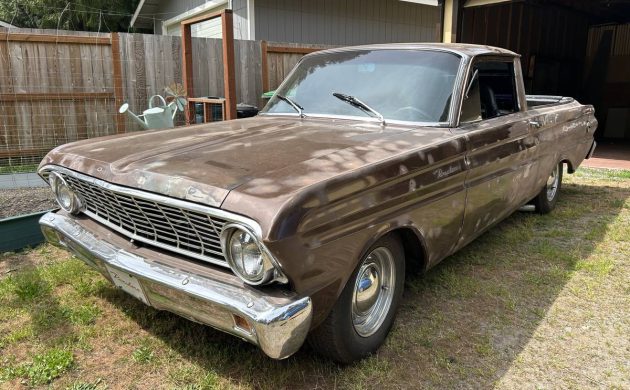
Let’s put one fact on the table right up front: this Ranchero-in-progress is a six-cylinder. But the longer I look at cars, the less I feel like every car has to pump out maximum horsepower from a big V8. The 1964 Ranchero could be ordered with two six-cylinder engines – a 170 or a 200 – or the 260 V8. It sat on the compact Falcon platform and weighed in at about 2700 lbs, so though the 101 hp 170 provided only reluctant acceleration, the 116 hp 200 made for a reasonably peppy ride. This example has seen plenty of work already, and with a price of just $6000, it offers a cheap entry point for anyone interested in easy project work to a finished product. Find it here on craigslist; drive it home from Port Hadlock, Washington. Thanks, Curvette, for hunting up this tip for us!
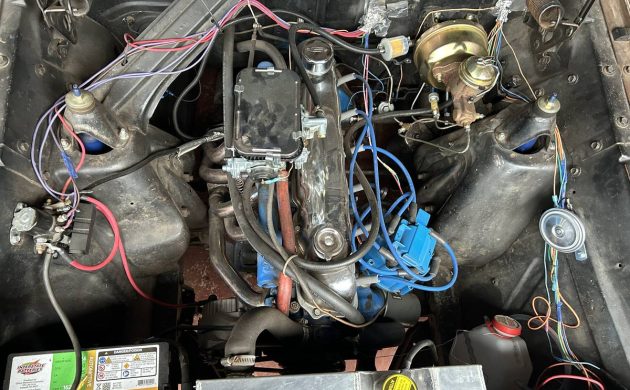
Underhood, the radiator, fan, carb, and fuel pump are new. The brakes have been rebuilt at all four corners. The fuel tank was replaced, and the lines have been either cleaned up or replaced. The wiring is new, though the seller notes that one rear lamp needs a resistor; the new owner will no doubt want to tidy the stray wires all over this engine bay. The car has dual glass packs – love the sound of those. With this six-cylinder, the transmission is likely a three-speed manual. If a buyer opted for the V8, a four-speed was more common.
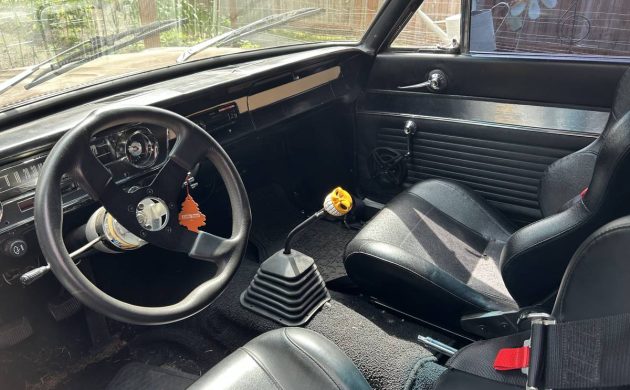
I’m not a fan of non-stock components, but that said, this interior is at least tidy. The bolstered seats are modern; the steering wheel is an aftermarket three-spoke; I admit I don’t love that gearshift knob. But I wouldn’t turn this car away for its interior – everything in here can be changed at minimal cost, and those seats might actually be more comfortable than the originals. The wide-web safety belts are a great addition.
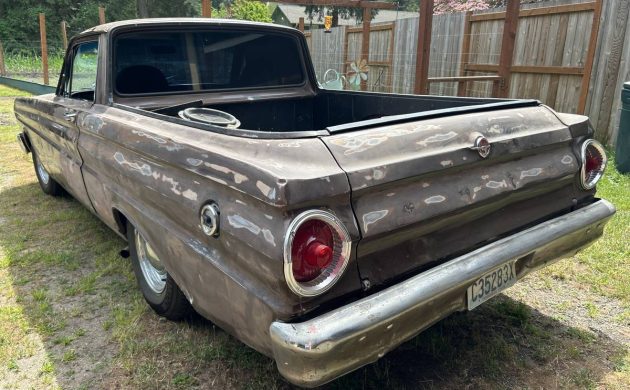
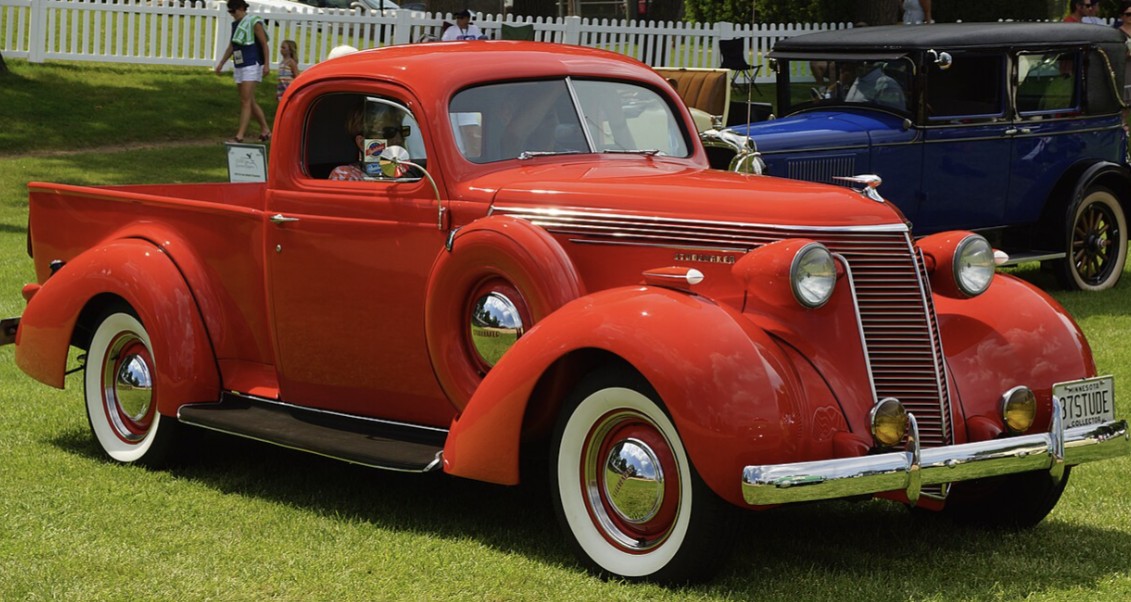
The coupe-utility was invented in the early 1930s in Australia when a farm wife asked for a vehicle that would haul the family to church on Sunday, and the chickens to market on Monday. That vehicle was a Ford. Then, in 1937, Studebaker produced its Coupe Express. At least 5000 of these specialty Studebakers were made. A long drought ensued until Ford resurrected the body style on its full-sized platform in 1957, calling it the Ranchero. Once situated on the compact Falcon platform, the Ranchero was touted as an economical hauler. Body prep appears to be underway here, though the new owner will be responsible for finish work. What do you think about this Ranchero – is it far enough along to justify the price?

might be an easy “build” but removal of the left firewall to shock tower export brace would be a concern.
These are fun little rigs…Hard to beat the 6 cylinder.The shift knob does need to go…..
A 302 isn’t a big V8. Would that be OK Michelle? That EFI intake would look pretty cool under there. Like Terry M mentioned, drive gently til you get that brace figured out. Does it have to be removed to check the brake fluid level?
Putting a V8 in one of these is a major undertaking. Best to buy a factory V8 rig.
Maybe for some a simple motor swap is “major”. A 260 was optional, a 302 is outwardly the same. It’s just bolts.
Ouch you dangled my second favorite V8 under my nose (after the 351 Cleveland), I guess I’d have to say okay to a 302!
There are differences in the bellhousings. The 221, the 260 and the earlier 289 all had five mounting bolts to the block. The later 289, the 302 and the 351 had six bolts. So there could be a need to swap a bellhousing when doing an engine upgrade.
🎶Stick shifts and safety belts, bucket seats have all got to go….🎶
Yes, TransAmMan. And let’s see how far I could throw that steering wheel.
a v8 swap is definitely not a major undertaking. I had a 65 ranchero, 200 cubic inch with three on the tree. bought a wrecked 65 mustang with a 289 and automatic. we swapped out the engine, transmission, rear end and front spindles (8 inch brakes and five lug instead of 7 inch and four lug) all in one day. had the engine fired up too. still had to get the exhaust done but I drove it home from my buddy’s place that same day. I later put a four speed out of a 64 falcon in it. Luckily I still had the clutch linkage from the three speed, I had to cut about an inch and a half or so out of the middle of it but it was all very easy conversion. I left the original clutch pedal in the whole time, just threw the floor mat over it when i had the automatic. Good times!
nice start
That is a nice project and a fair price. I also have a 64 and it has a 302 roller V8 and 5 speed. Yes it can get squarlly but fun. I would like to know ware the buckett seats came out of? Thanks