
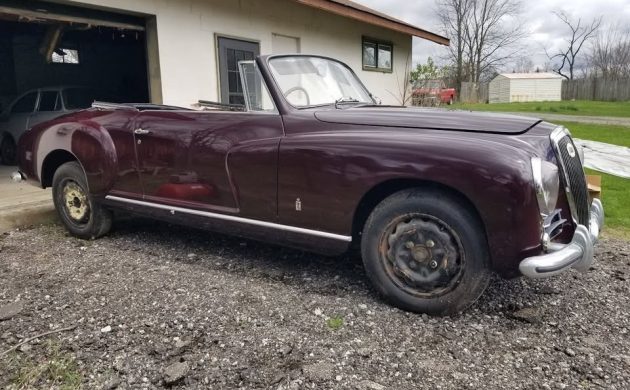
Today we pay another visit to Vittorio Jano, a standout in the Italian engineering milieu for decades beginning in the 1930s: he designed the Aurelia for Lancia – one of the company’s most successful models. Constructed in six series starting in 1950, the Aurelia was powered by one of the first V6 engines installed in a production car. Initially, the only Aurelias were the B10 – a four-door sedan – and a wonderful cabriolet, the B50. In 1951, the B20 GT coupe arrived. Responsibility for the Aurelia’s styling is a matter of debate: Boano, Ghia, Michelotti, and of course, Pinin Farina are all implicated at certain points in the development process; it seems certain that Pinin Farina was the manufacturer once the design was set. Production numbers were dominated by the sedan; fewer than 300 copies of the B50 cabriolet that we see here were made. This car is a masterpiece of Italian engineering, needing only a well-heeled buyer to finish what is evidently a high-quality start to a complete restoration. The price is $150k, the listing is here on facebook Marketplace, and the car is located in Bulger, Pennsylvania. Thanks to Zappenduster for spotting this swanky project car for us!
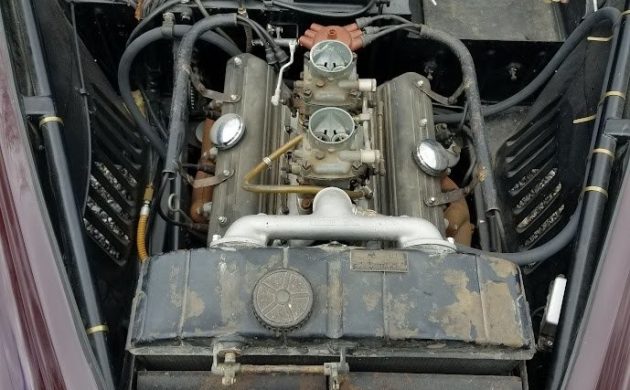
Lancia’s engineers employed sophisticated techniques to solve issues like front/rear balance, engine power vs. weight, how to configure brakes, and the best way to marry up suspension with all the car’s other attributes. The result is a car with unusual solutions to ordinary problems, pretty much from top to bottom. The narrow-angle V6 displaces 1754 ccs and generates about 56 hp. Ordinarily supplied with a single carburetor, this example seems to have a Nardi kit partially installed, with dual Webers, a special intake, and a twin-pipe water manifold. The kit typically includes a unique camshaft as well. The Nardi kit will supply another couple hp. Underneath, a transaxle combines the gearbox, clutch, and differential; the brakes are mounted in-board. This unit helps the car achieve a near-perfect front/rear weight ratio. Front suspension is sliding pillar, while the rear is independent. That mechanism attached to the front of the radiator operates shutters to help regulate warm-up temperature. This car is not in running order; the seller invites questions.
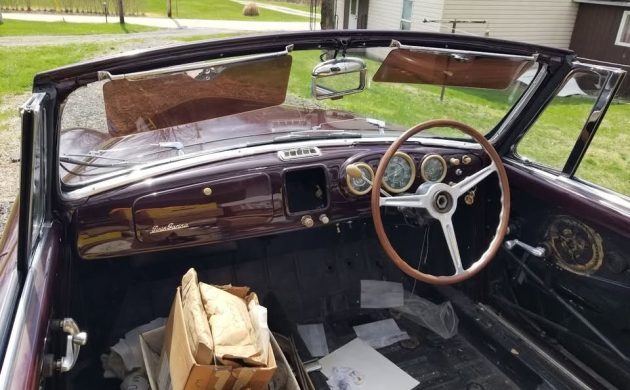
The seller is storing parts inside the cabin; we’re not told if all components are with the car. From the factory, the B50 would have received individual front seats upholstered in wool cloth and a column-mount gearshift. A Nardi shift kit can put that gearlever on the floor. The badge on the glove box lid reminds us of Pinin Farina’s involvement. Bone-colored switches and gauge trim add an elegant touch to an already-exquisite vehicle.
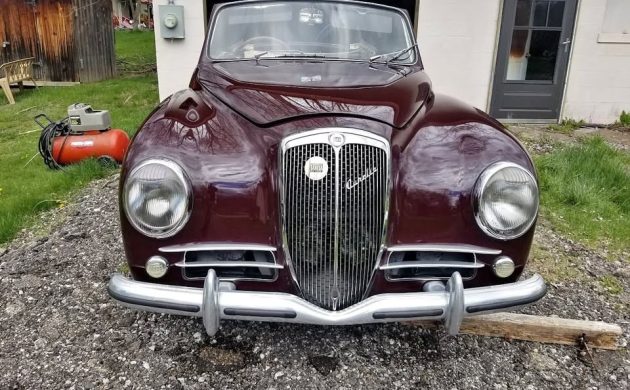
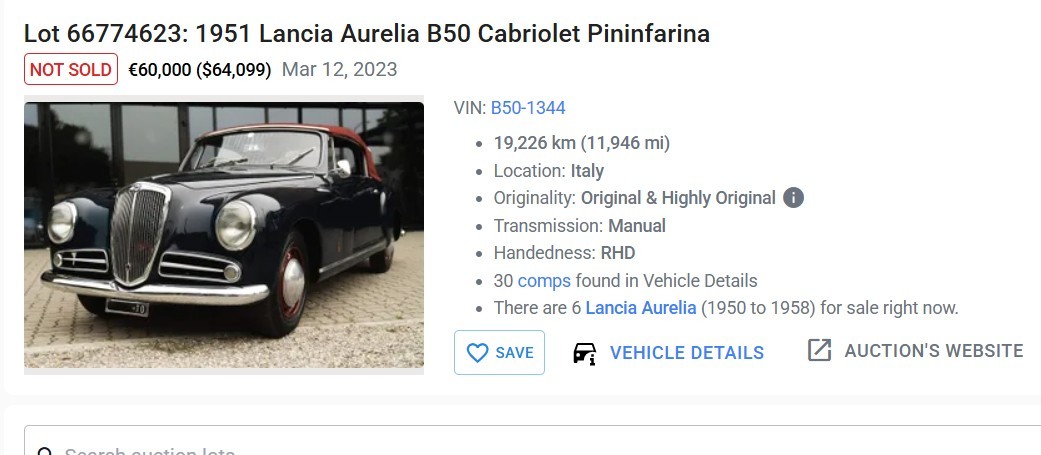
The paint quality, panel fit, and condition of the trim are above reproach. A call is warranted to discover what parts might be missing, if any. The top frame will be nearly impossible to source, so hopefully that’s included with the sale. Other parts are borrowed from high-production models, such as interior door pulls. Prices for Lancias have declined lately, alongside those for other collector cars. Not long ago, this car – even with its needs – would have nudged six figures. Today, this nice driver is available for about $110k. A better benchmark is the auction market, where this driver was bid to only $64k without selling. While appreciated in the market when new, Lancia’s tricky engineering can challenge restorers and repairers, particularly those located in the US.




This car has been listed for a very long time. The ad is very weak on details and photos. There is no way to determine how complete the car is, what has been done, the quality of work, or what is still needed to finish the car. It’s a great car (I have an Aurelia coupe). The asking price is already higher than these B50’s normally sell for in excellent condition, so it is going to be difficult to find a buyer.
Great model, but I agree with you. Requires an in-person visit and negotiation regarding price.
Very good write-up, Michelle. It is a very optimistic ask for a niche vehicle with lots still to do.
I don´t understand why Lancia always put out low power figures for what they have. I know a Lancisti will tell me its all about the quality, but I think some width would be nice too.
I remember seeing one of these in a metal model back in the mid 80’s in a model catalog. ( I think I still have it but it’s buried right now). I thought it was an absolutely beautiful design back then. I really like the front end design especially. You can picture the potential with this one. But like everyone has already said, its going to take some work, that’s for sure. Great write up Michelle, and find Zappenduster.
You are always so complimentary, I appreciate it!
Michelle….. You deserve the compliments. I always appreciate your time and research. I always learn something new. ( Now remembering it……. Well…… As I always say, with the grey hair, comes the grey matter in my brain lol).
Why the right hand drive? Don’t the Italians drive on the same side of the road as us? Beautiful car otherwise but 150k? If it’s a driver I would be afraid to take it on the road at that price.
All Lancias were RHD until 1955. It always did things different
I gather sticking with RHD was pretty common for higher-end Italian marques in general for quite some time even after Italy switched to driving on the right, something about a lingering sense of prestige about it, but it also helped with navigating narrow mountain pass roads to ensure your car didn’t veer off the right edge into a sudden, steep drop-off.
My understanding is that wealthy Italians didn’t want to get their shoes dirty by having to step out of the car into the street.
Lancia build their cars right hand drive… rare car for a discerning buyer with a nostalgic heart.
Sub Gothias is correct. If you are driving on the very narrow roads in the Alps in the pre WW2 period and the car is a luxury car (meaning it’s big) you need to be able to see the edge of the road regardless of your direction. A RHD car on a road intended for driving on the right allows you to see the edge so that you will neither go off from the outside lane, and it will also help the driver avoid grazing the mountainside while on the inside lane.
How on earth u discovered all these details Michelle! Bravo!
Also the readers are quite an educated bunch of gearheads!
Thanks! …. Been around a few Lancias over the years, the odd details collect in my memory…
U r welcome! U seem to be a Lancia file like a friend of mine, local Bank manager in my neighborhood who owned a Fulvia. We became friends when he saw my X1/9 out of a car washing shop in the area and wanted to buy it. No way but i drove his Fulvia for a short distance and i was amazed by the built quality all around.
Michelle, I want to second all of the compliments you have received here and in previous postings. I truly look forward to your posts, even on cars I care nothing about.
I am often reluctant to comment, where I clarify some technical minutia as I don’t want to appear negative. Just trying to be helpful.
Having said that, a comment about the engine is in order. The V-6 engine in this car is a 60 degree V and uses two separate cylinder heads. The narrow angle V engines (very narrow) Lancia is known for have bank angles ranging
from as low as 10 or 12 degrees up to 22 degrees. These very narrow angles allow for a shorter engine (more compact) which in turn makes for a shorter and more rigid crankshaft. And those narrow angle engines can use just one cylinder head to span both banks. So yes, the bank angle of this engine at 60 degrees is narrower than say the V-8’s 90 degrees but it is just one of the two optimal angles, (120 is the other) for V6’s and V12’s.
One more thing I forgot to mention in previous posts. Note in the picture (from FB, not shown in this listing) of the right rear quarter of the car. You can see the wheel and the four lug nuts holding the wheel to the car. You can also see 4 studs protruding from the center hole of the wheel. Those are for holding the end caps of U-joints (not present) which allow for placement of those joints as far to the outside as possible. That reduces the working angle of those joints which reduces wear and vibration.
This will be very nice when finished. I hope it doesn’t just languish in this semi-completed state.
Engine is 60° vee angle with separate head castings. Not narrow-angle.
Thanks to you and z1rider for the correction. I had Lancia’s V4 in my brain, totally different animal.
Certainly in volume Lancia narrow angle V4’s were the most common but they also made a narrow angle V8. I can’t recall ever seeing anything about a narrow angle V6 though.