

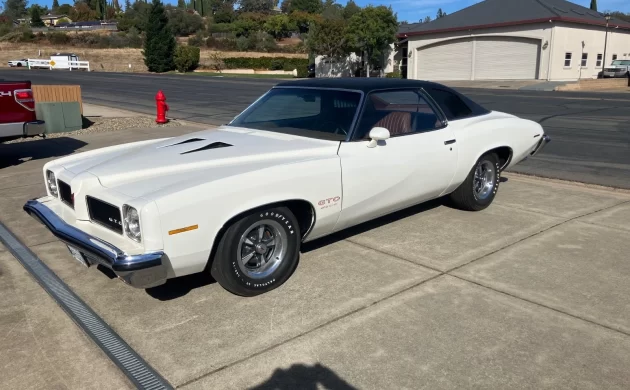
The 1970s brought major changes to the automotive industry. The energy crisis signaled the end of high-horsepower big V8 engines as federal emissions mandates took hold. New safety regulations changed the look of new vehicles, with heavy safety bumpers now standard. Also new was a pillared roof with frameless door glass and a prominent B-pillar to comply with federal rollover safety standards. This new look gave birth to the term “Colonnade” for General Motors intermediate vehicles across their various Makes from 1973 through 1977. A few muscle cars were still produced, though some purists shun them for their less-powered engines. My favorite Colonnade muscle car is the 1973 Pontiac GTO, and if you agree, here is a nicely equipped example located in Shingle Springs, California, available here on eBay with bidding up to $11,100 and five days left in the auction.

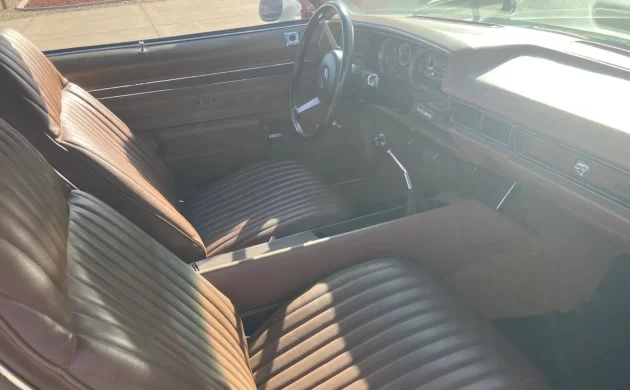
One of my favorite features of the 1973 GTO is the one-year-only hood equipped with twin ducts. The styled-after airplane air ducts were developed by the National Advisory Committee for Aeronautics (NACA); however, Pontiac marketing called them NASA-type hood scoops in their brochures. Unfortunately, the NACA ducts were non-functional and blocked by inserts. A few lucky owners made the ducts functional by choosing the ram air option or having dealers use over-the-counter parts. I got to see a functioning NACA hood ram air setup many years ago at a car show, courtesy of a 1973 GTO owner, and it was a sight to behold. This 1973 GTO is finished in Cameo Ivory with a contrasting black vinyl roof. The Saddle-colored interior reveals not only bucket seats but also a rare 4-speed manual. The seller notes that, according to Pontiac Historical Services, only 926 GTOs had manual transmissions in 1973. The factory shifter was also replaced with a Hurst shifter.

Under the NACA hood of this 1973 GTO sits a 400-cu-inch engine, a Muncie M20 4-speed manual transmission, and a 3:42 rear end. The stock 400 engine produced 230 hp, though the seller reveals the WK code engine was rebuilt and bored .030 over, with a crane cam and TRW pistons added, so it should perform better than the factory specs. The seller also states that the GTO runs and drives excellently.
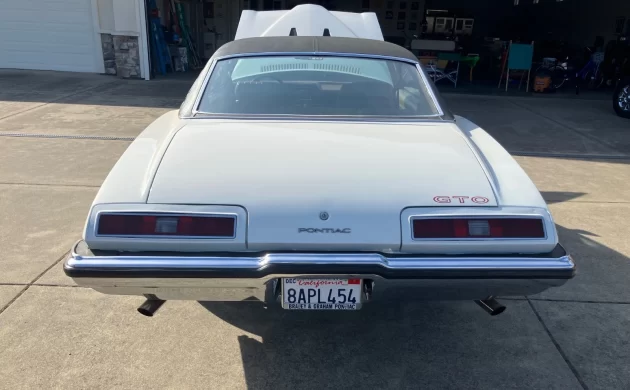
The ad for this 1973 Pontiac GTO states it is one of the nicest 1973 GTO’s left in existence and is numbers-matching, magazine-featured, and partly restored in outstanding condition. For those of you who appreciate Pontiac history, Jim Wangers, Pontiac’s marketing genius behind the GTO, signed the passenger-side sun visor. Whether this 1973 GTO is the nicest one around is certainly up for debate, but there is a lot to like about this Pontiac, and I would gladly drive it around. What about you, readers?





It’s always great to see any Colonnade with a 4 speed. But a ’73 Goat? Even better. This definitely is one of the nicest ones we’ve seen in a while for sure. These are good looking cars. I was always surprised at Pontiac only having the GTO built on the Colonnade platform for only one year. Hope it goes to a good new home.
Strange car, White with Black roof and Brown interior, should be Black interior to match the roof, why were manufacturers’ in the seventies obsessed with Brown, my least favourite colour.
Most ot the allure of the GTO to a youngster like me ment “here comes the”, you get it.
If you raced this one against the 1970 Judge you would might lose the drag race but I bet this handled better.
Could be wrong too.