
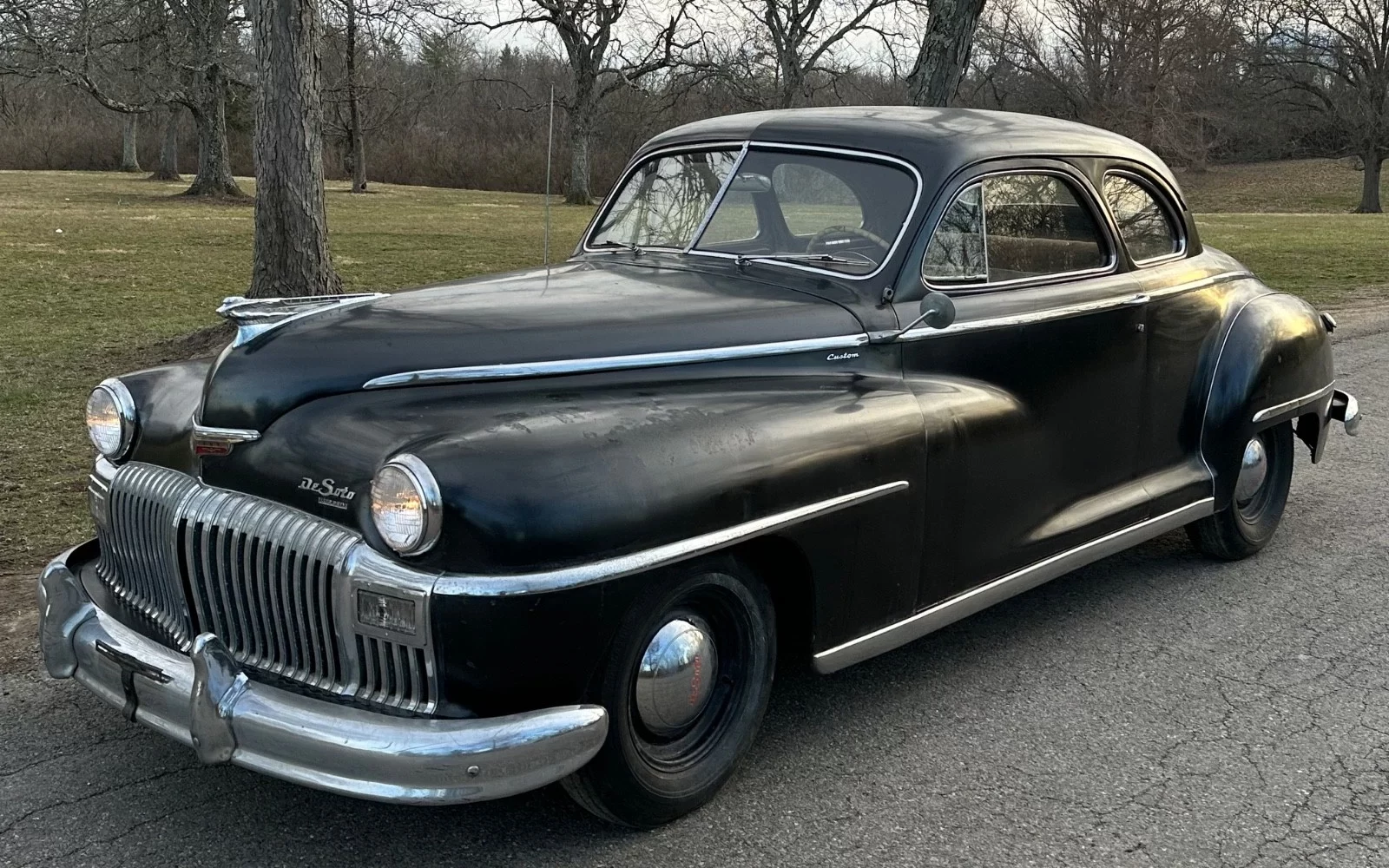
I’ll come right out and say it: I’ve never owned a car from the 1940s. It’s a shame, really, because it’s an important decade in the history of our country, and on top of that, it’s a decade apart stylistically: Nothing looks like those fat-fendered cruisers. While my ’40s tastes runs toward Buicks and Lincoln Continental Cabriolets, this DeSoto Custom Club Coupe makes strong arguments on its own behalf, the strongest being price. This is a No Reserve auction here on eBay, and the high bid currently sits at only $2,550. The seller has been featured several times here on Barn Finds; located in Cincinnati, Ohio, they seem to specialize in solid, affordable light projects with no reserve. This DeSoto continues that trend.
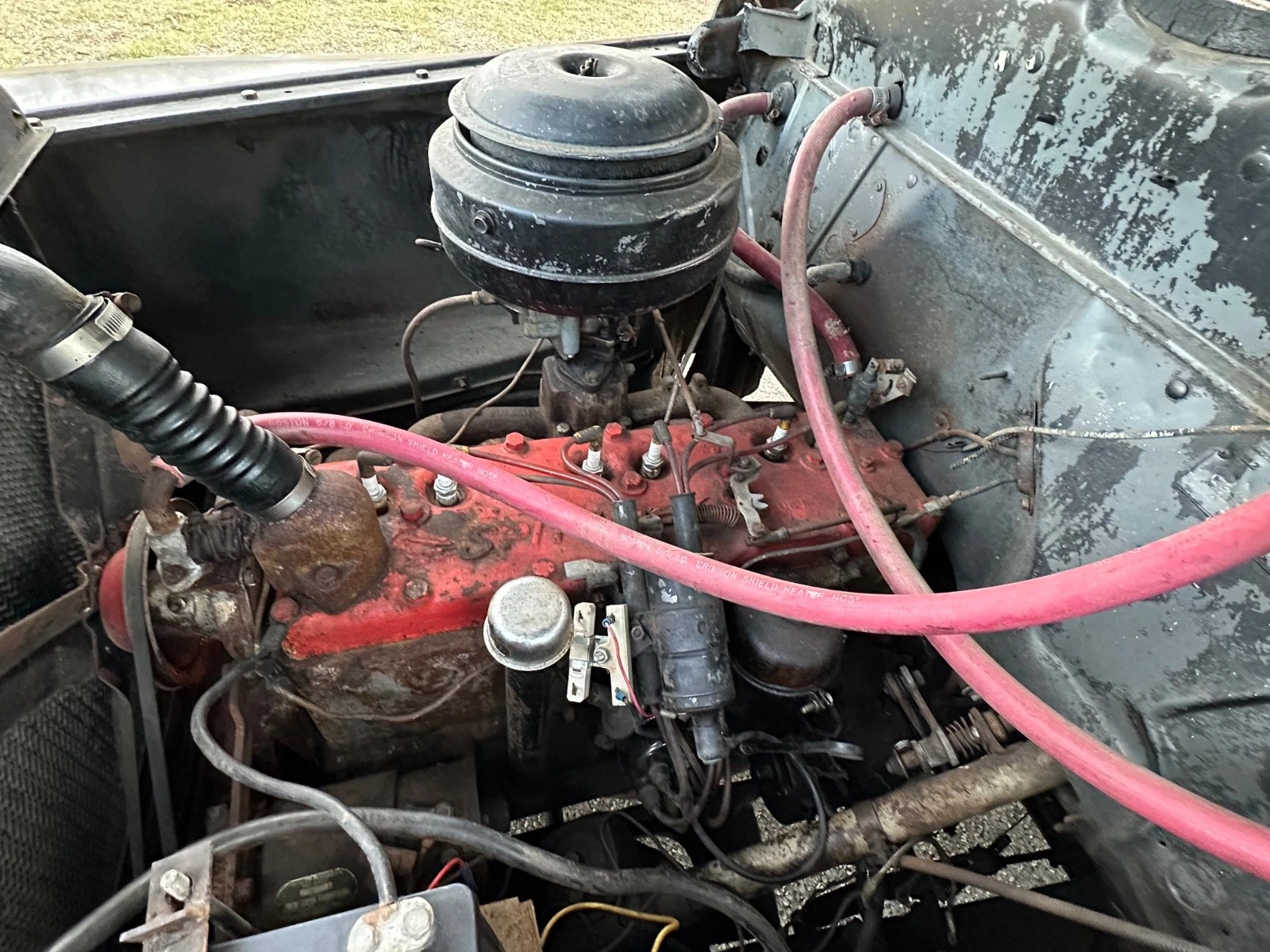
It takes a very sharp eye to differentiate between any DeSoto produced between the 1946 and early-1949 model years; all the automakers were pumping out as much volume as they could, and there was no need yet to worry about reviving the annual model year styling changes. The powerplant was static, as well; all DeSotos were powered by a 236-cubic-inch flathead six, which produced 109 horsepower. There is something, however, that makes me wonder about the engine in this example; it seems to say “Spitfire” on the cylinder head, which probably means one of two things: the engine is out of a Chrysler, or someone, at some point, installed a Chrysler cylinder head. Maybe our experts on flathead Mopars can illuminate the possibilities in the comments.
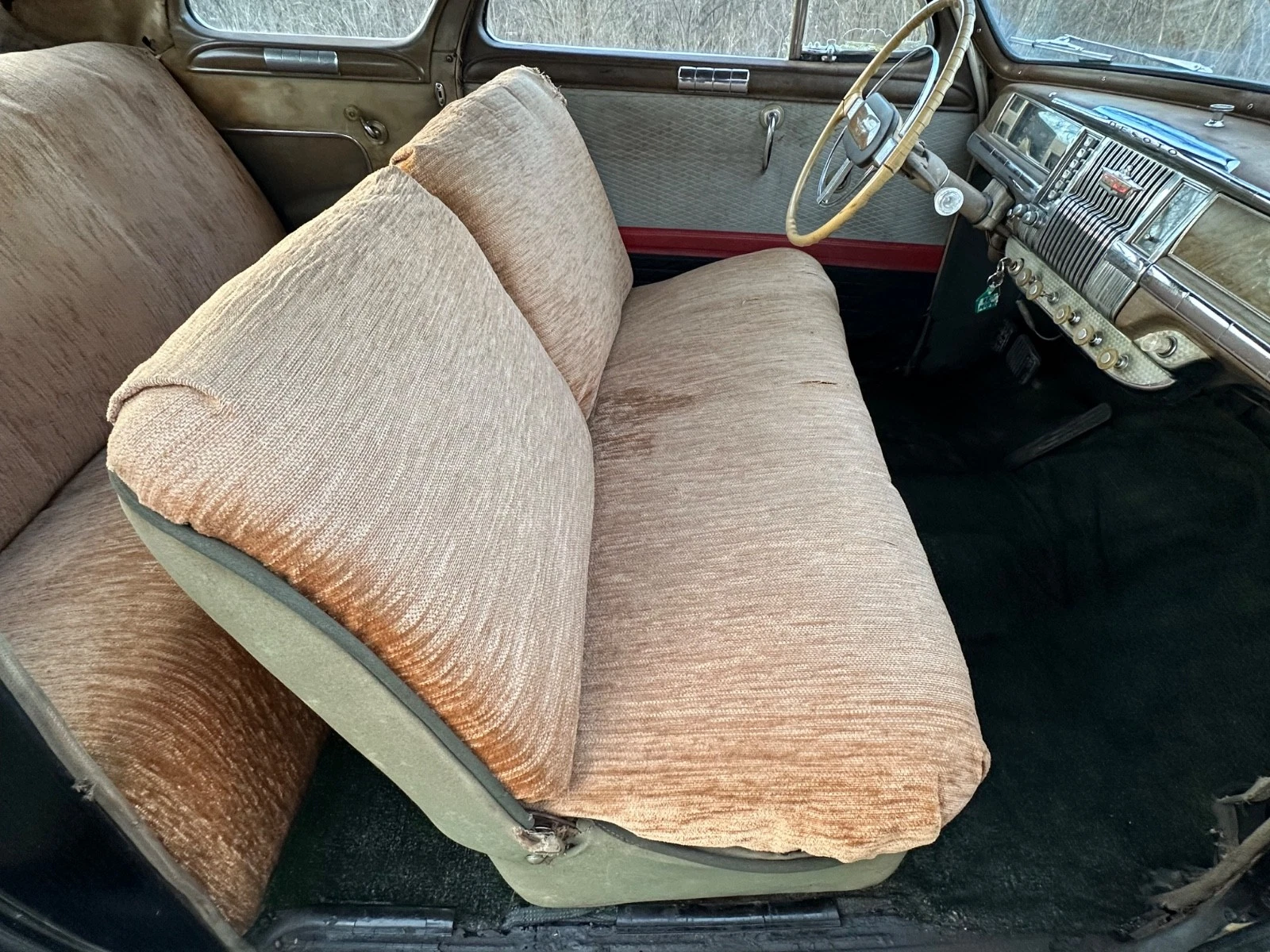
The DeSoto has a “Fluid Drive” badge on the dashboard, so the new owner, if they haven’t ever owned a car so-equipped, will be able to learn a new skill. The interior has been reupholstered fairly poorly, and is “showing some wear and tear,” but if that doesn’t bother you, you’re ready to go, except for one thing: the brakes don’t work. On the other hand, the seller pulled the car out of the garage where it had been sitting for ten years, drained the gas tank, installed a new battery, and the DeSoto started right up. Apparently, it “runs and drives great around the property.”
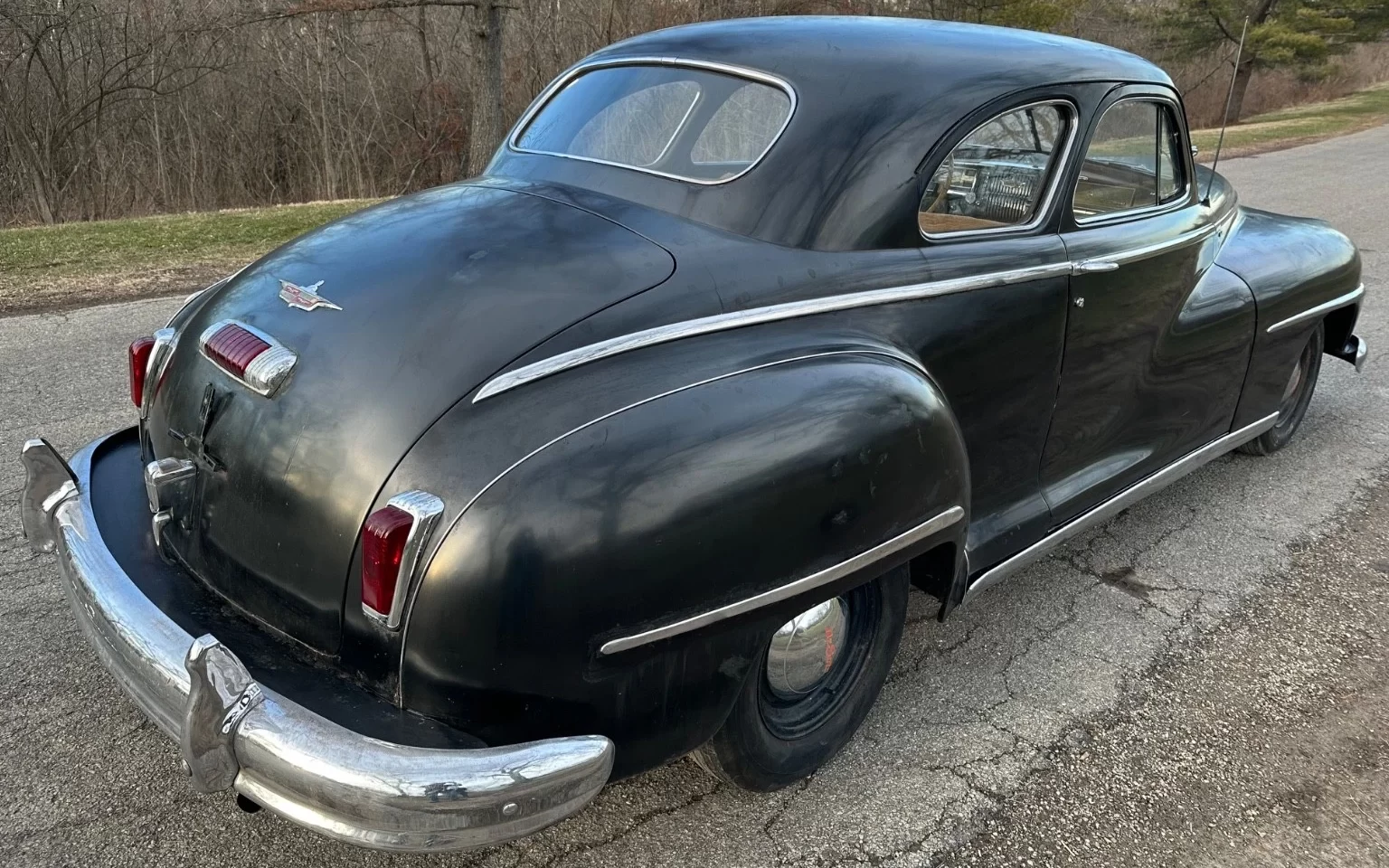
The car is being presented as a nice, solid, straight original with the typical dings and bruises one might expect from a 78-year-old car that hasn’t been restored. It would be an inexpensive, fun project for those who are either looking for their first 1940s car, or those who have owned a hundred. The seller “reserves the right to sell the car early,” and he’s left a phone number to talk directly to him and set up an appointment to see the little coupe, so if you’re interested, you may want to make that call.




She’s a lovely old gal with an equally lovely rear end. She would make someone a nice companion. Not much work needed and just some TLC and she’ll be ready for the next adventure. I do love those American cars from the 40’s.
Aaron, I’ve owned two 1940’s cars and they were both Oldsmobiles, but the “holdover” styling of the Chrysler products always appealed to me with their big trunks and long snouts and I always keep an eye out for a nice late ’40’s business coupe from the Chrysler family. This DeSoto is a club coupe of course and not quite up my alley but it would make a great project for somebody. As a buyer, the first thing I would address after the brakes would be that upholstery – yikes!
I had a ’41 Olds 2-door, flathead 6 back in the late 80s.. I agree about the business coupe Chryslers. Though this DeSoto is the next best thing.
It’s certainly an unusually styled car, big toothy grins were apparently “in” after the war, perhaps to offset the post-war depression going on. This was “pre-Groucho Marx”( 1952) and they called it, “bold, stylish, exciting”, not sure about that,, like most post-war cars, they were warmed over pre-war models. The “Spitfire” head, I found, was actually named BEFORE the war,( 1940) and I think was a slightly higher compression. That extra 6hp. got you over the hill? Nah, pure marketing. The fluid drive is going to confuse most that don’t know about a stick to begin with, push the clutch in? Don’t push the clutch? And will certainly come hobbling back from the test drive in reverse. And black just enhances it’s “ugly” position, but for originality, I bet most cars were just like this. Up to $4grand, which I think is probably all they are going to get.
It was called a harmonica grille. Have a’47 New Yorker business coupe and the interior dashboard and art deco styling is just too cool.
I like these 40s era Chrysler products and a two door coupe even more so! This looks very solid and I think with minimal work she could make the rounds at Karz and Kokane! (just kidding about the Kokane). It would be a head turner at any meet. I believe with the fluid drive, you shifted but didn’t use the clutch pedal, just let off the gas, move the lever, step on the gas..
During the 1940’s, Chrysler offered two versions of its Fluid Drive. The first used on Dodges and perhaps on some DeSotos was a conventional 3 on the tree behind a fluid coup[ling. To change gears it was necessary to depress the clutch and manually move the shift lever to another gear position. Once in gear, the fluid coupling allowed the car to sit idling with the clutch released and foot brake applied. Releasing the brake and applying pressure to the accelerator would have the car move forward. NB: when timing acceleration from a standing start in 3rd gear, an hourglass is recommended.
The other Fluid Drive was a 4 speed semi-automatic gearbox with a low range and a high range. When starting out in low range 1st gear, lifting off the accelerator would allow the transmission to automatically upshift to 2 gear. Likewise when in the 3rd gear (high range) releasing the accelerator would automatically upshift to 4th gear. In either range upshifts were accompanied by a very audible CLICK. When in 2nd gear (low range) or
4th gear (high range).quickly depressing the accelerator engaged the lower gear of that range. This was referred to as a “Kickdown” feature.
As I remember from my buddy’s ’48 Chrysler Windsor Club Coupe, low range 1st gear was suitable for pulling stumps and not much else. There was very little difference between low range 2nd gear and high range 3rd gear.
FWIW, my buddy had a drag race with a classmate who acquired a retired 1941 Cadillac V16 funeral limo. They raced for the title of slowest car on campus. My 1949 Dodge Coronet belonged in that same category.
There was a blue 49′ Dodge on the used lot I worked at.I still have the big chrome cigarette lighter from it.Unused.Had it in my 75 Imperial for a while
Lots of good pics on the eBay site; it appears to have the original radio and clock. Should be an easy resto. It’s at 4K with 3 days to go.
What a nice practical car. A six for good gas mileage, and Fluid Drive to make it easier for the wife in traffic. And its small size will make it a cinch to park. I would love to live in a time when this was a smart, sensible car to buy. A lot of good videos on Youtube about how to drive Fluid Drive. From what gather there are 2 types? I hope someone knows more about them than me. The 48’s were warmed over 42’s, but no hide-a-way headlights on these. Good luck to the seller and new owner, it looks like a worthwhile project.
De Soto did also have the Spitfire engines . So it is all ok.
http://www.t137.com/registry/help/otherengines/otherengines.php. The engine should show S11 …at the block
Not the “Business Man’s Coupe!” Nice DeSoto that survived being scrapped for WWII steel. Great shape car that can be driven now. Don’t see many cars from this era as most people who loved them have passed on. Hope it finds a new owner soon!
WW2 was long over by the time this car was new in 1948
not a big following on these rides. nice and original.
Would not have been scrapped for WWII in 1948!
As a DeSoto club member both national and local; this caught my eye right away. Fluid Drive is a “semi” automatic transmission. It eliminates using the clutch to shift between gears when moving forward from a stop. The clutch comes into play when moving the gearshift lever between the high and low range and of course reverse. Very simple and easy to learn. This is a solid candidate for a person who wants an affordable project and appreciates cars of this era. I’m past the project phase of my old car hobby and I have my 1952 Plymouth Club Coupe that I tinker with. I don’t have any more inside storage either. But I am sorely tempted. GLWTS.
My 1st car. It had a dent in the front fender, and to fix it, I needed a 5 lb hammer because the metal was too thick for regular body tools.
Love these old business/club Coupes.
It looks solid and could be a fun project for someone. But not for me. I’m sorry, but to me it’s just ugly!
Marie Laveau?
I was there a couple of days ago!
The do it yourself in an hour seat upholstery. Needs to be professionally redone and the dog dish hub caps tossed. Maybe some nice hub caps or chrome mag type wheels , would perk this baby up.
I am a big fan of the cars of the 30s with their deco styling, tall grilles that look like they were slicing through the air. The 40’s cars flattened their grilles into wide mouths and styling definitely took a turn for the worse. Big but lacking the artful design. A bit stodgy but someone may like it.
Seeing that face in your rear view mirror could be scary to some, but I love it.
Even though this car is its little brother, Richie Cunningham would still not want to drive it.
3 hours left and sitting at $5600. A great price for a very complete car. Original hubcaps. All the lucite/plastic knobs are present on the interior. Dash is complete and all the exterior trim appears to be there. Steering wheel needs to be restored. Obviously a potential repaint and reupholstery may be needed, but a lot to work with.
Same seller has a 1947 Dodge Club coupe for sale No Reserve. Likely out of the same collection. https://www.ebay.com/itm/227238223335?itmmeta=01KK7QV1QV4F1JR9VCXDK7EDCX&hash=item34e8741de7:g:nZEAAeSw6U9ppNjy