

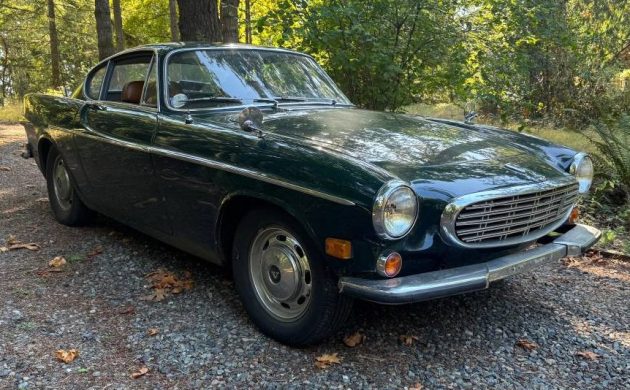
Volvo built its reputation on solid cars that emphasized safety and refinement. However, it entered the Sports Car world in 1961 with the P1800. It remained on sale until 1973 in various forms, with our featured 1800S rolling off the line in 1969. It’s been part of the same family since Day One, and aside from a repaint, it is a genuine survivor. Barn Finder Curvette deserves credit for spotting this sporty Swede listed here on Craigslist in Olympia, Washington, for $25,000.
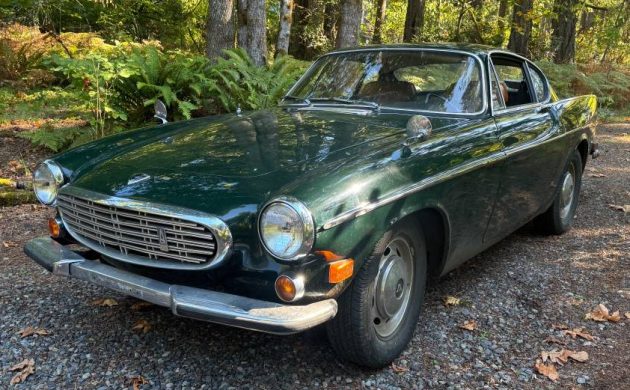
Volvo began developing the P1800 in 1957, with Pelle Petterson at Carrozzeria Frua penning the body. Volvo acknowledged it lacked the expertise to produce a Sports Car, so it contracted Jensen Motors in West Bromwich, England, to build its new offering. Jensen subcontracted Pressed Steel to construct the body shells using unibody construction, and the first completed cars left the line in 1961. Sadly, Jensen’s quality control lacked the two things that Volvo required above all else: quality and control. With the company’s reputation suffering as a result, Volvo brought production in-house to its Swedish facilities in 1963. This change also prompted a model designation change, with the new 1800S badges signifying that the cars were genuinely Swedish. Our featured car rolled off the line in 1969 and has been part of the same family since it left the showroom. The seller says that it received a professional repaint in its original Code 94 Dark Green Metallic, but not when this happened. They describe the quality as above average, and the car does present nicely. The paint holds a healthy shine, and the panels are straight. The seller provides a couple of underside shots, which seem to confirm its rust-free status. The weak point with the 1800S is the front end of the rockers, which are triple-skinned. These typically require careful inspection, but if they are okay, this 1800S should be a winner. The photos are slightly inconclusive, making it unclear whether the bumpers need polishing or would be better sent to the platers. However, given the exterior condition, I suspect the former.
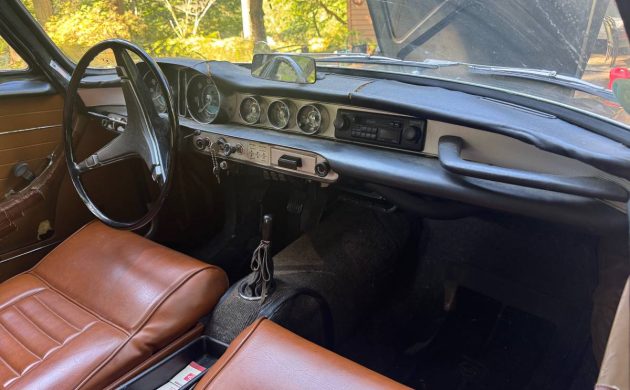
Apart from the rockers, the other acknowledged 1800S weakness is the interior trim. It doesn’t handle long-term UV exposure well and can deteriorate easily. This Volvo hasn’t avoided that fate, although the front seats wear new covers. However, the upper dashpad and door-trim center panels both need replacement, and the new owner will probably also install a new rear seat cover to keep the interior consistent. Sadly, this won’t be cheap, with replacement dashpads typically selling for around $675. The center door panels retail for $190 per pair, and a back seat cover will lighten the wallet by around $225. If the new owner wanted to go all in, they could spend $550 on a carpet set to elevate the look.
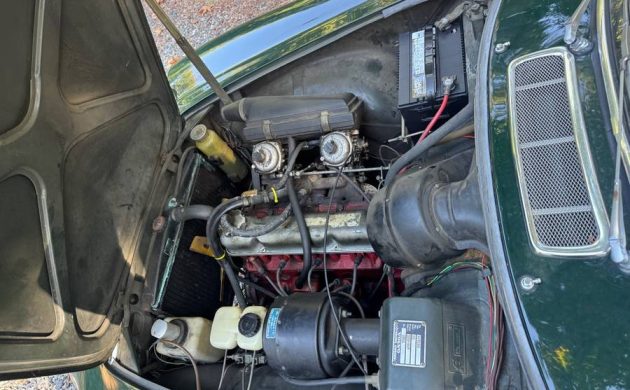
This Volvo’s true strength lies beneath the hood. Initially released with a 1.8-liter “B18” four-cylinder powerplant, the company updated this model year to the larger 2.0-liter B20B. Although its compression was lower than the motor it replaced, the 2.0-liter inhaled through a pair of Zenith-Stromberg carburetors to deliver 118hp. Power reaches the rear wheels through a four-speed manual transmission, and I believe this car also features the optional overdrive for improved open-road cruising. The seller says this 1800S has a genuine 91,000 miles on the odometer, supported by the comprehensive Service Records. It needs a new exhaust, but is in good mechanical condition. It runs and drives nicely, with no mechanical issues.
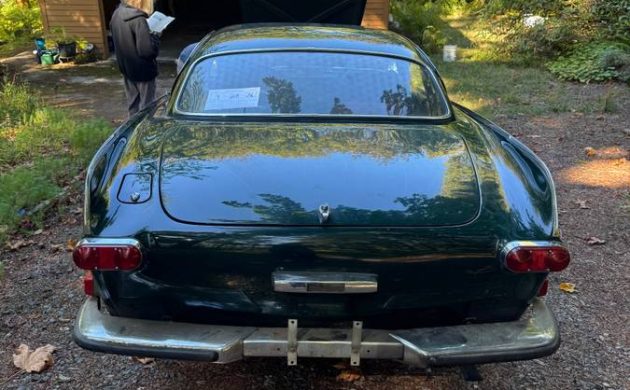
When Volvo ended production of the 1800 model range in 1973, it seemed its days of building performance-focused models were over. However, it later released cars like the 850 R, proving its sporting aspirations never really died. This 1969 Volvo 1800S is a sweet survivor needing little to present exceptionally well. The odometer reading is well below what you might expect, and the bulletproof drivetrain components should let it prowl our streets for many years. The longevity of the 1800S is confirmed by the Guinness Book of World Records, with a 1966 example confirmed as the record holder for the most miles covered by a privately owned passenger car, having traveled over three million miles. The reliability of these cars makes this Volvo worth a closer look.

As the years drift by, correspondence with old friends gets less and less, even though it’s easier than ever these here days. In the late 70s/80s, when I had my MGB, I had/have a good friend that had, and still has, a car just like this, only a 1970. Same green, but fuel injection, and I believe the O/D was standard on 1800s. I never saw one without it. It was also one of the 1st F.I. motors. I wasn’t overly impressed, my simple old SUs did just fine. These are some of my favorite cars, even though, they aren’t particularly fast, or handle all that well, but comfortable, reliable cruising are its best attributes. It’s no surprise at all, the late Irv Gordon put an astonishing 3 million+ miles on one.
I recently wondered what happened to “Alex”, and wrote an old email, and was surprised he got back to me, and still has the Volvo! Fantastic cars, and nothing, and I mean nothing today can compare to an 1800.
1969 was the lowest production year for the 1800, with less than 1700 units built. They aren’t really sports cars, but the design sure turns heads.
Once, when I was in my ’69 1800S, sitting at a traffic light, a baby in a stroller with a pacifier in his mouth saw the car and pointed at it!
Volvo car design seemed to be behind the times for a lot of models. For example, I think by ’69, tail fins for the most part had fallen out of favor with other cars. That’s one thing I like about Volvos.
The only way to get a good 1800 is getting it from the northwest because the body rusts from the inside out.
The one year Strombergs can be challenging compared to the SUs. They were an emissions holdover before the coming FI.
Thanks for the good writeup Adam!
I don’t think this color was (or is) metallic? It looks like this could well be a good example but it feels like $25k is a stretch. Isn’t that pretty close to the top end of the market, and this one surely has needs even if the bones would be good.
“However, it later released cars like the 850 R, proving its sporting aspirations never really died.”This maybe a correct statement. BUT the quality sure died with the front wheel drive cars. Being a Volvo service manager when the 850s came out. It made quite a few mortgage payments for me. The quality was so bad that Volvo started making warranty payments in 100ths of an hour instead of the usual (industry standard) 10s of an hour. Trying to shave every penny off the warranty expenditures. I don’t believe that they had ever experienced the onslaught of warranty claims that the 850 cars (and later front wheel drive cars) caused. And I firmly believe that those cars spelled the beginning of the end for Volvo. Yes, I know, that they are still around. But not in any numbers to talk about. We had very staunch Volvo customers, but after an experience of an 850 car. They hurriedly left the Volvo fold.
Not really a “sports car”, because the power and handling, while adequate, are not quite up to that description. It is more of a “sporty” GT. However, the good mechanical reliability and nice looks put it in a league of its own…and let’s not forget the Simon Templar connection… For the asking price I would expect something with no needs…but no one is saying that an offer can’t be made. Good luck to the seller and buyer.
It wasn’t a lack of expertise, it was a lack of production facility. 1800 was a unibody. Nothing new to Volvo and most mechanical parts were already in production used on Amazons.
Before 850R, 142E had the B20E and some of them won scca ITB championships.
242 turbos won British touring car races long before 850s. 740 turbo wagon won some in IMSA Firehawk.
Howard. 1970 1800E B20E with efi and 10.5 cr had 135 hp…no 4cyl MGB made 100.
DRV switch from SU to Stromberg was due to SU going on strike.
BEYFON. Correct, not Metallic and a bit high but they’re going up.
I don’t think Volvo had a lack of expertise to build the 1800 in house. Their production capacity was building trucks, tractors, military, heavy equipment(?) And PV544s, 210s and Amazons. The 1800 is essentially an Amazon in a different body.
I dont know if Jensen or Volvo contracted with pressed steel but the bodies continued to be made by pressed steel for years after jensen assembly.
Proor to the 850R:
142E had the high compression B20E and won scca ITB championships
242 turbos won British touring car championships
A 740 turbo wagon (i think…memory) won some IMSA Firehawk races.
Stock versions of those had acceptable or impressive performance for their time.
Am i censored here?
I posted a comment yesterday and it’s not here.
I reposted again this morning. I believe I did all steps because I did edit it and clicked save.
Everything else is a higher priority than writing again.