

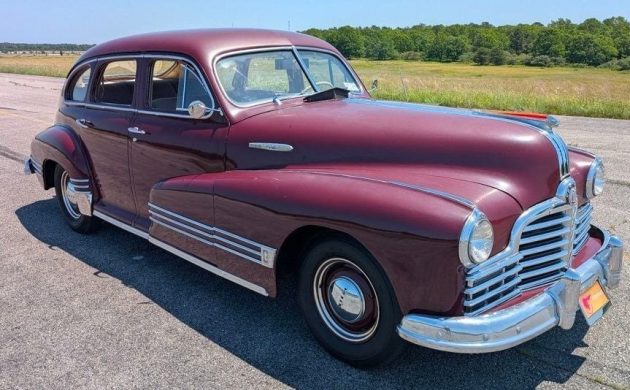
The Streamliner was a mid-level car built and sold by Pontiac beginning in the 1930s and through 1952, with a break during World War II. When production resumed after the war, there were few changes in the 1946 models. Six and eight-cylinder versions were offered, with the seller’s car having the former. It appears to be remarkably original after 80 years and has collected its share of vintage awards. From Manorville, New York, this old soldier is available via an online dealer here on eBay for $12,900 or about $3.40 per pound.
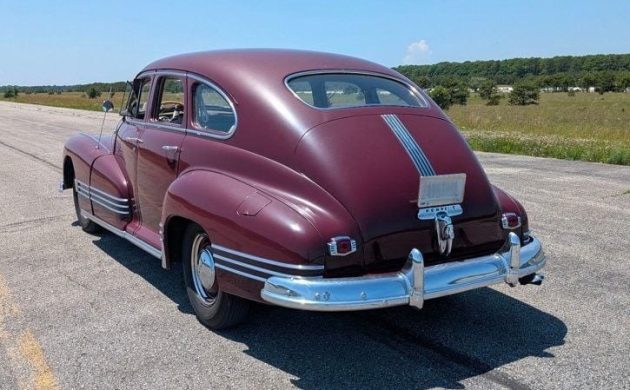
Pontiac sold a lot of the Streamliners after WW2, but it was hard not to with demand having been pent-up for four years. Lower-level models like this one came with a 239 cubic inch “flathead” I-6 with a 3-speed synchromesh manual transmission being the only choice at the time. The cars were noted for their fastback styling, which included 4-door sedans like this one. Colors other than black had become popular, and this car sports a burgundy paint job.
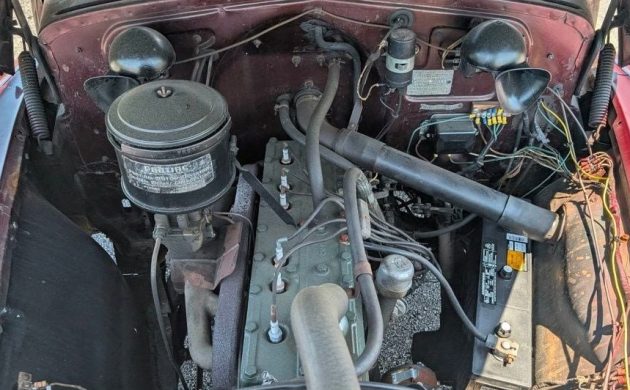
The motor is original to this Pontiac, and we’re told the car has accumulated 108,000 miles, normally when a rebuild would be due. Yet it runs like a top, so the car’s mechanical health should be good. We’re not sure if the finish is original, but the interior, with the headliner, shows signs of age. These cars used bone in the steering wheel, door handles, and elsewhere. Even the hood ornament lights up (cool!).
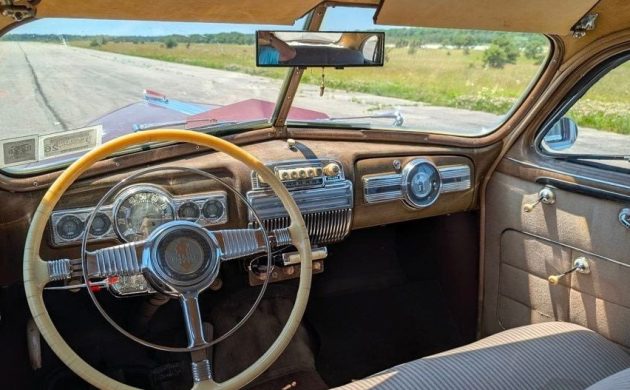
If you’re looking for a time capsule piece, this Poncho seems to fit the bill perfectly. Besides several awards, the automobile has also been featured in Newsday. Everything on the car is said to work properly, including the heater (which was a big deal in the 1940s). We’re told the Pontiac doesn’t experience the Winter months, so it can be driven smoothly in warmer weather. If you’re looking for turnkey, could this Pontiac do the trick? Thanks for the tip, T.J.!

Great article Mr. Russ Dixon! Great find T.J.! A beautiful car! I hope whoever buys it will drive it for all to enjoy! I wonder how many readers drove 1940s cars in the 1950s and 1960s?
I’m surprised this has chrome bumpers, as I read in 1946, many cars were shipped with what was called “Victory Trim”, or wooden bumpers until supply returned. I apologize for being the “wet blanket” here, but THREE(3) viewers? For this wonderful car? Yep, I think the price is okay, but the manual transmission is the deal breaker for any future sales, you’ll see.
Mike, my Mom had the 2-door version of this car when I was very young. My grandparents bought it for her after she divorced my biological father in
’58. Even though I was maybe 6
years old at the time, I still remember that car. It was a dark
blue with a silver gray roof and
trunk. It also had a fair amount of options such as fog lights, a
spotlight, a radio 📻, a heater, and accessory bumper guards with those wing tips on the ends.
I can recall being driven to a day
care center along with my sister
before Mom went to her job at the Eureka Company where she
made and installed fuses for nuclear weapons from the early
’60s til her retirement in 1982. Our house sat on a hill and sometimes Mom had to roll the car down that hill to start it when the battery was dead during the
winter. Aside from battery issues, the car was very reliable
and never left us stranded. She
traded it in mid 1961 for a ’53 Nash Statesman sedan. Pretty
cool but loaded with problems.
Even today, I can still recall the smells, the sounds, and the feel
of that old Pontiac as we went
wherever we needed to go. Cars
like this one always showed up
and were always very reliable. Too bad they can’t build ’em that way today.
Thank you for sharing your great memories Mr. Ken Carney!
That may have been so Howard.
My stepdad would tell me stories
of what the car scene was like after VJ Day. And yes, he did say
that GM cars built in September of ’45 did indeed have the bumpers you mentioned. Once the lines got rolling again, they went to a painted metal bumper
til early ’46 or thereabouts. Both
the grille, the bumpers, and the
headlight rings were painted silver to simulate all the chrome that Americans craved back then.
Dad said that he saw a lot of these cars with painted trim when he was 15 years old or so.
Early ’46 models were put together by hand and with whatever parts there were available to them. And other than the fastback that I just talked about, I did see one of these in 1968. It was a very early
model with painted trim on it. Even the speed lines were painted or stamped into the fenders. Pretty cool for what it was, and sadly not for sale. The
old guy that that owned it said that he was gonna keep it just in
case we had another great depression. I didn’t really understand his reasoning until I
survived two recessions and the
crash of ’08. Funny thing was that even though he wasn’t driving that car, it was kept in running shape and could be called on when the bottom really
did fall out.
This beauty just needs a little TLC; maybe a clay bar and a buff for the paint? The seller can ask the `69 Olds 98 seller for his whitewalls!
Glad to see people are still interested in restoring old four door sedans. I would go softly with that paint clay bar but if it makes the car shine go for it.
Wow. Am I in awe or what? I’m a real stickler for originality, and this car is way beyond merely impressive. Even the driver’s side of the seat looks good. One of the many things that I love about old cars like this is the smell of the interior. My 1950 Pontiac Streamliner had the upholstery and door panels redone (in a non-original style), but it retains its’ yellowed headliner, and that gives the car the smell I like. I think the price for this car is very reasonable, and I hope it goes to someone who will respect it for the amazing piece of rolling history that it is.
Yep, the smell. At a car show, I stuck my head inside an original, pre-war Chevy. The owner had it displayed with a soldier’s cap in the driver’s seat and a stack of mail beside it carefully tied together with pink ribbon. Letters from back home. He’d also put a little, portable CD player out of the way on the floor of the back seat that was quietly playing big band music. With that music, the vintage momentos, and the smell…. It was as close to time travel as I have come.
Keep it as is. Maintain it. Garage it. Learn how to shift three-on-the-tree if you don’t know. (Funny. We all knew how back then.) Drive it in decent weather. Give it the respect it deserves. Maybe you’ll understand your grandparents better.
I was just 9 years old when I washed my neighbors Pontiac, very similar to this car, 4 door, same color. I believe it had chrome bumpers, etc. His daughter-in-law paid me in cash, $1.00. I got a chance to move it into his garage. Those were the days, I would have done the job free just to move the car.
looks like my first car except mine was black and a 1948 grill was a little different it had a flathead straight 8 and was a automatic no park just neutral drive low and reverse it was a tank bought it for $25 sold it for $10 it was running and bought a 1950 ford 2dr v8 stick for $50 times have changed
Molly, I agree with you on all counts. Yeah, I’ll have to teach my SIL and neice how to drive a 3 on the tree 🌲 but I know I can teach them if they wanna learn. If I can teach my wife to drive a 4-speed, it shouldn’t be that much
trouble to teach the girls. And now, are you ready for this? I taught my wife from the passenger seat of a ’71 Vega wagon while being legally blind!
I taught her to listen to the engine
as it revved and to make gear changes when the engine was at
the top of the revving cycle. It’s
like driving a semi. You listen to
the engine, watch the tach, and
shift accordingly. Nothin’ to it! Used to watch Mom and Dad do it all the time and they made it look so damned easy too! And it’s a great theft deterrent today as many teen age drivers don’t
even know what a manual shift is
today. I know my kids at my store 🏪 don’t. When I tell them
about it, they give me that WTF look and ask me how it works!
Russ, Thank you for another great write up.. This is an excellent turnkey either entry into, or expansion of their collection, into the classic car hobby. A little TLC and the buyer can cruise the back roads to shows in very enjoyable comfort.
Some confusion in the article. Starts out saying this is a mid level Then goes on to say “lower level” The truth is Pontiac had two lines, the Torpedo and the Streamliner. The Torpedo would be the lower level, while the Streamliner is the top level. On both series the eight cylinder was an option. So this particular Pontiac is a top level model, with out the eight cylinder option. Just to clarify, the Torpedo line is a smaller car, the Streamliner a larger car.
Back “in the day” (around 1952, 1953, or so), nearly every Pontiac of this type that you saw, was a 1948, secondly a ’47, quite less frequently a 1946 or 1942. But in more recent years, I encounter far more ’46s than ’48s, for some reason. I liked the squared tail-lamps in ’46: the round ones just didn’t “cut” it with me. I’d love to own a 1946 Pontiac — but just too impractical now for daily transportation. But they have a handsome beauty all their own, especially with four doors! — and in this example, with the clock and the radio! The only drawback, here, is that this one has the six and not the eight.”Oh well… can’t have EVERYthing…
i hear those straight 8s are very quiet when they are running but i have never heard 1 personally. that hood ornament is i think the best part and still lights up. Looks good in the pics.