

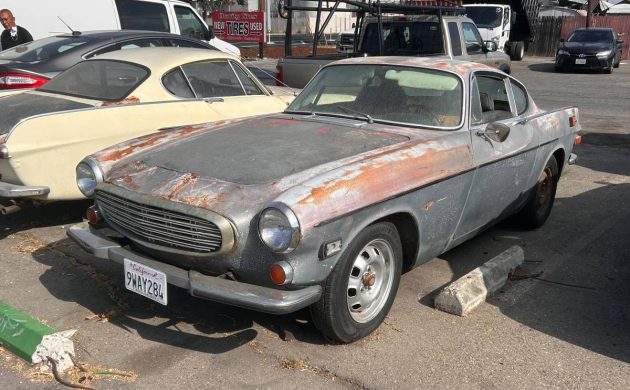
What you see is what you get with this project 1971 Volvo 1800E. It’s listed for sale here on Craigslist and is located in Santa Clara, California. The seller has included enough pictures to give you a good idea of the condition of the Swedish sports car and has priced it fairly reasonably at $3,500. I really like the lines of this unusual sports car and have considered purchasing several over the years. Read on to learn more about this particular car.
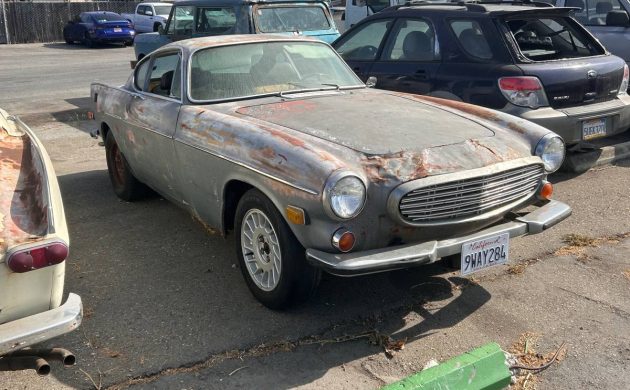
The seller states that the car isn’t very rusty except for the lower right front. From this angle, we can see that the bottom of the right front fender is pretty bad; it looks like it isn’t even attached at the very bottom. The entire area between the grille and the hood needs a *lot* of body work. However, it’s encouraging to see the other 1800 next to this one, coupled with the seller’s statement that “It’s mostly complete. The missing parts in the pics I should have.” Perhaps the seller is an 1800 expert!
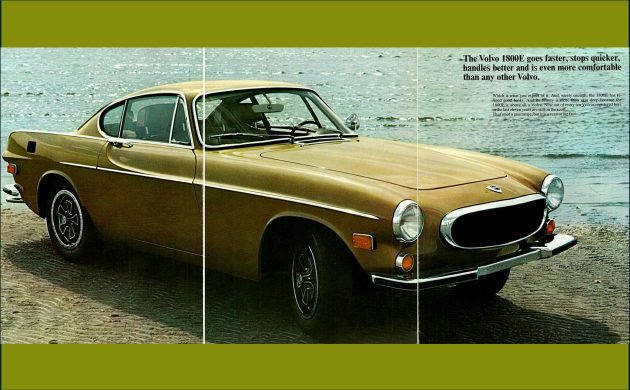
Volvo thought pretty highly of the 1800E, stating in the 1971 factory brochure that it went faster, stopped quicker, handled better, and was more comfortable than any other Volvo. The “E” in the car’s nomenclature is pretty important. Volvo introduced the 1800 (then called P1800) in 1961, and improved its specification throughout the model’s life. The year before this car was produced, Volvo beat many other car manufacturers to the punch by ditching carburetors and switching to Bosch D-Jetronic electronic fuel injection. The ‘E’ in the model name stands for Einspritzung, the German word for fuel injection. The 1800E also received high marks from period reviewers for great seats, a generally solid feel, and differentiating styling. The fuel injection boosted horsepower to 130, and since the engine in this car is said to have been rebuilt, hopefully all those ponies are there!
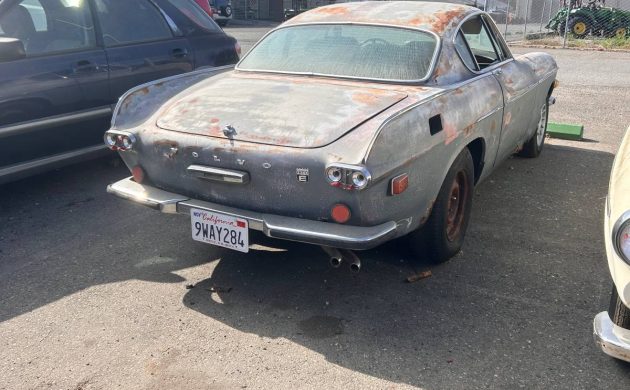
While there is some crustiness evident in the rear quarters as well, honestly, it’s not too bad. And I found a complete new front fender available here for over $1,300–but there’s an appropriate patch panel for less than $175 here. VP Autoparts USA seems to have pretty much anything you’d need to complete the cosmetics challenges.
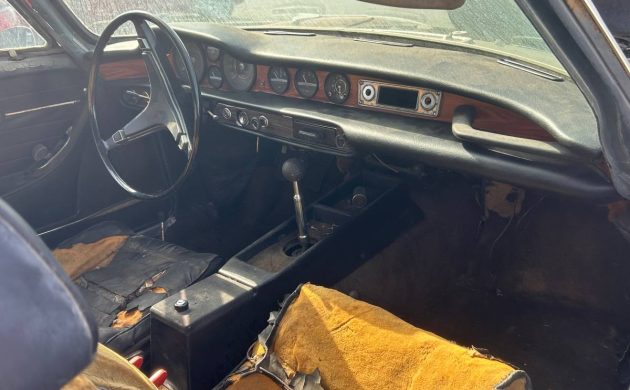
It’s hard to believe that the dash appears uncracked considering the horrible state of the seats! The interior of an 1800E is a nice place to spend some time when everything is in nice shape. Again, everything seems to be available to return this car to immaculate condition. Or you could throw a set of auto parts store seat covers on and enjoy it as-is. The car is equipped with the optional electrically-actuated Laycock overdrive that I know so well from Triumphs; it’s a real nice thing to have, especially on the highway.
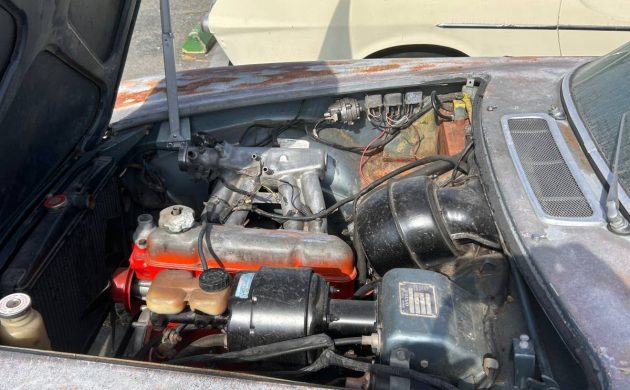
Speaking of mechanical components, that seems to be the high spot of this particular car. Since the engine has been rebuilt and the car is titled and registered, I wonder what it would take to make it roadworthy? Aside from the air cleaner, a cursory look at this picture makes me think that if the car is as complete as it seems, this might really be a good buy for the right Volvo enthusiast! Is it you? Let us know about your 1800 experiences in the comments!

Growing up, our neighbor had a black ’65. He retired it in ’73 for a Datsun 610 (if you can figure that one why). The Volvo went in the barn (concrete floors) and just sat there. We tried to buy it around ’82, he wouldn’t sell. The poor thing was already starting to deteriorate. In the meantime, he parked the Datsun, & bought an LTD wagon so they could haul their dogs around. Upon his passing in ’89, we offered to take it off his wife’s hands. She refused to sell to us. By now, it was really starting to biodegrade, even in a closed garage, so we gave up. She passed around ’94, and a customer of mine scoped out the estate, wanting the houses for rentals. By now, the poor thing was chassis on the ground, beyond salvage. The mice and squirrels didn’t help any. Believe it or not, the Datsun was even worse. Shame that had to happen to that poor little car, just because, for some unknown reason they didn’t like us. Point of the story: The poor thing went back to nature over 20 years in a closed garage. We learned these cars (beautiful as they are) can disintegrate, even in a closed environment. Please be careful what you might be buying.
Wanna know the reason why folks put a layer of linoleum (or vinyl flooring) under cars stored on concrete floors?
Had a ’70 as a DD back in the early ’80’s. Red/Black with A/C that worked! Excellent cruiser and even though it had been rolled at some point and was full of bondo I thought it a fine ride and in Tulsa OK never saw myself on the road. As Jamie mentioned the O/D makes all the difference at highway speeds. I got a thicker head gasket (my choice of four, from 91 to 75 octane fuel!) at the local Volvo store so it would run regular, leaded premium being hard to locate by that time. Everything was great until the brain of the D-Jetronic started fritzing. Traded for a new piano to a guy who told me he disassembled the FI box and floated some solder over the connections. Reliable as rain after that. Who knew?
I owned four Volvos, a 122S wagon, 142, 144 and 145 cars and wagon, the third number designating the number of doors (5 for the wagon). All good cars with SU and Stromberg dual carbs. No problem with the carbs, though I liked the SU’s best. A friend had an early fuel injected Volvo with the mentioned problems, however.
I owned four Volvos, a 122S wagon, 142, 144 and 145 cars and wagon, the third number designating the number of doors (5 for the wagon). All good cars with SU and Stromberg dual carbs. No problem with the carbs, though I liked the SU’s best. A friend had an early fuel injected Volvo with the mentioned problems, however. This car is best for parts.
The 1971 Volvos that had the B20 E engine came with a high compression motor of 10.5:1. I believe that was a one year offering with the next years model detuned to 8.7:1 for emissions reasons. To this day my favorite car was the
‘71 142E I owned. A love lost to a telephone pole.