
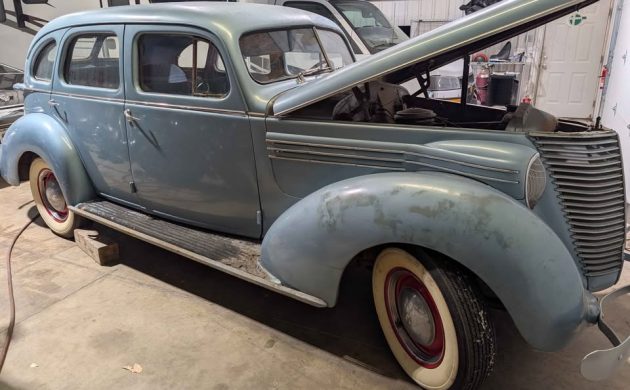
A Hupmobile, eh? How often do we review one of those on these august webpages? Not often, and never a 1938 Model Six, four-door sedan such as today’s discovery, courtesy of Zappenduster. Hupmobile was another one of many domestic auto marques that got their start in the early twentieth century and were ultimately unable to hold their own among the onslaught of bigger and stronger automotive competition. Located in New Palestine, Indiana, this stylish sedan is available here on Facebook Marketplace for $7,500.
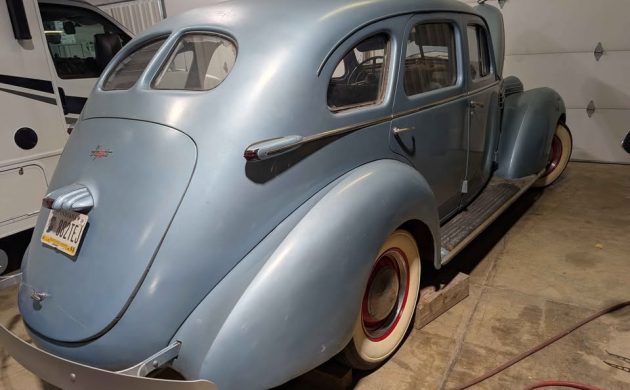
“Hupp has always built a good car,” was Hupmobile’s 1938 slogan (note that it proclaims “good,” not “great”). Anyway, Hupp Motor Car Company was started in 1909 by Robert Hupp and continued production into model year 1940. The company had a successful marketing strategy to take on entry-level competitive models, but decided to move upstream in the early thirties. However, the plan didn’t pan out – the sales for a more upscale variety just weren’t there, likely affected by the Great Depression. By 1938, Hupmobile offered six-cylinder models (our subject car) in Standard, Deluxe, and Custom trims, as well as an eight-cylinder Custom model. Total Six production reached only 637 units in ’38, while the Eight series put up a paltry count of only 197 copies. Our subject appears to be sound; there is some paint fade and discoloration, but no obvious crash damage or rot. The prominent grille, a hallmark of cars from this era and often on the receiving end of parking errors, looks fine – no missing teeth. The seller adds, “Extremely solid car all the way around, all 1938 metal. The driver’s vent window, I do have the original replacement complete. Have original bumpers; have a spare rear vent window.”
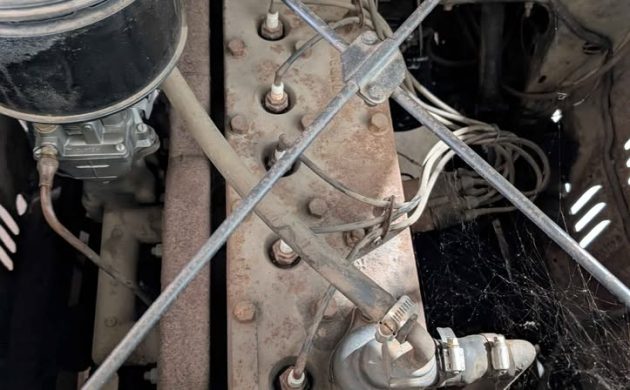
That “Ran Flawlessly When Parked” claim references a 101 HP, 245 CI, in-line six-cylinder flathead engine, engaged to a three-speed manual transmission. The seller also mentions, “Carb has been redone, new starter, have a brand new battery, not installed.”
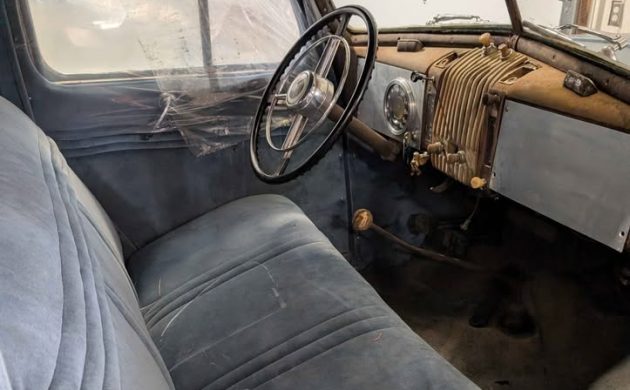
The interior, not referenced in the listing, looks like a velour redo. While it’s probably the wrong material, it is wearing the correct pattern. Other than the dash, the entire environment is in decent condition, and even the headliner is not gravity-bound. Back to the dash, it appears that homemade aluminum panels have been fabricated to replace whatever was in place before – the passenger side piece doesn’t look as if it’s attached. What we call a center-stack today resembles a wooden handmade attempt – something’s not right about it.
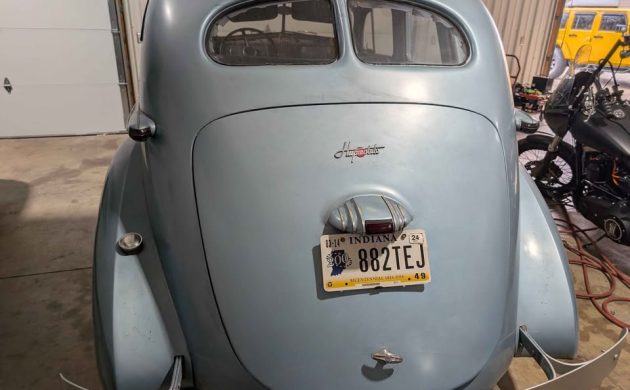
The seller gives us no indication as to how long this Hupmobile has been sitting, and knowing that detail would help gauge the engine’s running potential. Regardless, this is an unusual find. Despite the market for these prewar cars, which we have discussed many times before here on BF, this sedan’s rarity, its fallen flag status, and overall condition provide some marketability. Who do you think a likely buyer for this Hupmobile Six might be?



I like the high mounted brake lights. Thats a nice unique touch. I remember my father talking about Huppmobiles when I was a young kid. I’m thinking they were a fairly well made car. This one looks like a solid car with good bones to work with. Which is important when you’re restoring something as rare as this. I’m not sure how hard it would be to find parts. But it’s a beautiful find Zappenduster and great ( not good) write up Jim.
Thank you!
JO
Wow, that dash treatment certainly leaves a lot to be desired. But in these days of modern times, you gotta take the bad with the terrible.
Yes, the dash is a project unto its own. On the other hand, seeing the condition and apparent completeness of exterior ornamentation is encouraging indeed!
I just got a chuckle about “these days of modern times” as though we were talking about a 2025 car whose dash is an LCD screen with a picture of analog gauge faces on it. That and replacement dashboard trim for a ’38 Hupmobile has probably been NLA since before Pearl Harbor.
I’m a big fan of pre-war cars and would give $7500 if I were looking.
My mother always talked about my grandfather having a Hupmobile. 1920’s I would imagine, as their lives were upended in the 30’s like many others. This one was looking good until I saw the dashboard. With only a little over 800 made for the 1938 model year, where would you find parts. I guess by then the writing was on the wall. Then they bought the Cord stamping dies and teamed up with Graham to make rear drive Cords. Even though customers wanted Hupmobile Skylarks and Graham Hollywoods, too many problems with the tooling left customers waiting and put both companies out of the car business.
The center part of the dashboard looks just out of position. The sheet metal parts stuck on there were sheet metal on the original. Interior photos of restored ones show they were painted metal. The glove box features a generic looking lock, and a clock of the same diameter and style as the speedometer. The rest of the dash is metal painted to look like wood, a common feature of cars of the era. People who remember these cars are mostly dead, and my brief check of prices on Bring a Trailer and Hemmings show Hupps of earlier vintage go in the mid 20s to 30s. There was only one for sale of this type which was a restomod. If you HAVE to have a Hupp of this vintage this is about the best you’re going to get. Or, join the Hupmobile club and scan the obituaries.
Wonderful to see such a rare orphan not only still around, but in such great original condition. Definitely a worthwhile project, and there’s a Hupmobile Club to help locate any needed parts 👍
Loved the fallen flag description in Jim’s write up. I’m sure that there are Hupmobile aficionados who can get this old piece of automotive history back on the road.I hope someone does. I think with a little tinkering one can get the dashboard looking a bit more finished. There is still a lot of information out there about applying the wood grain finish and I think that with the right products and applicators it would be possible to achieve a driver grade result here. GLWTS.
The dashboard parts could be 3D printed – who knows how much that would cost – but maybe you could sell a couple of copies to the Hupmobile Club to cover some of the costs.
In the January issue of Hemmings there is only ONE Hupmobile offered: a 1926 E1 sedan for $9500. These are like hen’s teeth. This is a restored unit. A set of hubcaps for a 33 are available for $675. This gives one an idea the scarcity vs value. Still a very nice example! I sincerely hope it finds a good home!
Forty years in business, AND through the great depression is no small feat. Unfortunately, the big three do have a talent for “rubbing out” the competition.
This is a nice looking car for the late 30s, of which I know nothing about, except, those high mounted lights and the end of the chrome spear, are the running lights, Driveinstile. The single brake light is above the license plate.
I used to play in a 1938 Pontiac my father had in one of the barns. Big roomy rear seats in these old cars. I wonder what Hupmobile would look like today had it survived?
Wow!! I did NOT see that until you pointed it out Angel. Now I see the center brake light. I really thought those were the brake lights but even as running lights, I like the location of them. Thank you for telling me that.
You’re welcome. I like that the lights are up high and part of the side spear.
Most, if not all 30s and 40s cars had one center mounted brake light usually in the middle of the trunk.
After that they moved the brake lights to both left and right side integrated into the running lights and the center brake light disappeared until the 1995 Cadillac, 1996 on all other cars as a third brake light.
I won’t ask how you know about the back seat roominess. At least it was probably better than a Corvair’s. Hupmobile were one of the 20 or so independent manufacturers that were around on Black Friday 1929 but were out of the car business by 12/7/41. However, IIRC the corporation survived and got into the stadium business.
Really good-looking car! Out here in California, we call those running lights “taillights” – is it safe to assume they include turn signals? Anyway, these must be the coolest ones around back in 1938. Did any car have the brake lights incorporated with the taillights back then?
@GitterDunn
No, brake lights were not incorporated into the taillights back then. Hence, the single brake light in the center of the trunk.
Turn signals were not introduced until 1939 when Buick put them on some of their cars, but we’re not widely used until the early 1950s. You can find some cars from the 1940s with turn signals but those were options back then, not standard equipment.
She is just a,classy old gal looking for some love. Unfortunately, showing up at a cars and coffee with one of these would garner some interest. But no respect. “Just another old car”. I never knew the history of Hup, and didn’t know the Cord/Graham connection. Even if properly restored, you can’t use it as a,daily driver as parts are too rare. It would be destined to be a trailer/garage queen. The “old gal” is in decent shape for a restoration. But who will desire to do it?
The reference to a Hupmobile that I remember was in the movie “Some like it hot” where Tony Curtis cons a woman into letting him use her Hupmobile but instead they witnessed the st. Valentine’s Day massacre.
Okay, that’s it.
GOD BLESS AMERICA
I just bought this car. The engine does run very quietly, feeding the carb. Haven’t tried the tank yet. New brake lines but the back wheels are stuck. Will try to keep it original as possible.