
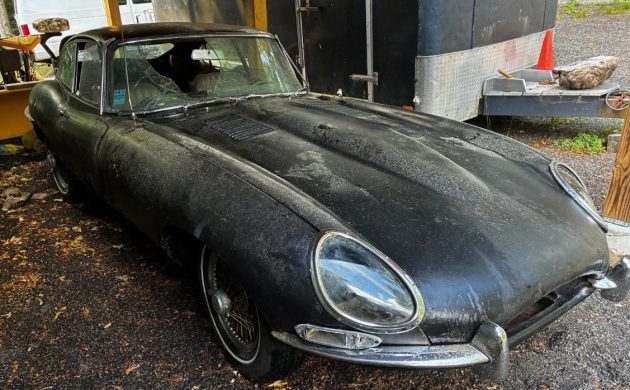
Taste is purely subjective, but I have always considered the Jaguar E-Type to be the most beautiful passenger car ever built. Many believe the E-Type to be designer Malcolm Sayer’s master work, although he also turned his attention to the D-Type and the XJ13 racing prototype. Given my passion for these classics, you can imagine how distressing I find the sight of this 1965 E-Type Fixed Head Coupe. It is unclear how long it has occupied this spot, but the seller candidly admits that it requires a total restoration to return to its former glory. It isn’t a cheap project candidate, but with spotless late Series 1 cars consistently commanding six-figure prices, it could be worth the effort. The seller has listed the E-Type here on eBay in Hanover, Massachusetts. They set their BIN at $22,500 wth the option to make an offer.
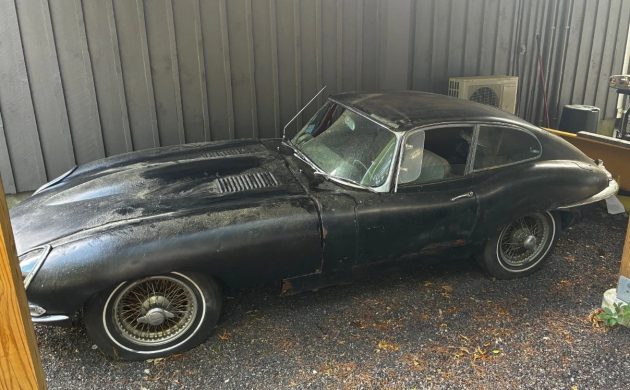
It is worth noting that while Malcolm Sayer penned the beautiful lines of the E-Type, he never considered himself to be a designer. He viewed himself as an aerodynamacist, believing that it was possible to successfully incorporate aesthetics and aerodynamic efficiency into vehicle design. The E-Type demonstrated this, featuring sweeping lines and a body that cuts cleanly through the air to deliver a top speed of 150mph. Okay, time for a Pop Quiz. What do British Racing Green and Black have in common? Both were the only shades that remained available to buyers throughout the E-Type’s production life. This Black beauty would have been stunning in its prime, but time has taken a toll. The paint is tired, the windshield is smashed, and there is evidence of rust that doesn’t bode well. It is visible in the rockers and doors, while the floors are an unknown quantity. Interestingly, the hatch opening and rear valance, both known trouble spots, appear to be sound. However, anyone considering tackling this build must accept that a nut-and-bolt approach is the only option. That process will include sending every bright trim piece to the platers, replacing every seal and rubber component, and reconditioning the beautiful wire wheels.
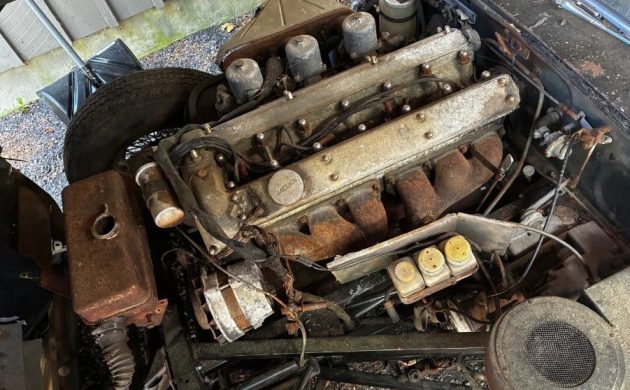
The biggest change introduced by Jaguar for the 1965 model year was a capacity increase for the DOHC six that resided under the sweeping hood. It rose from 3.8-liters to 4.2-liters, and while the power remained at 265hp, torque climbed dramatically from 240 to 283 ft/lbs. The other upgrade performed by Jaguar surrounded the four-speed manual transmission, which gained synchromesh on first gear to be more user-friendly. The seller states that this E-Type is numbers-matching, a fact verified by the included Jaguar Heritage Certificate. They say that it rolls and steers, but doesn’t currently run. It is unclear when the E-Type last fired a shot in anger, but factoring a mechanical rebuild into the project budget would be wise.
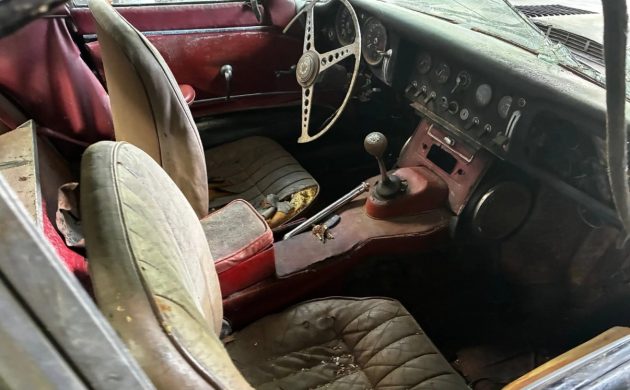
The dash was one of the defining interior features of the Series 1 E-Type. Buyers received traditional toggle switches that have an inherently “correct” feel in British sports cars, with the company eliminating these in favor of rocker switches in what became known as the Series 1½ cars that emerged during 1967 and early 1968. The first owner ordered this Coupe with its interior trimmed in Red, but, as with the exterior, time hasn’t treated it well. The radio is gone, the wheel is broken, and I can’t spot a single soft trim piece that is salvageable. Therefore, the new owner faces the significant cost of a complete interior restoration to recapture the former glory. Trim kits typically cost over $5,000 before the builder even considers replacements for the wheel and radio.
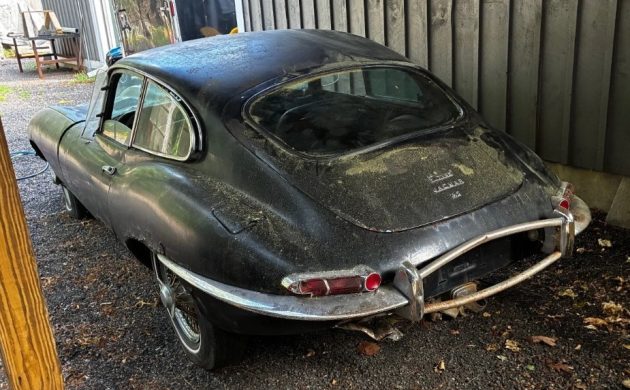
There is no denying that $22,500 is a lot of money for a project candidate. This is especially true when the vehicle in question is an unknown quantity, sending mixed signals. Such is the case with this 1965 Jaguar E-Type Fixed Head Coupe. Prone areas like the hatch opening and rear valance look sound, but there is visible rust developing in the rockers and at least one of the doors. That makes me wonder what might be hidden below the surface, and how much cutting and welding is required to return the body to a pristine state. It is worth noting that Series 1 cars powered by the 4.2-liter engine are among the most desirable vehicles produced, so a value well beyond $100,000 could be within reach if the build is of a high standard. It is also possible that with values climbing, straying slightly over budget may not be a problem, with the ability to recoup the additional cost in the future a realistic expectation. Are those thoughts enough to tempt you, or do you potentially see a world of heartache with this Jag?



Always nice to start with the bile to the tip of my tongue. I must apologize to our British cousins, this has got to make them wretch too. I mean, this wasn’t a AMC Hornet or a Sapporo for heavens sake, how could anyone allow this to happen. Even the most inept had to know what this is or was. Same old thing, I’ve noticed, prices for E-types seems to have leveled off, even fallen, while I’m sure parts have skyrocketed, be under water with just the delivery. I don’t know if these, while the epitome to us, will have a future. Not when a 454 Chevelle is available. I don’t know what Jag parts cars go for, but 5 figures seems awful out of line for one. Old Malcom not happy here, I bet.
Same-year roadster project cars are selling between $28k for a complete rat to $50k. For a coupe, where finished-car prices can now rival roadster prices if they are very nice, this is a reasonable ask. That says nothing about how wide you must open your wallet to get this done or whether you even want to be that far underwater. Some people don’t mind being upside down to finish the car they’ve always loved the way they want. There are plenty of expensive finished cars out there where short cuts were employed – some owners don’t want to take a chance of ending up with one of those.
Well put, Michelle. There may be room to be above “break even” on this at less than $25k, depending on what the underside reveals.
You know Michelle. You just brought things into a much different and in a way better light. Many people, including myself have said to buy the best example you can afford. But, how many of those ” best examples” were done correctly? How many times have we read right on here about individuals purchasing restored cars only to find some very shoddy workmanship. If this is your dream car, and you have the budget, restoring your own, or at least watching over the process is a good way to go. If its your dream car, your not buying it for an investment. Your buying it because its what you want, you’re not going to be selling it anyway. And you know its all done right.
Sheesh… That was long. Sorry.
There is no way to break even on this ine unless you get it for free and do work yourself. With all the visible rust on engine components, will guaranty it has rust in the birdcage. Everything will have to be disassembled, rust removed, in many places replated with nickel or chromate. This is a multi-year job. One of the members of the Carolia Jaguar Club recently did a well written chronology of his multi-year ’62 coupe restoration.
I’m in violent agreement with John. When you get finished dipping this there isn’t going to be much metal left. I doubt that there’s a panel on this car that isn’t going to need repair or replacement. New shells are over $50k so you’d be underwater real fast trying to go that route. The engine needs a total rebuild and the interior is worthless. If you’re good with bodywork then you’re going to be earning $10/hour for your time by the time you’re done. Almost every part of the car needs repair or replacement. Far better to buy a nice driver than start with a basket case like this.
The roofline looks more like a 2+2 than a coupe. At least it’s a manual…!
I have stayed with the smaller British marque’s (B’s, BGTs and Spridgets) in my days (now in my 70’s) and I have always fared well ( selling $-wise) in the driver restorations and then to the eventual parting of ways, hence going on to new projects. These Jags were somewhat affordable ($1500 project cars) back in the early 70’s when they were more common. They were always beautiful cars to me but the work was more complex. I never pulled the trigger on one. This looks like it was ‘driven hard and put away wet!’ as the saying goes. They level of age corrosion in the engine compartment and the outright dryness of the interior doesn’t sit well with me as a project. This car has been sitting a long, long time with no attention put to it. These are projects that I steer away from except if the price is so good, that I can’t refuse. This one is not one of those (for me). If you got the car for free, it will still carry a substantial investment to get it to where the current market will have a buyer (unless it becomes a keeper). I still can’t understand how a vehicle like this reaches this point of neglect. I know I don’t know the circumstances and that is a life story in itself. Still, it hard to believe that once upon a time, this car was spanking brand new!!
Brings to mind the brg roadster I bought in the mid ‘70s for $135. It needed a total restoration but was super solid, complete and rust free. Towed it home and sold it 3 weeks later for $800. Score! I still have one of the headlight lenses which I kept as a memento. Also, best written Craigslist ad ever!