

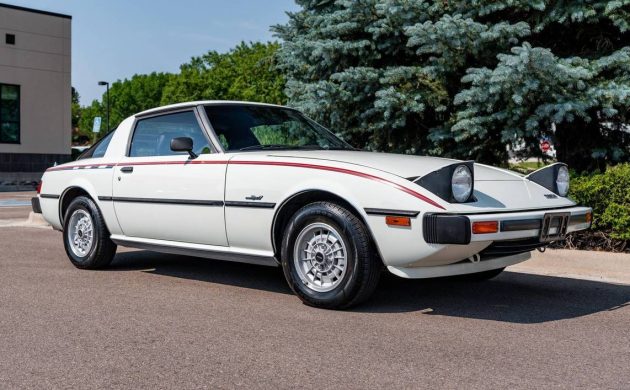
Mazda developed a reputation for pushing the automotive boundaries and is the only manufacturer to persist with the Wankel rotary engine after other manufacturers placed it in the “too hard” basket. The RX-7 wasn’t its first production car featuring a rotary, but it is its most iconic. This 1979 example is an impressive survivor, and with comprehensive recent maintenance, it is ready for action with a new owner behind the wheel. I must say a big thank you to Barn Finder Curvette for spotting it listed here on Craigslist in Vancouver, British Columbia, Canada. The seller set the price at $12,700, though they don’t specify the currency.
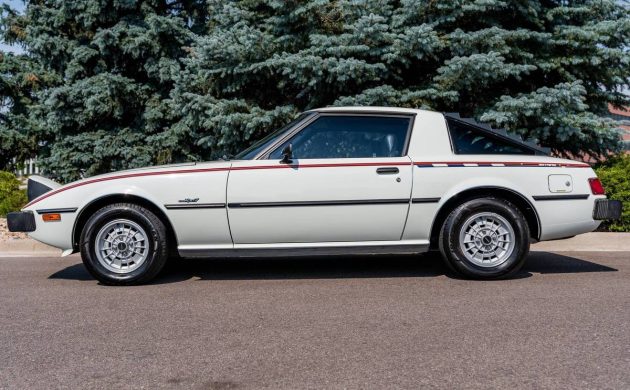
Mazda introduced the RX-7 in 1978 to replace the Savanna RX-3. The pair were like chalk and cheese in terms of styling. The RX-3 was based on the Mazda Grand Familia, sold in North America as the Mazda 808. The company threw caution to the wind with the RX-7, developing a bespoke body penned by its lead designer, Matasaburo Maeda. Low and sleek with a long nose and a glass rear hatch, its profile was designed to be aerodynamically efficient, maximizing the performance delivered by its tiny engine. This 1979 example is an extremely tidy survivor, ordered by its first owner in Aurora White with contrasting Red stripes and a factory sunroof. Its presentation is first-rate, with no significant paint or panel issues. A close inspection will probably reveal tiny chips or marks, but the car’s appearance would command respect and positive comments at any Cars & Coffee. I can’t spot any rust, and the glass and trim look excellent. This beauty rolls on its original 13″ alloy wheels, which aren’t stained or damaged.
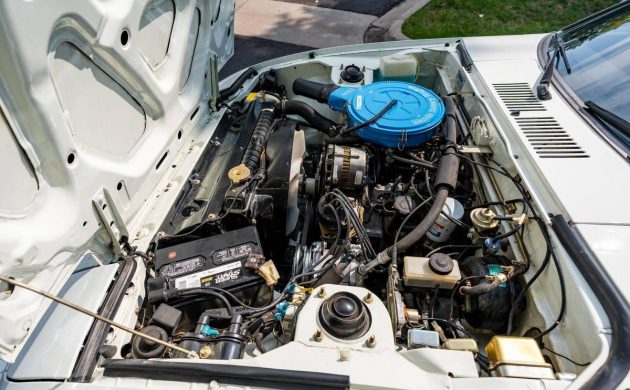
The styling was only part of the RX-7’s story, because its engine bay housed something pretty special. Several marques had tried to develop the Wankel rotary for their production models, but failure was typically the result. NSU introduced its first version in the limited-edition Spider, with the later Ro 80 featuring a twin-rotor design that was ultimately unreliable. Mazda developed a solution to the common apex seal issue, producing its own rotary that first saw service in the Cosmo 110S in 1967. Further development saw its adoption across other production models, including every generation of the RX-7 and the subsequent RX-8. The secret of the rotary’s success was its exceptional power for its capacity, and its almost eerie smoothness. This RX-7 features the 12A version, with a nominal capacity of only 1,146cc. The size might be conservative, but it should produce 100hp and 105 ft/lbs of torque. Sadly, this car’s first owner teamed the rotary with a three-speed automatic transmission, not the more desirable five-speed manual. That will impact its performance, but you would struggle to find a smoother combination for heavy city driving. It might take a while to get there, but cruising at 70 on the open road is a realistic expectation. The seller says that since August, they have rebuilt the carburetor, fitted new plugs and plug wires, a new battery, a fuel filter, a water pump, and replaced the oil metering system lines and idler arm bushes. A recent compression test confirmed the rotary’s good health. They don’t mention any mechanical issues, suggesting this Mazda is a turnkey proposition.
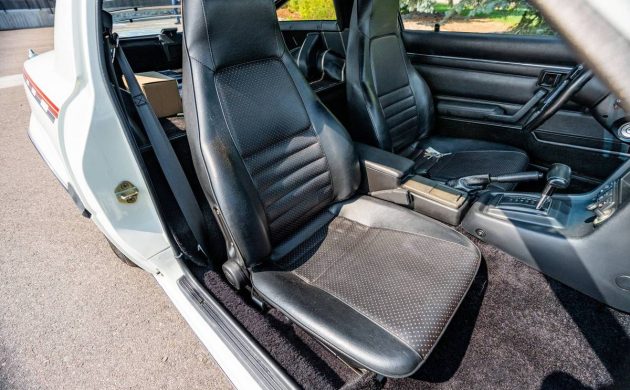
Japanese classics from this era often have interiors that haven’t stood the test of time. Upholstery can wear and split, and plastic can crumble from age and UV exposure. That makes this RX-7 a breath of fresh air. The Black vinyl trim looks excellent, with no obvious shortcomings; even the outer seat bolsters are in good condition, which is a significant achievement. The dash is excellent, and the gauge cluster features a clear lens and crisp markings. The only obvious fault is the discolored ashtray, but that isn’t a deal-breaker. It isn’t lavishly equipped, but the buyer receives air conditioning, an AM/FM radio with a power antenna, and a factory tachometer.
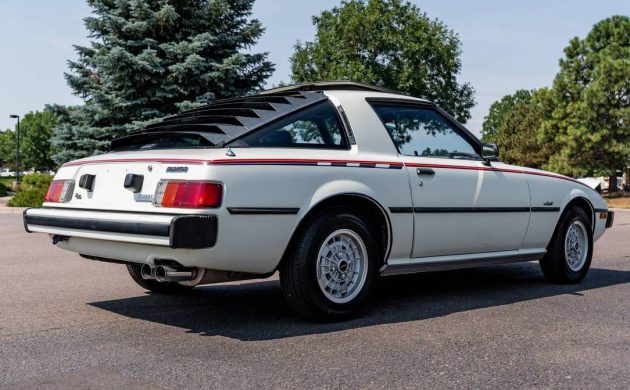
When Mazda ceased RX-7 production in 2002, it ended a line that had been almost unbroken for twenty-four years across eight generations. The company has hinted it might revive the badge, and enthusiasts who appreciate the Wankel rotary’s syrupy smoothness will no doubt welcome the news if it ever happens. The company squeezed impressive performance from each successive model, but many people prefer the purity of early examples like this 1979 survivor. I believe it should easily find a new home, but are you tempted to make it yours?

Nice car,but a pity it’s an automatic.