
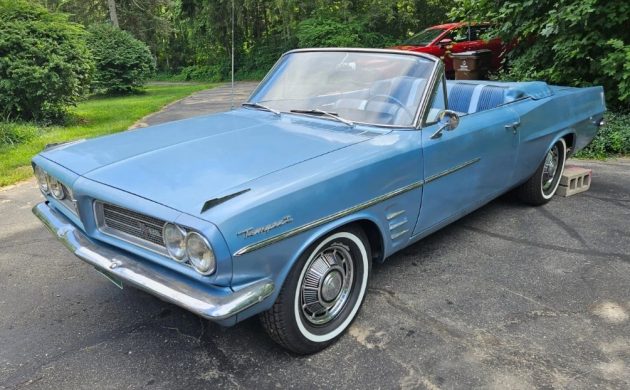
One-year-only models are not a new phenomenon in the automotive world, although their appearance isn’t always by design. The 1963 Pontiac Tempest is a perfect example of this, because it was the only year when a buyer could order one of these classics with a 336ci V8 under the hood. This Convertible is an unfinished project with plenty of potential. Adding to its appeal is the seller’s affordable sale price. They have listed the Tempest here on eBay in Dimondale, Michigan. The BIN on this beauty is $7,500 with the option to make an offer.
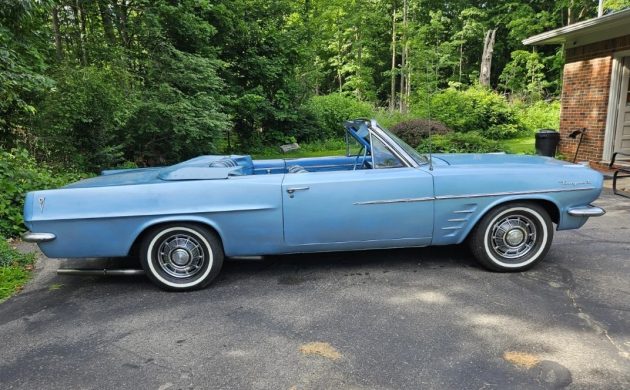
Pontiac looked at the relative success of the Chevrolet Corvair upon its release and decided that it wanted its share of the growing compact market. It unveiled the Tempest in 1960 as a 1961 model, with the First Generation remaining on sale until 1963. This Convertible is a final-year example, and the seller is refreshingly candid about its condition. It left the factory wearing Nightwatch Blue, with the seller performing a color change to its current Yorktown Blue. They admit that it isn’t even a good 10-footer, and to quote the listing, “a trained monkey could have done a better job.” Therefore, a repeat performance will be on the buyer’s to-do list, which may also provide the opportunity to reinstate the original shade. The seller also performed some repairs on the rockers, but once again, they are blunt in their assessment. They state that the work quality proves that they “don’t belong within 10 feet of a bucket of Bondo.” One rocker was replaced, but that area requires more work before the new owner reaches for the spray gun. The seller doesn’t mention any rust issues, suggesting that this Tempest could be a solid old beast. The top is reasonable, although with the back window cloudy, a replacement will be required to achieve a high-end finish. One aspect of this classic that fascinates me when I examine the supplied images is how low the rear section of the dual exhaust hangs. I suspect that reversing into a steep driveway may prove to be an issue, and this is something that should be addressed before it becomes a problem.
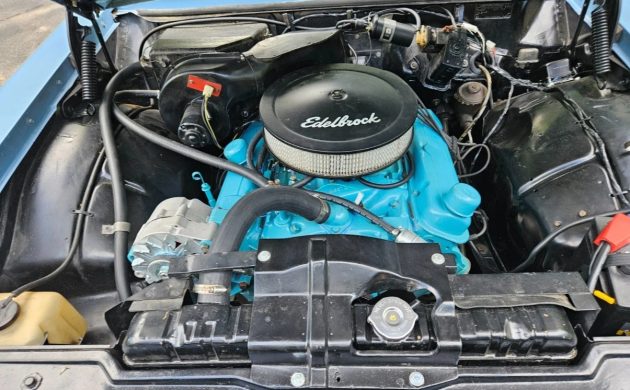
There was a lot of lateral thinking within various General Motors marques during the early 1960s, and Pontiac was no exception. The company chose to follow the traditional front-engine path, but by utilizing the rear transaxle from the Corvair, the Tempest provided excellent front-to-rear weight distribution. The 1963 model year was also unique because it was the only one when buyers could order a Tempest with a 336ci V8 under the hood. However, following a directive from the halls of power at General Motors, Pontiac marketed this V8 as a 326, ensuring that its capacity was perceived as smaller than the engine used in the Corvette. Pontiac reduced the capacity for the following year, making the 336 a unique feature in 1963. The seller admits that while the V8 in this Convertible is date-correct, the car isn’t numbers-matching. They sourced the motor from a Tempest that was destroyed in an accident, but the V8 only had a few miles under its belt following a rebuild before fate saw it bolted into this engine bay. That means that it should be able to match the power and torque figures of 260hp and 352 ft/lbs, as quoted in the Sales Brochure. The seller has performed a significant amount of mechanical work, but it is worth noting that this isn’t a turnkey proposition. The original three-speed manual transaxle is in line for a rebuild with a specialist, and the one bolted in by the seller refuses to engage second gear. Once the rebuilt transaxle is returned to service and the car receives a small amount of additional mechanical TLC, it will be ready to hit the road with a new owner behind the wheel.
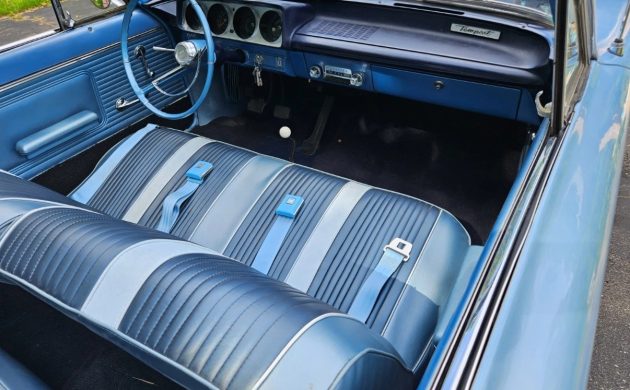
The seller splashed plenty of cash inside this Tempest, and the buyer will reap the benefits. They were unable to locate a replacement for the tired and torn front seatcover, so they had a new one custom-stitched in the correct materials and colors. That lightened their wallet by a cool $3,000, but the results justified the expense. They also installed new door trims and armrests, and dyed some trim pieces to match. The interior presents nicely, with no significant shortcomings.
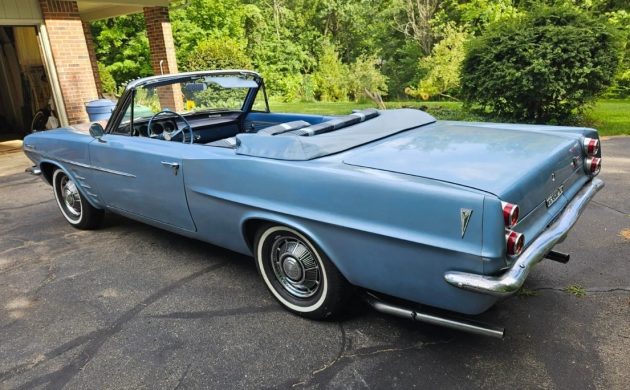
This 1963 Pontiac Tempest Convertible demonstrates that a load of good intentions can sometimes lead to a substandard result. The seller is candid about the fact that their attempts at a cosmetic refresh exposed the fact that they confused their ambitions with their ability. However, it is far from a lost cause, and enthusiasts with more experience could transform this classic into something genuinely special without spending a fortune. The fact that its engine makes it a one-year-only vehicle, and that Pontiac only produced 5,012 examples of the ’63 Tempest Convertible, are factors in its favor. Therefore, I hope that someone grabs this Pontiac and treats it to the TLC that it deserves.




That’s one low hanging exhaust.
And ridiculous.
I doubt a dual exhaust was even available when these were new.
Yes you could especially if it came with the 285 hp “326” that year.
They are Pypes brand, ordered from Summit Racing that supposedly fit the 1963. They clearly don’t, and will need rebending.
1963 Pontiac Tempest? The car from My Cousin Vinny… and “troubled yutes”!
I owned a ’63 Tempest with the slant 4. It was a troublesome car, but I came to realize that the worst cars offer the best opportunities to develop the automotive diagnosis and repair skills.
Why am i remembering that scene so well, now.what was that firing order again. ;)
It was all about not having Limited Slip (PS) in 1963 I believe.
An example of nice cars leading into the mid-60s. Both the trans-axel Tempests and more near conventional Buick Specials made excellent convertibles, great smaller cars–called compacts for the era (full-size or larger if comparing with today’s options) were both reasonable and fun. Ended up with a “compact” 63 Falcon myself but the Buick always made me drool. Hope this ends up in the hands of someone that appreciates what it was and takes it back in that direction.
Pretty sure – 326, not 336.
No, it is a one year only 336 which was available for the 1963 model year only. The 326 was released in 1964. The 336 was a smaller bore 389 that had the same bore/stroke as a previous GMC V8. The 336 lasted only one year until a slightly smaller bore brought it down to a 326 for 1964.
wow jack I just checked and you are right it was one year only GMC truck engine I’m 80 years old very much into Pontiac of the 50s and 60s my first car was a 1948 Pontiac silver streak straight 8 flathead thought I know it all now I have learned something new from this site going to see how many of my car friends know this thanks for the info
Thx Jack – I learned something! Just thought it was a typo….
A bit more detail – “Pontiac had gained experience with reducing the bores in its standard engine when it downsized the 370-cu.in. V-8 in 1958 and the 389-cu.in. engine in 1959 to 336 cubic inches, for use in certain GMC trucks. It was also possible to put the engine on a weight-loss program by employing thin-wall casting techniques for the “326” and 389 (and even the 194.5 four-cylinder engine) that saved about 30 pounds over the 1962 model engines. By decreasing bore size to 3.781 inches from the 4.0625 inches, 336.67 cubic inches could be realized while retaining the 389’s outer dimensions and accessories. Any features required for mounting the engine in the Tempest and Le Mans were also added. Despite the fact that this “new” engine measured 336 cubic inches, Pontiac identified it as a V-326 in marketing materials and on the car’s emblems.” So – let’s nail down all the details and round our math properly – it’s a 337!
More detail – “Pontiac had gained experience with reducing the bores in its standard engine when it downsized the 370-cu.in. V-8 in 1958 and the 389-cu.in. engine in 1959 to 336 cubic inches, for use in certain GMC trucks. It was also possible to put the engine on a weight-loss program by employing thin-wall casting techniques for the “326” and 389 (and even the 194.5 four-cylinder engine) that saved about 30 pounds over the 1962 model engines. By decreasing bore size to 3.781 inches from the 4.0625 inches, 336.67 cubic inches could be realized while retaining the 389’s outer dimensions and accessories. Any features required for mounting the engine in the Tempest and Le Mans were also added. Despite the fact that this “new” engine measured 336 cubic inches, Pontiac identified it as a V-326 in marketing materials and on the car’s emblems.” So – it’s actually a 337 if we round up properly!
I believe it’s a 326 not 336 326 was a great engine had one in a 1966 lamans covertable
Just a heads up, the transmission is the type used in a Corvair. There is no real magic in rebuilding it. When someone says “a specialist”, I see $$$. You can also upgrade the internals in the transmission at the time of the rebuild.
When I was 14 or 15 years old I ran into a 1963 Tempest wagon with a floor shift and a 326 badge on its front fender sitting at a used car dealer. The V8 was sitting right there under the hood. It seemed incredibly cool.
I wanted my parents to buy it to replace our rusty Studebaker Lark V8 wagon and mom actually came and looked at it. Based on scars in the cargo area, she felt it had been used hard and rejected my idea.
Being no expert, I don’t know today whether it was a 326 or 336 under the hood. But the badge said 326, and it was definitely a ’63 Tempest.
These Tempests were nice cars and the Corvair-style rear indie suspension was kind of a good idea, except that it was a swing axle design that did Corvair and Tempest drivers no favors in emergency situations or overly hard cornering. A Buick Special V8 would have been a safer car for most drivers.
I hope this ragtop finds a good home with someone able to bring it back properly and enjoy it. Just don’t corner too hard or fast.
A college girlfriend had one of these. It was a cool, peppy little car. I liked it, though I found the transmission odd.
This one shows some promise for someone willing to make it right. Those ridiculous tail pipes need to go asap. If it was closer I might have wanted to check it out. My mom had a 4 cylinder Tempest wagon when we were kids. I have a soft spot for old Pontiacs.
My college car was a 63 Tempest two door with the then called 326 with three on the floor. The car was a beautiful handling, trouble free vehicle. I would have kept it for several more years but my first job out of college was at the Oklahoma City V.A. Hospital and being a California kid my dad insisted I get a newer vehicle for the trip. He cosigned for a 71 bright red Maverick with a six and three on the floor, a car that provided 30 to 33 MPG on the road.
This is what happens when you get your tailpipes done at one of those “Five Minute Oil Change” places.
This car has positraction, you can’t make these marks without positraction.
you are right I believe the first year for positraction in GM was 1959
Yes you could especially if it came with the 285 hp “326” that year.
look like the local fence company left some posts laying around and somebody used it for the exhaust. boy that really looks pitiful
Honest seller, good price on a unique car. Worth $7500 all day long. 326/336 will go like a rocket in this car and these were decent handling with the fully independent suspension.
Adam,
Excellent write-up on the oft-misunderstood and misquoted specs to the 1963 Tempest
I had a ’63 326/3 speed manual Sport coupe for my Senior 1965 HS year and on to college. Great looking car; not too reliable due to my heavy foot.
This looks to be a great project for a great price.
Too bad that I’m now too old to enjoy it…
Yes you could especially if it came with the 285 hp “326” that year.
Ended with no takers.
Shame.