
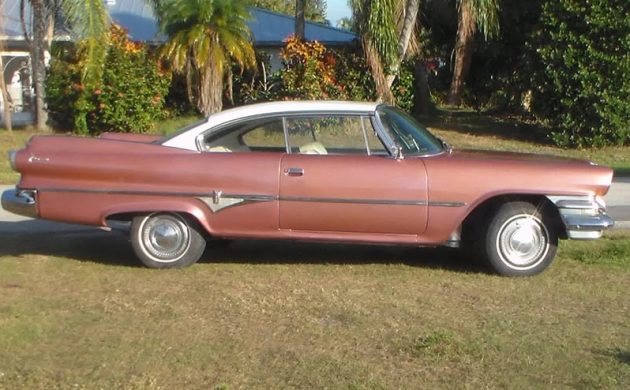
Generally, when the Dodge Dart is mentioned, thoughts steer towards the late sixties through mid-seventies A-body compact. But in the beginning, it was a full-size model such as this 1960 Pioneer example. It’s definitely, today, one of those seldom-seen cars that have often slipped from the recesses of memory. The seller claims, “The car is in supper (sic) great condition,” so let’s examine it and see if we agree. Port St. Lucie, Florida, is its home port, and it’s available here on Facebook Marketplace for $20,000. Thanks are due to T.J. for this tip!
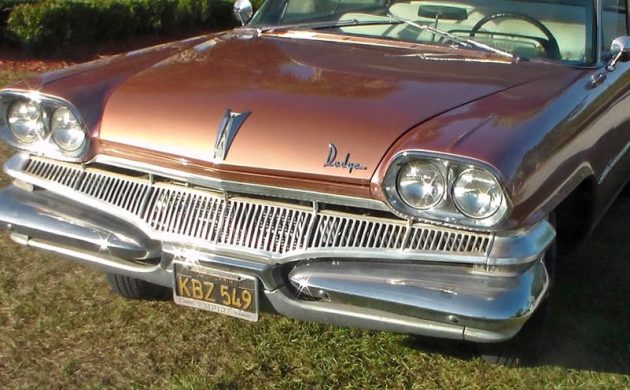
First up, the listing images aren’t very good, and that’s unfortunate, as some of this car’s better qualities are obfuscated by the crummy photography. Darts were available in three trim levels for ’60: Phoenix, Pioneer, and Seneca, and the Pioneer was available in two-door hardtop and sedan body styles, along with four-door sedans and station wagons. The total Pioneer production stat reached 80K units, but I couldn’t uncover a specific volume for the two-door hardtop.
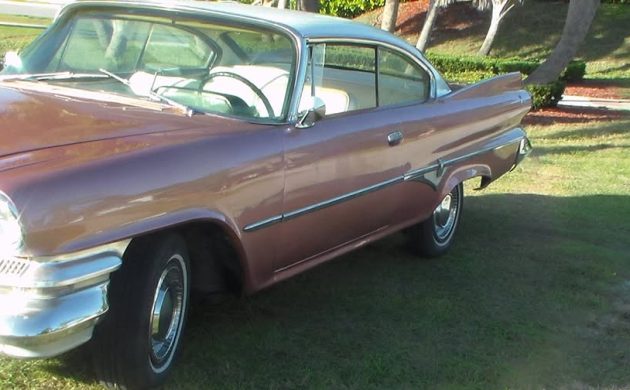
The copper finish shows as being pretty strong, as do the chrome-plated bits, and there’s no indication of rust, rot, or crash damage. Whether this 65 K-mile Dart is wearing its original finish is not disclosed, but if it is, proper storage has been part of this car’s 66-year history. The only unusual aspect of this car’s appearance is its noted rear-high attitude – replaced springs, maybe?
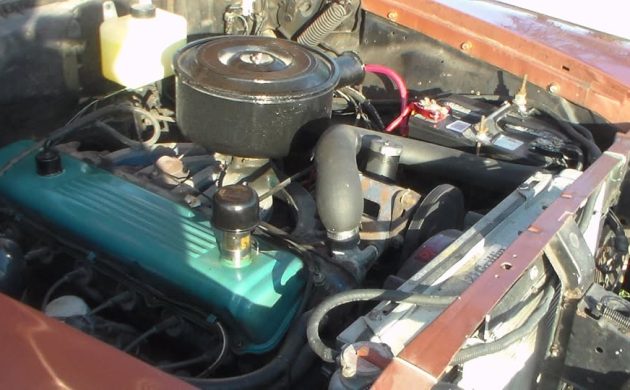
I was expecting to find “old reliable” in the form of a 318 CI V8 under this Dart’s hood, but nope; it’s a newer old reliable, a 145 gross HP, 225 CI “slant-six” powerplant. The seller adds, “Rebuilt p/s pump, starter, rebuilt trans, front end, new battery, dual master cylinder, rear differential seals…Car runs and drives great.” A three-speed manual transmission handles the gear-related activities.
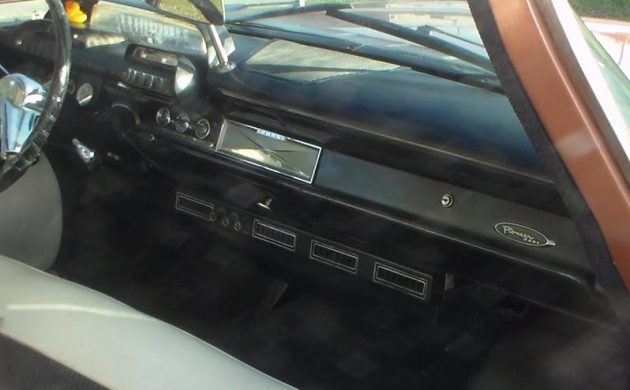
The interior looks pretty good, but the lousy images aren’t painting a comprehensive, detailed picture. The two-tone vinyl and woven upholstery, along with matching door panels, probably show beautifully, but I can’t tell for certain – how unfortunate. It’s the same story with the dash and instrument panel; it appears to be fine. The dash image is clear enough, however, to note that this is a radio-free Dodge. It’s also had A/C added, and the seller states, “has electric AC – needs charge.” Well, if it simply needs a charge, why not do it? That sort of an excuse statement leads me to believe there’s something beyond a charge that’s affecting the system’s proper operation.
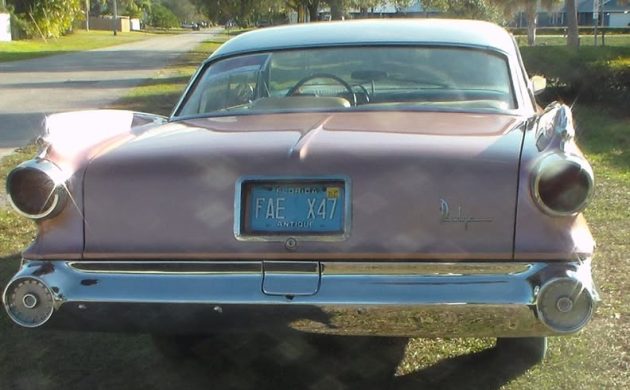
Plusses? This Dart is not a commonly encountered car these days, and it appears to be in very nice condition – the two-door hardtop body style is always a sales enhancer. The negatives? The $20,000 price tag. I say GLWTS, how about you?



I’m thinking that 1960 is the first year for the slant-6. But for 20K I’d want a V-8 w/Torqueflite. At least the Torqueflite.
Agree but this one’s nice….really nice…..and for that kind of money in the condition it’s in and being kinda rare because the salvage yards didn’t like them….I’d say it’ll be going on a boat across the big pond to Europe or down under…..
A 1960 Dodge was our family car when I was in early grade school years. It was a low-end Seneca, six cylinder (I assume), blackwalls and dog dishes, I think it had a radio, and was an automatic. But the fact that my dad was okay with low-end low-optioned cars, that probably was about it. I don’t remember much more about it, other than the view from the back seat of that highly-styled instrument panel.
Good write-up Jim.
US Dart Pioneer production was 79,970
Canada Dart Pioneer production was 31,119
For a combined total Pioneer production of 111,089 including 2 door hardtops, 2 door sedans, 4 door sedans & 4 door wagons (both 2 seat & 3 seat).
There was no Pioneer 4 door hardtop or convertible offered.
US: 8475 /6 Dart Pioneer 2 door hardtops (above model for sale)
Canada: 693 /6 Dart Pioneer 2 door hardtops.
US: 14,966 V8 Dart Pioneer 2 door hardtops.
Canada: 643 V8 Dart Pioneer 2 door hardtops.
I will add the station wagons were available as pillared or hardtop vehicles. The wagon looked odd because the fins started just behind the rear doors and ended just short of the C/D pillar (tailgate). The tail light housing was longer and extended beyond the tailgate. The fins look like a tacked-on bad idea.
Only Chrysler New Yorker, Windsor and Dodge Polara offered the 4 door hardtop wagons in 1960.
The Dodge Dart Pioneer, Dart Seneca and Dodge Matador wagons were all pillared.
There was no Dart Phoenix wagon.
All Plymouth wagons were pillared too.
There were no DeSoto wagons for ’60 in the US.
Export DeSoto Diplomat wagons had ’60 Dodge Dart sheet metal, and they were pillared.
The last US DeSoto wagons were in ’59.
Though some Memphian ambulances used ’60 DeSoto front ends and fins.
Update: 320 total Phoenix wagons were built in the US only.
Breakdown below.
All Seneca wagons were 2 seats.
Only Pioneer & Phoenix wagons offered 3 seats.
Only 3 /6 Phoenix 2 seat wagons were built, and only 1 /6 3 seat wagon was built.
Only 195 V8 Phoenix 2 seat wagons were built.
Only 121 V8 Phoenix 3 seat wagons were built.
Only the US got Phoenix wagons.
Canada got Seneca & Pioneer wagons only.
When someone spells super, S U P P ER, antennae rise.
The front license plate is a California Black plate – originally from the California dessert?
Whoops…
I no what you did there….
It’s a pretty safe bet that the bulk of vehicles in the eastern half of the USA with a California front license plate have never set foot west of the Mississippi River.
Nice synopsis of this seldom seen beauty ~ Thanks for all your knowledge and explanations. I really loved the fact that in the comments, a breakdown of production totals was given. I would love knowing what the other models show for numbers, especially the Seneca.
I have a ’60 – 2 door Sedan Seneca in metallic blue. No radio or air, no cigar lighter, just rubber floor mats and manual on the column with overdrive and a slant six for power. A Montana car originally so quite dry and rust free.
This beauty would really look great sitting next to it in a car show, but the 20 thousand asking price is a bit off the realm of reason…..
Thanks for showing us this specimen. If it was available for around 12,000 it would already be mine
1960 Dart Seneca Production US & Canada.
2 door sedan /6: US 27451 / CAN 1247
2 door sedan V8: US 8478 / CAN 376
4 door sedan /6: US 50763 / CAN 3652
4 door sedan V8: US 24951 / CAN 1391
4 door wagon /6: US 9580 / CAN 474
4 door wagon V8: US 9883 / CAN 658
All Seneca wagons were 2 seats.
Only Pioneer & Phoenix wagons offered 3 seats.
Only 3 /6 Phoenix 2 seat wagons were built, and only 1 /6 3 seat wagon was built.
Only 195 V8 Phoenix 2 seat wagons were built.
Only 121 V8 Phoenix 3 seat wagons were built.
Only the US got Phoenix wagons.
Canada got Seneca & Pioneer wagons only.
I Admin The Dawn of the Dart group on Facebook.
If you join the I will direct you to the other Forward Look groups
Thank YOU David Zornig…. I will go to that f/b page and join up. GREAT info and it also explains why a local yard out in the prairie (having at one time around 18,000 scrap cars) has at least around 8-10 Seneca 2 door sedans, all with the slant 6 tower of power in them. I thought my 2 dr. stripper was sort of rare, but note with nearly 27,500 constructed, it is more common than I realized when new.
Mine was a one owner from a farmer living in n.e. Montana near the ND and Canadian border. It has not quite 80,000 miles and the plates on it were last registered in the mid ’70s (a ’61 MT “Made by Prisoners” plate was lying in back with some other crap and had a dealer tag on the trunk as sold by : ‘Handler Auto’. I got the original title and kept it as a point of interest, registering it with the other documents and bill of sale I got with the transaction. (in liberal law states, one may do that and it’s legal)
Thanks again David !! And thanks Jim for a great write up and link to f/b marketplace
I’m with you Jim. I hate when descriptions state….needs this and needs that. Just fix it already and I’m sure the selling price might actually approach the asking price.
I had one like this that was equipped with a 838 and cross ram dual quads. I never got to feel the power because it had an over heating problem that my novis hands couldn’t cure. From start up until steaming only took a couple of minutes. The standard cures like removing the thermostat did nothing. As a broke teenager I moved on and the car sat in my dad’s pasture until it was eventually scrapped. I still think it is one of the most basic cars of that era.
Love it!
My uncle had one of these a 4 door sedan stripper with a torque flight. 318 IIRC. I was about 10 yo at the time. He bought it used in 1963. Back then I thought it an odd looking car. (Comming from a youngster who’s father had cornered the market on ’57 Plymouths) And I still feel the same way. I guess it’s different enough to be cool. Definitely not going to see yourself coming in the opposite direction!
JIM, thank you for saying what we all are thinking!.!.!
AC – needs charge.” Well, if it simply needs a charge, why not do it? That sort of an excuse statement leads me to believe there’s something beyond a charge that’s affecting the system’s proper operation.
depending where you are, R-12 can be hard to find and always expensive. Converting to 134 isn’t really cheap either. Maybe can’t afford it?
It has a modern aftermarket electric AC system which probably uses 134 so it wouldn’t be expensive to recharge. From what I’ve read about the electric AC unit it takes a signifiant amount of amperage that older cars charging systems can’t support. Anyone using one correct me if I’m wrong.
My very first car!! Mine was a Seneca in baby blue, and I LOVED that car! The see through speedometer and push button trans were a lot of fun!
This is literally in my neighborhood. I’m not really in the market, too much going on but I may try to take a look on this long weekend.
If any of you are interested let me know, I’ll try to give you a report.
CA license plate in the front and FL plates in the rear??!! Things like that and the comment on the a/c just launched my red flags!!
I would appreciate some more photo’s, I am interested in this vehicle , as i own a 61 phoenix hardtop , in decent condition , my name is pat.
Contact the seller via the hyperlinked Facebook Marketplace listing.
JO
Always liked these year Darts and they’re a lot less commonly seen than the later 60’s and 70’s varieties. Great color and the interior looks really nice but the photography wasn’t the greatest. The way the car is sitting seems a bit off. I’m not going to say it’s worth the $20K he/she is asking but would definitely warrant a look if these era Darts are your thing.
I was looking it over as I once had a 60 4 door. That radiator looks like a GM radiator.
No, it had an aftermarket Griffin radiator.
Kim, try pulling out the freeze plug and hosing out the water jacket. Algae globules sit in the bottom and wait for the engine to start then float about and clog some return port.