

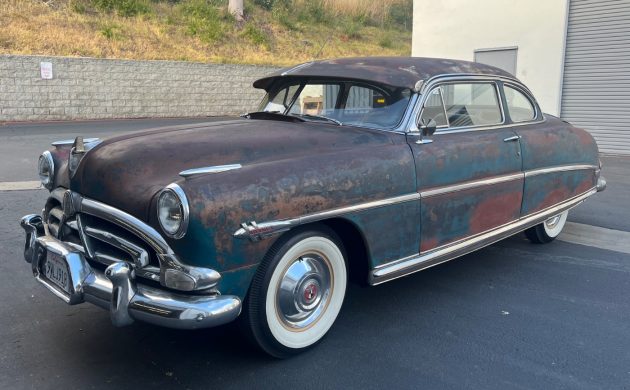
This 1952 Hudson Hornet Club Coupe is an unfinished custom build. It needs fresh paint and an interior retrim, but the seller has spent a considerable sum below the surface. Its engine bay houses a Chevrolet small-block V8, while other mechanical upgrades make it a “complete” package, with the hard work done. However, it is a cosmetic “blank canvas,” providing an opportunity for someone to make their mark on this classic. The seller has listed the Hudson here on eBay in Oceanside, California. The seller set their No Reserve auction to open at $16,000, but has received no bids at the time of writing.
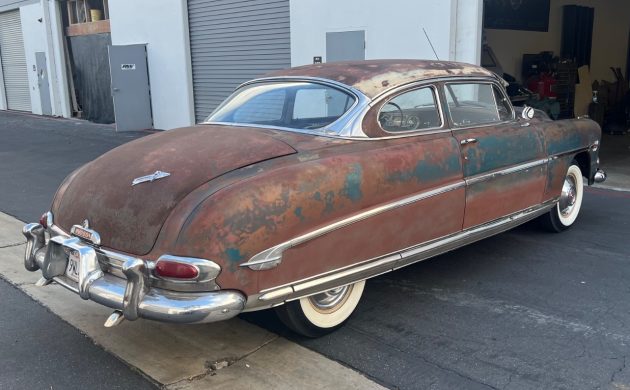
Hudson caused a sensation in 1948 when it released the Commodore. The “step-down” design philosophy resulted in a car that was significantly lower and sleeker than the competition. It continued that trend when the Hornet hit showroom floors in 1951. The approach not only improved interior space and ride comfort but also lowered the car’s center of gravity. That made the Hornet an effective racing weapon, resulting in significant success in NASCAR. The 1952 model year brought a few cosmetic upgrades, with our feature Club Coupe emerging at that time. The seller describes the exterior as “multicolor,” which is a fair call. There are hints of what could be Code P Symphony Blue Green Dark, though the deterioration suggests it could conceivably be Code B-96 Broadway Blue. Much of the paint has surrendered to surface corrosion, but there is no apparent penetrating rust. Therefore, stripping the exterior would be the logical first step in a cosmetic restoration. With no significant dings or dents, it should be relatively straightforward. The seller refreshed the underside during their mechanical exploits, ensuring that this classic is rock-solid. The trim looks great for its age, and the seller includes a significant selection of additional parts that most potential buyers will welcome. One thing the buyer won’t need to contemplate is substandard glass, because the seller replaced every piece.
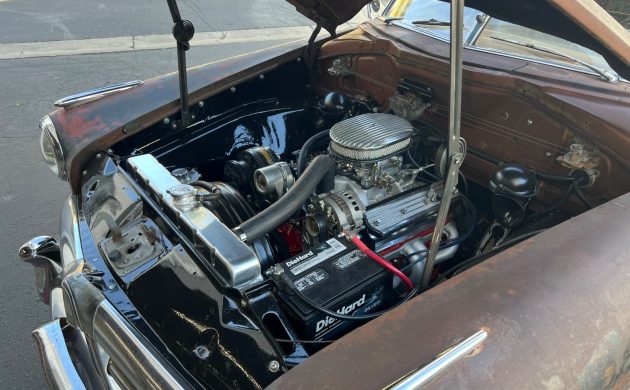
Okay, it’s time to take a deep breath as we assess the profound mechanical changes made to this Hudson by the seller. Its engine bay would have housed a 308ci straight-six engine that developed 145hp and 257 ft/lbs of torque. However, much has changed since that day in 1952 when this Club Coupe rolled off the line. Lifting the hood reveals a 350ci Chevrolet V8, teamed with a three-speed Turbo 400 automatic transmission. The seller fitted these, also adding a new aluminum radiator, a new fuel system, a new exhaust, new brakes, and new wiring. Various underside shots reveal plenty of new suspension and steering components, suggesting that the mechanical hard lifting is complete. It is unclear whether the Hudson is genuinely roadworthy, but reaching that point shouldn’t be difficult if it isn’t. The seller appears approachable and is willing to supply relevant videos to interested parties.
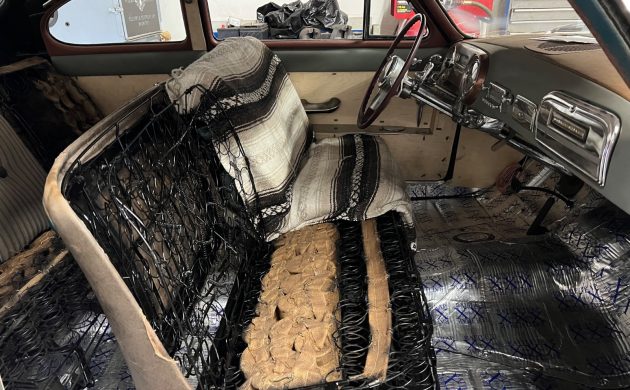
This Hornet’s exterior isn’t the only blank canvas. Its interior features all of its hardware, but it is begging for a retrim. Considering the mechanical changes, the buyer might forgo the faithful approach and select something luxurious, such as leather, for its upholstered surfaces. The Hornet’s interior was never a noisy environment, and the seller’s extensive use of sound deadener will further improve the situation. The dash houses a custom gauge cluster with a period-correct look, and the factory radio is intact. I’m unsure how I would tackle this aspect of the build, and it will be fascinating to discover how many readers would opt for a “stock” look.
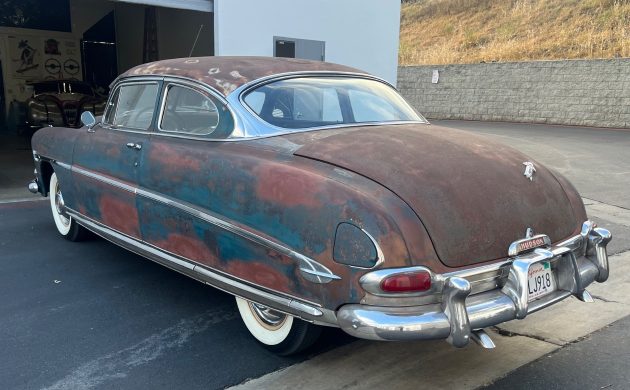
Classics like this 1952 Hudson Hornet Club Coupe invariably leave me torn. It would look stunning after a cosmetic restoration, and many readers will believe that it is the best approach. However, retrimming the interior and preserving the exterior in its current form would create a striking contrast, ensuring the Hornet draws crowds. The engine upgrade makes it a genuine sleeper, regardless of the path its new owner chooses. It is also an intriguing vehicle, and monitoring the auction might be worthwhile. The lack of auction action and the no-reserve factor might allow someone to become the new owner with a single bid. Do you find that prospect tempting?

Whoa, here’s a knife turned in the gut of Hudson fanatics, surely the creator will go to the “naughty place” for such blasphemy, but you know, THIS is the car that should have been, a V8 Hudson. Who knows what would have become if Hudson would have gotten those Olds V8s, the very nemesis that was killing them at the track. We can only speculate, and the V8 here changes the car completely. The hard part is done, and I don’t care if you get 14 rattle cans from Wallymart, PAINT THE DARN THING,,,it’s a nice start to a great retro car.
Paint it blue, with a “Fabulous Hudson Hornet” logo!
No Olds or other V8 was “killing Hudson at the track.” Hudson dominated through 1954. 1955 Hudson’s were basically Nash bodies and were not raced. Chrysler hemi V8’s dominated in ‘55.
No Twin H-Power, no bueno.
Far more reliable and easy to own with the 350/400 combo. Its only a win.
Growing up in a Hudson family. (Uncle Smitty always had a fleet of these) I’m not sure I would agree with the “more reliable” comment. But I would agree with the easier comment. Just sayn’.
You can just tell that this Hudson, even as it currently sits is a handsome design.that blue, with the chrome must’ve looked beautiful. I’m taking a guess the original 6 may have been shot, or unable to be rebuilt so they went this route. No matter what powertrain it has, or the opinions of it, it will be a beautiful car painted and with a nice upholstery job. Thanks Adam, I enjoyed your write up!!!
Sweet! I’m in the “trim out the interior and drive as-is” club. And I’d have to drive this with a pack of cigarettes rolled up in the sleeve of my T-shirt.
Have to ask, what color choice would you want to see on the exterior? I’m seeing a deep shiny black. The interior I would take to a custom interior shop and have it done in red or tan colored leather with a forward custom console incasing a modern stereo and components. An air ride suspension system would be cool. Speaking of cool, ai would add AC.
I’m thinking the original blue with a cream colored ( with Blue piping) interior. But I like your idea too Greg B. That would look sharp.
IF ONLY! I love this car and I want it!. The price is right, the hard work is done. From this point, I would just make it my own. Stance ,color, wheels and great details. It could just be way COOL!
I am with Driveinstile with blue and the cream colored ( with blue piping ) interior. But i would go with surf pearl blue that Dodge used on 2008 chargers have loved that color since i first seen it. Then again i believe this car would look great in just about any color what a great looking car.
The Hudson of this vintage is the only car I could lay down in without hunching about at all. Concave armrest to concave armrest is 2 meters (6 ft. 6.75 in.)
You might think it trivia, but it is not.
Does the original engine come with?
I see it in a to-be-determined shade of metallic copper with a cream roof and chestnut leather interior. Definitely air-ride suspension and front (at least) disc brakes. Such a timeless yet era-specific design (how can such a contradiction be so compelling?)-accordingly, minimal comfort and performance mods would be indicated. Whenever I see one of these, I think of Dean Moriarty-I think of Dean Moriarty……
Adam, What a great find!!!! As you said the seller has done all the hard work. You did not mention what upgrade the seller has done to the BRAKES?? Definitely they would have to be upgraded to stop this heavy beast!! Especially as this power train will let you run at highway speeds. Finish the interior (bucket seats and console??) Paint it (two tone??) and the buyer will have a go anywhere / anytime classic as a daily driver as well as a show stopper!!
Two tone green and sea foam green. I believe I remember a stock Hudson color combo like that. And light Grey leather interior!
One year at Hot August Nights burn-out contest. There was a Hornet with a 460 Ford engine. It did really impressive burnouts!
for a least 16k it should have a useable front seat
Just get a whoopi cushion for the girlfriend. She can put it as close to the driver as she likes.
It is useable, for one only!
Of all the best features of the Hudson is the Hornet engine, and they put a chevy in???
Good luck getting bids with an opening bid needing to be $16K.
I’d try to preserve the existing exterior finish as much as possible, then re-trim the cabin in tan/cream leather.
I’m always wary about abandoned projects. Yes, the seller has done all the “heavy lifting” but did he do it right? Why is he trying to unload his project?
Mike, You could be right, but I don’t think so. Doesn’t mean I would buy sight unseen. But wouldn’t stop me from looking!
In the 1990’s I was considering a Hudson coupe that had a Ford V8 in it. My mechanic that came from a fanatical Hudson family with a Hudson collection told me that if I ever bought a Hudson that did not have a Hudson motor, he would never work on it. R.I.P. Bobby Kerchner of York, PA.