
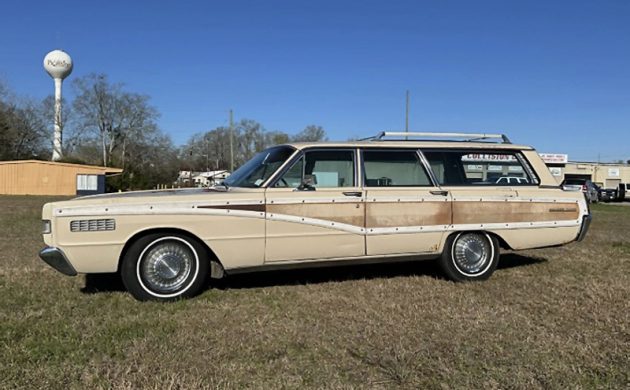
They don’t make ’em like this anymore. The Colony Park was large because it was a station wagon, large because it was on a full-size platform, and on top of all that, it was a luxury car. Introduced in 1957, the Colony Park nameplate was distinguished by a hardtop roofline offered as standard when other makers charged buyers extra for that style statement. The model was produced in six generations through 1991. Here on eBay is a 1966 Mercury Colony Park wagon, still boasting its faded but intact faux woodgrain side trim, listed for $12,500 or best offer. The wagon runs well, so the new owner should be able to drive it home from Picayune, Mississippi. Thanks, Curvette, for finding this majestic people-mover for us.
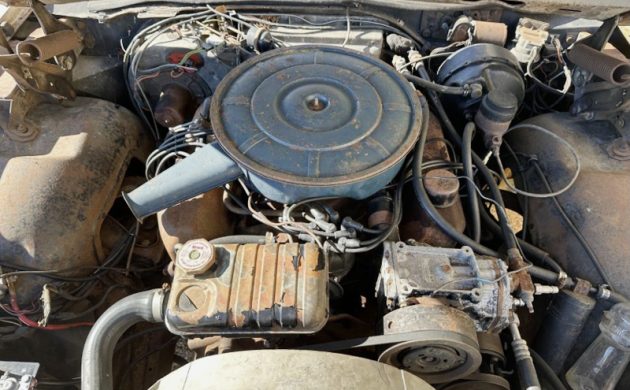
Standard equipment was a 275 hp 390 cu. in. V8 coupled with Mercury’s Multi-Drive Merc-O-Matic automatic transmission. The big-block Marauder 410 was optional, offering a significant boost to 330 ponies (and most likely a significant downshift in fuel economy). Power steering and power brakes were standard. By 1965, the rear suspension was modernized from leaf springs to a coil spring/live axle combination – a good thing since these wagons weighed in at 4300 lbs. This honest old engine bay matches the rest of the car so well – I wouldn’t touch it.
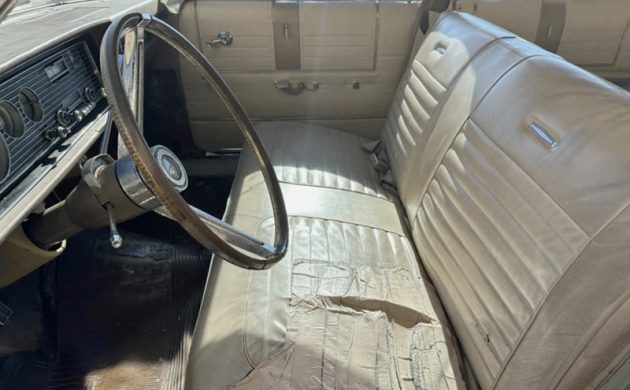
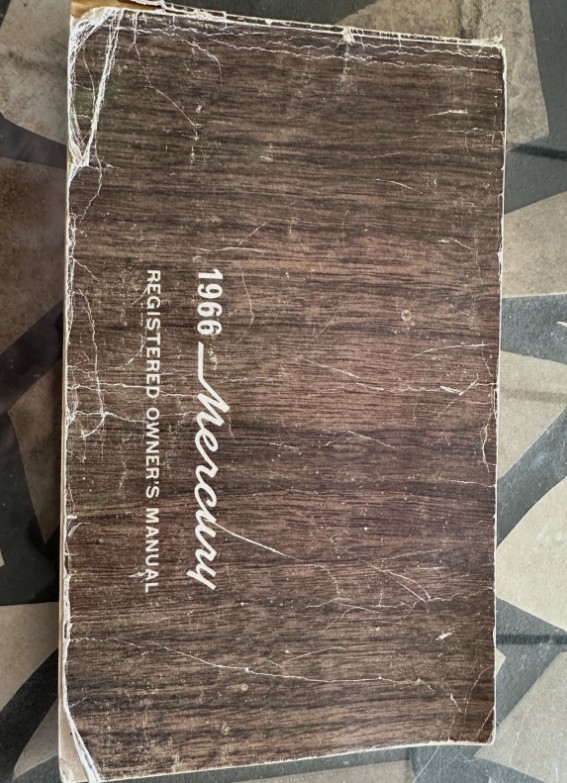
The cabin, on the other hand, presents a conundrum: it’s ratty but original, and upgrading even one element will bring the rest of the patina into less flattering relief. I might opt for a seat cover and leave the rest of the finishes alone. A clock, chrome interior trim, power rear window, and Mercury’s “Channel-Aire” system designed to clear interior condensation were standard equipment on this luxury wagon. This example comes with its original owner’s manual.
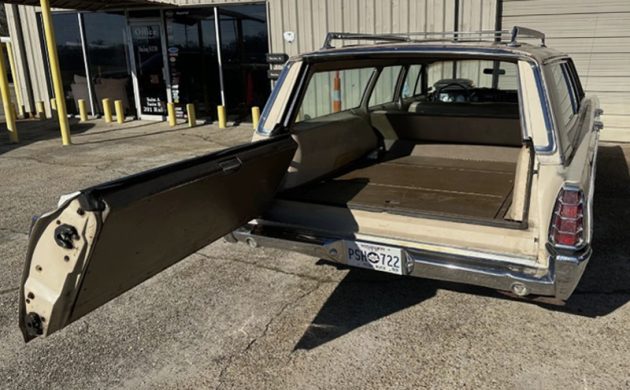
Also, for ’66 Mercury introduced the Dual-Action tailgate, which could fold down or, as above, swing out. Plenty of space in there! These wagons came with a second-row front-facing bench seat, and an optional rear-facing set. Production numbers ranged around 20,000 units a year through 1978; the gas crisis and the advent of smaller imports caused a plunge in units sold as the decade faded. Prices are highest for first-generation examples, but cars from the ’60s draw plenty of interest. This survivor sold for $19,250 a few years ago; asking prices for better cars are well over $20k. What would you pay for a cosmetic project like this wagon?




Test,,oh the site is doing that stupid thing again, not counting the posts. Some things just don’t change,,oh, nice Merc, in case logging out DID work.
My folks bought a ’65 almost like
this one. Cream yellow with all the fake wood you could handle.
The only real problem we had with it was a weak fuel pump return spring that freaked us out as it sounded like a very noisy lifter. Took us 3 times tearing the
engine down to find it. I was surprised to find out these high priced wagons had vacuum wipers that never really worked
right. My Uncle Dean told us that
all Ford products even Lincoln had them. Doesn’t sound right to
me. Anyone know for sure?
The electric wiper motor is visible…. this was a ”nicer” car,,,
The ’59 Ranchero had vacuum wipers as standard… electric was optional… probably for 8 dollars or so…. makes you wonder….
Anytime the driver added power, the wipers would stop…like when passing someone on a rainy day on a 2 lane…. or going up a hill.. but somehow we made it….
Ford did not have vacuum wipers in 1966, or 1965, or 1963 (all based on personal experience).
Thunderbirds from around 1964 to 1969 had hydraulic wipers that tied in with the power steering system. Maybe they’re thinking of that arrangement but figuring it was vacuum operated.
Without doubt it’s a beautiful car when done.
You can buy nice ones out there for 20 plus K. To restore this one, it would take a master body person. The cost for labor alone would be 30k for the body.
Then, engine, suspension, electrical, interior…
I hate to write this, but it’s a parts car. The seller could make some decent cash parting it out.
For a novice to buy it and use it as a weekend driver it’s a 2500.00 vehicle.
My parents bought one of these brand new. Something about the frequency at which they engineered the suspension on that car, I threw up every time I rode in it. True story! It never happened before or after with any other car. Also, the driveshaft fell out in the first week of owning it. Needless to say, they got rid of it quick. Other than that, ours was a beautiful vehicle – silver and wood grain exterior with a burgundy interior.
I am pretty sure the wipers were hydraulic like Thunderbird.
Asking way too much – Pass.
My 1946 Super Deluxe Ford V-8 had vacuum wipers, and I DREADED that trip on the New York State Thruway west to Utica in any but guanteed sunny weather! What a BEAR! You see, for those who don’t know that stretch of road, as you head west from where the Little Falls exit is, going out towards Herkimer (noted for its diamonds), there is a long hill going up towards a rise from where you can look down upon the whole upper Mohawk Valley and guarding mountains. That might sound “innocent” enough, even picturesque — but is anyone familiar with the song, “The Erie Canal”? Beginning about 40 miles west of Albany, you run into a nearly unique rain (or, for that matter, snow) alley coming down the Mohawk Valley from Utica. Rain can fall there at a rate of about four inches an hour (NOT KIDDING!). Storms seem to come from nowhere, and suddenly the sky is almost as black as night, and it is Drown City! Tractor-trailor trucks with any sense at all stop underneath the next bridge and “wait this one out”. But fools like me, who think they have some place they need to GET to by a certain time, keep on going, even as their windshield becomes a wavy river. And those wipers slap back and forth with force and vigour, dutifully pushing little walls of water out of the way of my vision… that is… until I get about halfway up that hill… then they stop… DEAD midway across the window, exactly when you need them MOST! And I had those accessory vacuum-tanks intended to keep this from happening. But even those succeed but just so far. Vacuum-wipers give a sober reminder to the driver of an antique car, that you are no longer motoring, you are camping. And just as that tent leaks in a sudden downpour, wet such as this will soon locate for you every gasket in your car that has dried and cracked… and leaks (please pass the towel so I can put it inder the rear window…)(DAMN! Now my KNEE is wet: the WINDSHIELD leaks, TOO!)
As for this Mercury station wagon (assuming that everything works, except for maybe the clock and the radio): it’s too far gone to spiff it up into a decent driver, especially with that ragged interior); it’s too good to junk it or part it out; therefore, if you’re not embarrassed to be seen it it, buy it for around $2,500-$3,000, throw a moving blanket over that front seat, and use it the way it is to get to places and haul things: it’ll out-live you!
YES…. JC Whitney used to sell vacuum tanks.. to provide extra vacuum.. as you describe..
Mine were actually 1946 Ford accessories which mounted usually inside of the front fenders and had rubber hoses to and from them. But as I stated, their capacity to hold onto vacuum when it was being depleted and not re-plenished was not without limits!
Lovin’ old wagons!
cool wagon. not sure i would say it’s a parts car though. it needs interior work for sure. worth more in the 7500.00 range. clean it up and drive it as is
Definitely in the Don’t Part It Out group on this one. Just too few of them left to have that fate. Lots of FoMoCo mechanical parts around to keep her up as an interesting and unique offering on display at your local C&C showings. And you can even do that RIGHT NOW from the sounds of his writeup of its being a presently-driveable machine!
Just don’t get delusions of grandeur and attempt restoration. You’ll go crazy trying to find those sortof parts…and from trying bankroll such an effort.
Simply allow her to be an honest old car who has enough moxie and good fate to still be with us!
I love these big old FoMoCo products