
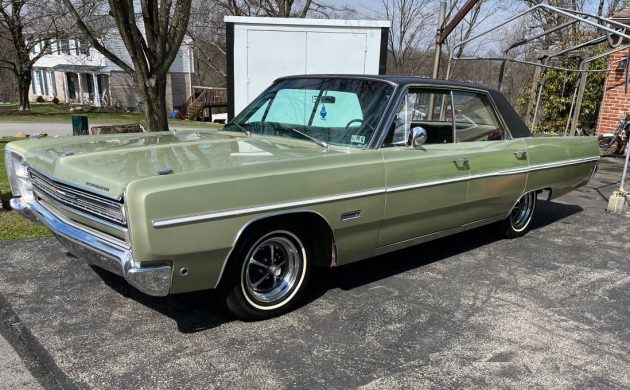
Numbers matter! More on that to follow. Commonly reviewed here on this august website are full-size cars from Chevrolet and Ford, but how about the third leg of the stool, Plymouth? Not so much so, and again, a lot has to do with numbers. Take today’s discovery, for example: it’s a 1968 Plymouth Fury III, a model that has been reviewed here before, but nowhere to the extent that its competitive counterparts have been scrutinized. Thanks to Jack M’s sleuthing, today I’ll review this Pittsburgh, Pennsylvania-based Plymouth hardtop, and we can try to see why the Fury III never matched the volumetric performance of the competing Chevrolet Impala and Ford Galaxie 500. Here on craigslist is where you’ll find this four-door hardtop, and it’s available for $10,000.
The big fight back in ’68 was among Chevrolet, Ford, and Plymouth, and full-size cars were still the gold standard. While trim levels varied, the sweet spot for the Detroit Three was Chevy’s Impala, Ford’s Galaxie 500, and Plymouth’s Fury III. Let’s look at some model year 1968 numbers:
Full-size cars, including station wagons, with the appropriate trim level listed underneath (excluding Ford’s XL and Plymouth’s Sport Fury)
- Chevrolet 1.2M
- Impala: 843K
- Ford: 867K
- Galaxie 500: 437K
- Plymouth: 349K
- Fury III: 195K
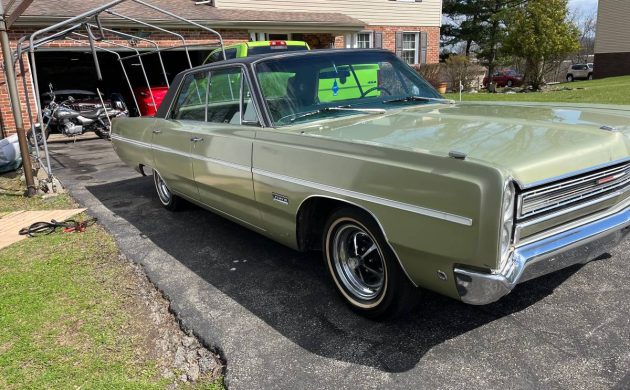
Wow – puts things in perspective. The bigger Chevrolet and Ford volumes explain why there are still many (and so many in Chevrolet’s case) still roaming the roads, but Plymouth’s numbers are scant by comparison – so much so that I triple checked my numbers and used two different sources. So, fewer assembled leads to fewer existing 58 years later. Sure, we could factor that further by the quality of build, the quality of workmanship, the quality of engineering, and so forth, but that gets us into some subjective areas that I would prefer to avoid. Speaking of a subjective position, I think Plymouth nailed it on styling in ’68 – this four-door hardtop is as sleek and balanced a design as you would have found back then. Some may find the over-under headlights a dated styling cue, but I think they worked perfectly in the Fury’s case and were one of the car’s defining style elements. The listing images are few and not particularly revealing, and the listing detail is close to non-existent, but the limited images do tell a story. What we find here is a car finished in Mist Green Poly, a very popular ’68 shade that still presents well, a sharp-looking black vinyl top, and all four corners being supported by original (they were an option on Fury) Magnum 500 styled wheels. Rust and crash damage need not apply – this Plymouth appears to be sound!
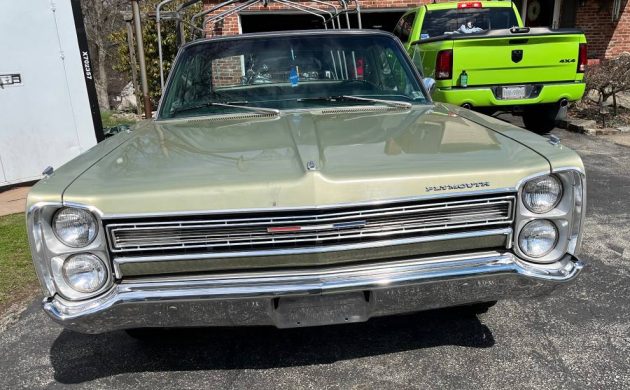
Unfortunately, there’s no included image of the 230 gross HP 318 CI V8 engine – always a faux pas in old car sales. There’s no comment regarding running or driving characteristics, but I do remember way back, an old friend had a similar ’68 Plymouth so equipped, and it moved out fine with just 230 HP on tap. No, it wasn’t a speedster, but it did fine when pedal hit metal. As is usually the case, a three-speed TorqueFlite automatic transmission manages gear changes.
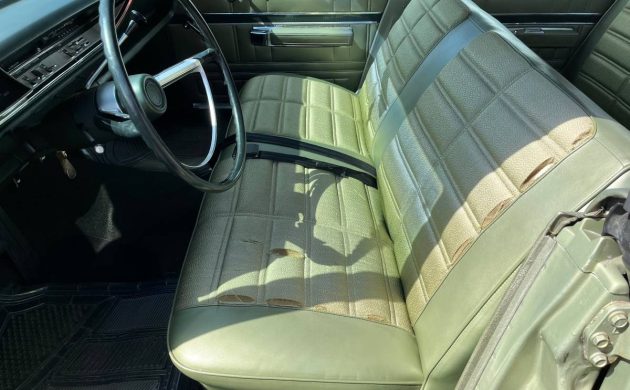
If this hardtop has a weak spot, it’s inside where the fabric portion of the combination upholstery is starting to let go – no surprise really. It’s especially telling that it only affects the driver’s side of the front bench, while the back seat shows as unused. The rest of the environment reflects better than I would have thought for a car of this age. The mileage claim is 64K miles – light usage, but there’s no authentication provided.
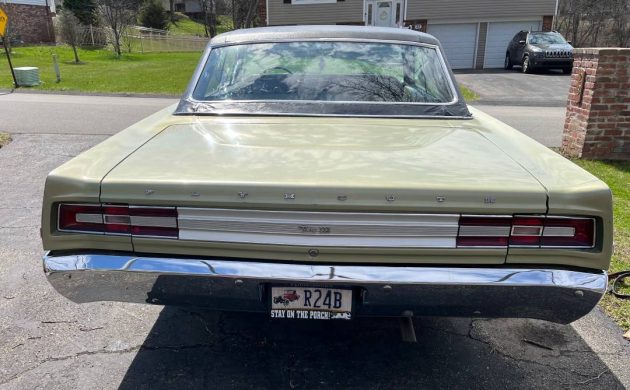
Conclusion? If you like full-sizers from this golden age of Americana motoring, and you want to be a bit different, this Fury III four-door hardtop may be the car for you. But first, let’s talk price. At an ask of $10,000, do you think this Plymouth is priced right or not quite?


I had a 2 door in this exact color combination. The 318 ci was adequate though no barn burner, it was one of the most dependable and durable cars I have owned and I have owned many. This is a nice looking yacht and seems priced fair if the mechanicals check out.
Great writeup on a great car, Jim.
It has been argued, and convincingly so, that 1967 or 68 was the pinnacle of Wally Chrysler’s little car company. The styling was good, the engineering was excellent, and the build quality was top-shelf. During that ’64-’68 time period they had worked all the bugs out, and the cars were as good as anything Detroit produced. Even the following 5 years were very solid as well.
Oddly, though Chevrolet produced over 1 million Impalas in 1965 and 1966, you almost never see one at a classic car show. One would think that with those kinds of numbers, car shows would be flush with those Impalas, but not so. But that’s why I like my oddball Mopars; they are rarely seen.
That one of yours Rex ? Nice 👍
I think it is. Rex has a few really nice mid 60’s Chryslers.
Yep, that’s my Imperial. Now if I could just get the brakes to work…
Yes I think it’s worth $10k, it’s beautiful. Regardless of how clean things are under the hood, it’s obviously been taken care of and loved in it’s lifetime. These rode and drove like a dream for late 60s iron. I’d enjoy having it
With just a few pics, and none of the engine compartment or undercarriage, it is hard to tell for sure, but it appears to be a nice car, Perhaps one could work the seller down a bit on the price and you’d have a clean well driving cruiser. Looks like the seller has a MCSS tucked in the garage as well.