
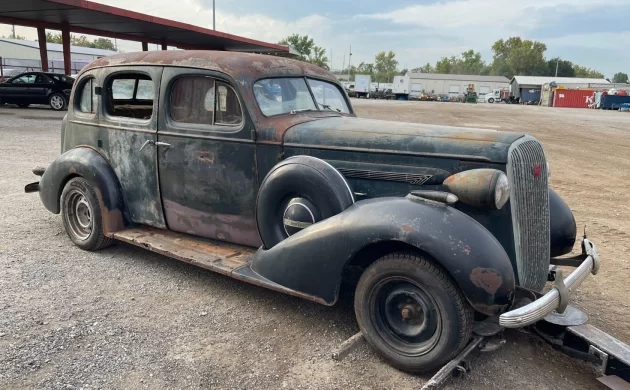
“Styled for a party but powered for a thrill” is the opening line of Buick’s 1936 Roadmaster brochure. Well, being one of Buick’s top dogs that year, and riding on a 131″ wheelbase, one could have quite the rolling ruckus in this Cincinnati, Ohio, domiciled rig. As for that thrilling power business, I’ll have more on that in a bit. Admittedly, this big sedan looks rough around the edges, but let’s investigate more closely and see what it’s all about. Here on eBay is where this 89-year-old Buick Roadmaster can be found, and it’s available for a BIN price of $3,500. There is also a ‘make an offer’ option available.
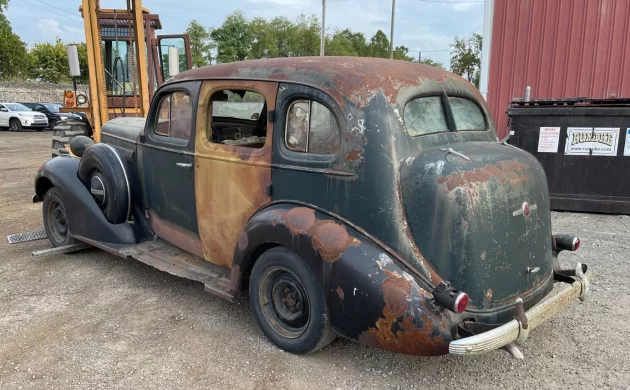
Buick’s ’36 lineup included the Limited, Roadmaster, Century, and Special. Roadmasters were offered in two different body styles: a four-door sedan and a four-door Phaeton. Production numbers were light, with only 3,000 examples leaving Flint, and of that total, just 1,800 were four-door sedans such as our subject – yes, that’s rather rare. The seller tells us that this Roadmaster has been stored in a trailer for 30 years, but offers little additional information. Storage aside, the thirty years prior were likely outside. The finish is faded, and there’s an abundance of surface rust, though I don’t detect any serious rot. The running board’s surface has been removed, but the body seems to be intact, as in, it’s all there. The prominent Buick grille looks to be unscathed, so there’s a positive. My thought is that the mismatched driver’s side rear door is a replacement for the original.
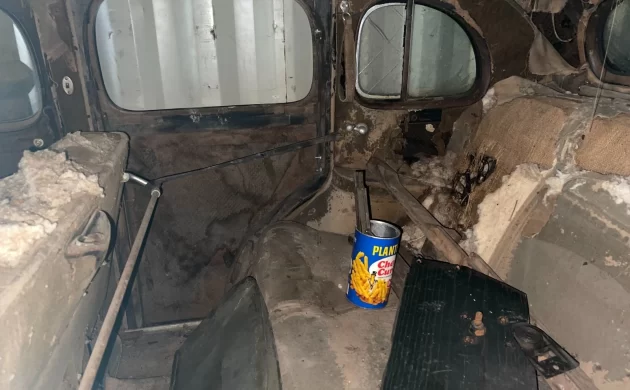
The interior looks like the setting for a horror movie. It’s a mess of rodent infestation and water intrusion – and the front seat is no better. If you cruise through the listing images, you’ll note that the steering wheel and steering column seem out of place. Well, that’s because the column originated with a 1970 Camaro; the wheel is an unknown aftermarket piece.
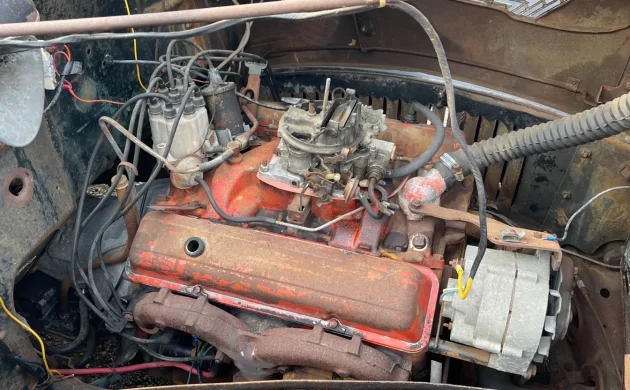
As for that “…but powered for a thrill” claim, Buick equipped its Roadmaster with a 120 HP, 320 CI, straight-eight powerplant – heady stuff for 1936. Well, that heavy, long chunk of iron has been given the bum’s rush and swapped with something a bit more contemporary. You know how the ubiquitous Chevrolet small block V8, over its many years of existence and incarnations (110 M produced at last count, and that was a while ago), seems to have invaded anything and everything? That’s the deal here, a 350 CI of unknown provenance to be exact. My guess is that it’s a non-runner as there’s no reference to running or driving capability (and the wheel chocks are a giveaway). The seller adds that the front suspension and twelve-bolt rear axle from the previously referenced Camaro have also been relocated. The transmission is an automatic, but which one is not stated; my guess is either a Powerglide or a Turbo-Hydramatic 350, three-speed. That carburetor is a head-scratcher. The front half looks like a common Quadrajet, but the secondary portion is unlike any that I’ve seen before, specifically the lack of an air valve assembly.
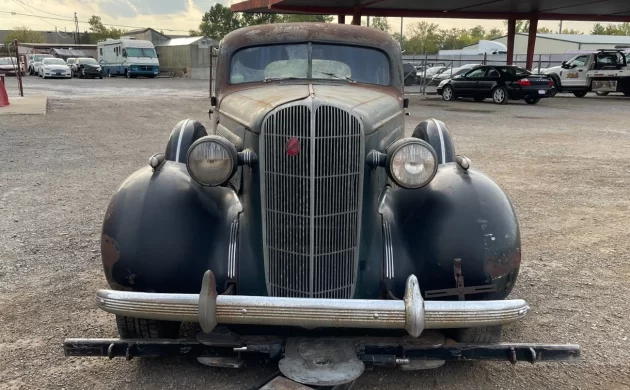
Final thoughts? Rarity aside, this car’s condition and lack of an original engine are not helpful. The V8 swap would be less of a negative if something more robust than a generic, probably stock, 350 had been chosen. Beyond that?GLWTS is my concluding comment; what’s yours?




Dual jet carburetor
Here’s a Dual Jet carburetor; it doesn’t look like what’s on this Buick’s engine. The installed unit has some sort of secondary structure, but not one I’ve seen before.
JO
It looks like it might be a Holley Economaster, which was a period Quadrajet replacement.
Bingo! That’s it, thx!
JO
https://carbkitsource.com/images/carbsnapshots/RochesterM2MC17057173.jpg
Dualjet 200, looks like a quadrajet.
Sort of, but it doesn’t look like what’s on this Buick’s engine. Aaron got it right, it’s a Holley Economaster.
JO
Its a Holley , long ago they made a Q jet replacement . This is one of them
Yes, that’s already been established.
JO
It’s been sub-framed too. Should have left it stock. A buddy has a rare ’36 Studebaker coupe with the same engine and subframe job (done by prior owner). Otherwise stock. Pity it’s missing its original straight 8.
Yeah Poppy a Batwing Stude coupe is worth about anything to undo and restore to original condition, Next best thing to a ’37 Zephyr coupe but I don’t have to tell you about what those are worth. I’ll never have one of those, but Road Legends makes a 1/18 diecast of it that’s the best model ever done at any scale or any price and can currently be had for $50-$150..
Just need a Tommy gun and some moonshine and your good to go.
Ha! That was my 1st thought too, but a bit late for “The Untouchables” and too early for rum runners. For the mid 30s, who would drive an ostentatious looking car like this? Da’ mob,,,and yes, it looks like an Economaster Holley.
Fantastic looking car and as far as the body is concerned, looks to be all there. What a bear of a restoration or renovation it would be to take on…and then what would you do with it?
I don’t know, but stay within a “cheap” budget, as there would be no return otherwise. Get it running and “safely” driving, then address the cheap foam and blanket seat restoration. Paint it with a brush, as needed, and go to shows with it. Lots of attention with this. Some of it negative likely.
The days of doing a quality restoration on a car like this are coming to an end, if it’s not already here. There are so many similar cars (of different makes/models) available from that era, they now compete on price. Turn key drivers aren’t particularly expensive. The people most interested in these cars are aging out of the hobby and not being replaced with great enough numbers to sustain an expensive restoration. If a particular car does not have a strong following, the price will drop to the point where decent cars become cheap enough that cars needing this much work don’t make sense to take on. I know there will be people that disagree, but are they going to dig into their own wallet or are they just advocating for someone else to dig into theirs?
Steve R
Not a bad thought. I’d consider putting a few sturdy tree trunks under it to get the tires out of the dirt and make it lawn art. I wouldn’t mind seeing this every day in my front field (mostly hidden from the road view).to admire it and dream of what it was like when new.
I was thinking more on the lines of a 1971 Cadillac 472 cu.in. before they got emission choked, or something with 2 fours.
Pops had a 1938 Pontiac sitting in one of the barns for about 15 years. As kids we used to play in it. He got it running and moving and at 12 I actually drove it from the driveway back to the barn but he never did get around to doing anything with it. Sold it sometime in the 70s
A strong effort in the style category, and a dirty shame what befell this example what with such butchery. You must remember too, that being a ’36 this is essentially a wooden car with sheet metal cladding, GM held to that formula almost to the very last producing its first all steel cars in ’37. Anywhere you see rust through is guaranteed to have rotten wood behind it Let the buyer beware.
A lot of people commenting here are not reading what you wrote – “this is essentially a wooden car with sheet metal cladding”.
It might look nice on the outside, but what is important for its’ survival (and usability) is what’s INSIDE.
Should have left the original drivetrain intact. Buick straight eights are fine engines!
Yes gill. Probably the best engines in the industry excluding Pierce Arrow and Duesenberg which were exotics in the Ferreri class of another age. Nothing bested a OVH straight eight for smoothness and serviceability, not to mention the performance they were capable of. If one wanted to restore this car an original type engine/trans/rear end would not be that hard to source and one could be forgiven for using the latest most powerful Buick straight eight built up to 1953. Or a real matching ’36 mill would not be that impossible to find. As I said, a shame what befell this example but it could be undone.
Yes, a ’52 Roadmaster 320, with the 4 bbl carb and power steering would be a nice upgrade.
maybe Bad Chad will buy it and make it a Bugatti Grande!
Steve R you are right it not worth throwing 50k +++ at this old metal day gone by
Yeah Dogwater. I did a 19-year restoration on a 1929 Pontiac 4 door that included extensive sheet metal work and about a 85% replacement of the wood. A fool’s errand to be sure, but had I but world enough an time I’m sure I’d plunge into another such madness. My drug of choice as is that of so many who are following Barn Finds. For true old car enthusiasts it’s not about the money that our heirs would just piss away following their passions.
Thanks to the Rat Rod hobby, such cars are worth driving again. By “worth” I don’t mean in money, I mean in fun factor. The work already done puts it a long way down the road to a driver. Now a shade tree mechanic can get it driving, put in some glass and some seats from somewhere, maybe even wash it and have some fun, even to the point of local car shows. I have a home built RaTT that gets more attention at local shows than most other cars. :-) Terry J
I had a 1938 model of the same car. Everyone talking about restorations. This car, the 1936 model still had a lot of wood in it’s frame. 1937 was the first year they were totally metal. So add woodworking skills to your restoration fantasies.
How right you are Chemster! What a lesson this 14 year old was about to learn when on June 4, 1960 he bought a 1929 Pontiac and thought he’d just robbed Ft. Knox. What a dark tunnel I plunged into. Highly recommend you have compulsive/obsessive disorder before such an embarkation. There are car people and then there the heathens that think of a car as an appliance and just don’t get it.
I’ve never actually tried to work on a car with wood in it’s frame, but I understand from people who have that a lot of the time the wood is not that easy to get to. The mindset when building the car is that it’s going to last forever, so why would you have to access the wooden frames.
Chemster, Oh it’s easy enough to get to on say pre 1930 cars. You simply pull out the nails and remove the sheet metal panel by panel The nails will be found under rain gutters and aluminum moldings that cover the seams between the panels. Start getting up a few years the panels were nailed to the wood and the joints between say top and quarter panels were welded and leaded so the wood has to be removed from inside, I cannot figure your last sentence. Cars of the period in question were expected to last say 15 years or 100,000 miles before being euthanized so nobody worried much about the longevity of the wood. Europe held on to wood framed car bodies well into the ’50s and Morgan never gave it up.