

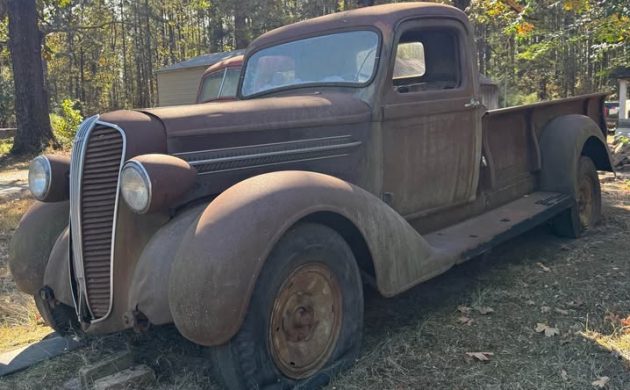
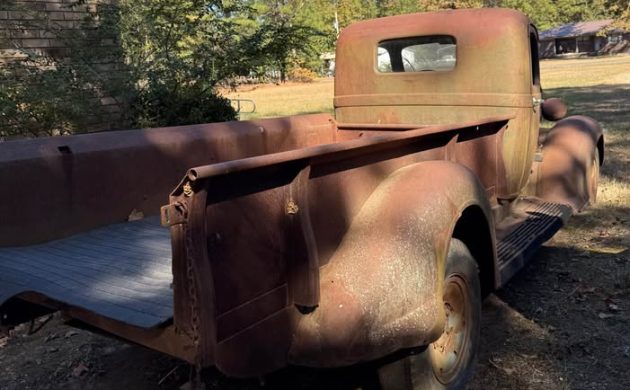
The Dodge Brothers made their first truck in 1917 by converting a WWI ambulance design into a commercial delivery vehicle. That truck sat on a car chassis, with a wheelbase of 114″ and a load capacity of 1000 lbs (less than the Gorilla dumper cart I just bought!). Twenty years later, the company replaced the underpinnings with a beefy ladder-type frame, triggering the production of a long march of capable, Ram-emblemed trucks. Here on facebook Marketplace is a 1937 Dodge MD-16 pickup, ready for restoration. The MD was part of Dodge’s streamlined series, and it’s the big daddy; the “D” refers to the 3/4 ton version, the “16” gave buyers a 136″ wheelbase under a 9′ bed. (For a smaller option, buyers could choose an MD-15, on a 120″ wheelbase with a 7′ bed.) The seller wants $5000. He’s owned the truck for two years, and while it still has its original key, there is no title. Haul it home from Sheridan, Arizona. Zappenduster spotted this stylish Art Deco Dodge for us – thanks!
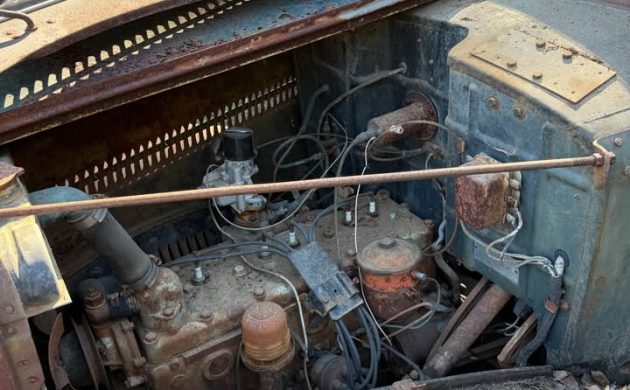
In 1937, Dodge increased the displacement of its flathead six to 218 cu. in. This engine was used across its product lines, making about 75 hp in trucks and about 85 hp in cars. A floor-shift three-speed manual was the base transmission, but research shows that a four-speed could be had for a $25 upcharge; hydraulic drums at all four corners took care of braking. The engine hasn’t run in years, but it will turn by hand. Looks like someone might have tried replacing or rebuilding the carb.
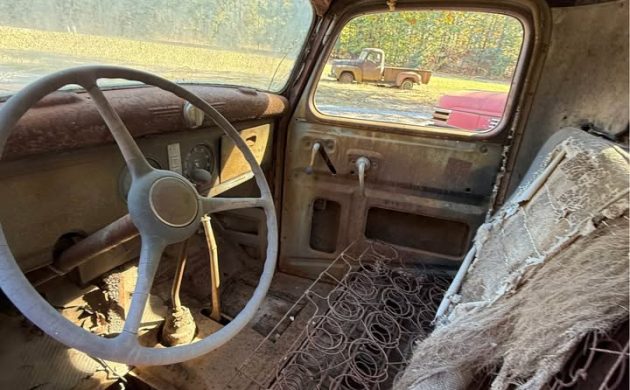
The interior… needs improvement! But hey, it could be worse – at least the seat frames and springs, interior handles, steering wheel, and gauges are present. The Art Deco influence can be seen in the linear indents on the dash. Looks like the seller might have another truck or two on the grounds – always fun when you can see multiple vehicles in one visit.
The ultra-talented Raymond Dietrich was Chrysler’s first chief designer, working from 1932 through 1938. His crew styled everything that came out of Chrysler in those days. Dietrich also founded two coachbuilders, LeBaron Carrossiers and the eponymous Dietrich, Inc., which specialized in custom bodies for luxury cars. He was inducted into the Automotive Hall of Fame in 1974. (Anyone know what non-automotive product Dietrich designed near the end of his career?) While 1937 marked a pre-war/post Depression high for Chrysler production, these trucks remain vanishingly rare. What do you think, is this Dodge worth restoring? And what path would you take if it were in your shop – restomod, or factory original?


Oy, okay, seems I’m not alone in wanting more trucks( dig), and this is no exception. Trucks are just so much more universal. I simply can’t figure out where these folks are getting their selling numbers from, these are the types of finds people would pay YOU to take. I know, turn the page, pops, still, it’s tough to see this kind of stuff with lofty price tags. Okay, the Plymouth, about 38 posts back, is a bit of a different story, this is square 1, and just too far gone. Very typical of something that baked in the hot sun, ignored for decades. Original key,,,oh boy, that’s the lamest attribute yet. I realize the ongoing struggle, stock or resto-mod, both with sound purpose, and the Plymouth was nice enough to leave alone, but I just don’t see any attraction like this. People are really scraping the bottom these here days, huh.
Good write up, Michelle! I always enjoy your posts.
A ‘37 Dodge. I can’t say that I ever saw a long wheelbase that wasn’t a Tonner. That’s okay; people needed long stuff hauled back in the 30s too.
I always liked the styling of Dodge/Plymouth/Fargo trucks in the 30s, and onto ‘39 and ‘40. As I said in other posts, I was not fussy about the ‘41 and up trucks because the headlights perched out on the fenders left a lot to be desired. Just the same I wouldn’t kick one off my driveway.
Driver quality rebuild would be the order of the day. I would keep the flathead six.
I’m not in the market, at least not right now, but I always enjoy looking at any old trucks that show up here. I’d keep it stock if at all possible, it needs a lot of work, but the right person, with some garage or barn space, and some long winter nights, with heat in the garage, could probably get this up and running again. Like Geomechs said, driver quality rebuild.
It’s a mess and there is no title, for only $5,000. Unless this is someone dream truck, better to keep looking.
Steve R
Since no one appears to care or bothered to look it up, I did check into your question about Raymond Dietrich. It seems that he doubled in designing electric guitars at the end of his career and without going in depth on the article I found seeing looks like he was using Gibson guts and parts to make them.
Now you know.