
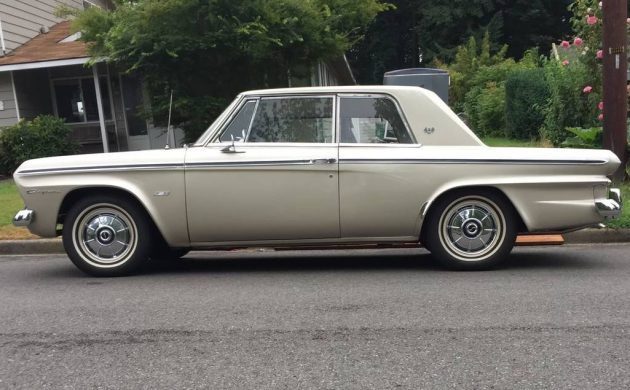
The 1964 model year brought major changes to Studebaker Corp. In December 1963, the company closed its long-time manufacturing plant in South Bend, Indiana, choosing to consolidate production in Hamilton, Ontario (Canada). They also phased out the Lark name, using snappier monikers like Daytona to describe restyled hardtops such as this beautiful ’64 2-door. Located in Canby, Oregon, this trophy winner is available here on craigslist for $15,000. And it’s a cool tip brought to us by “Curvette”!
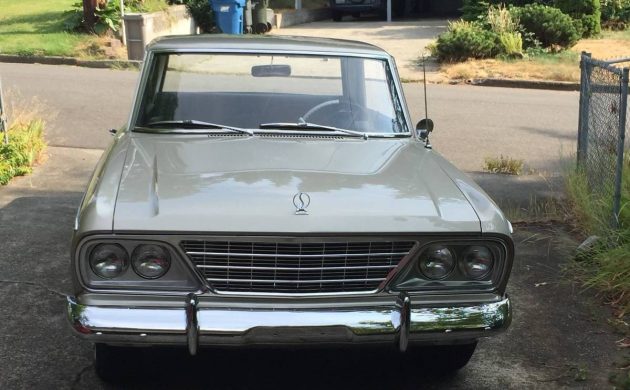
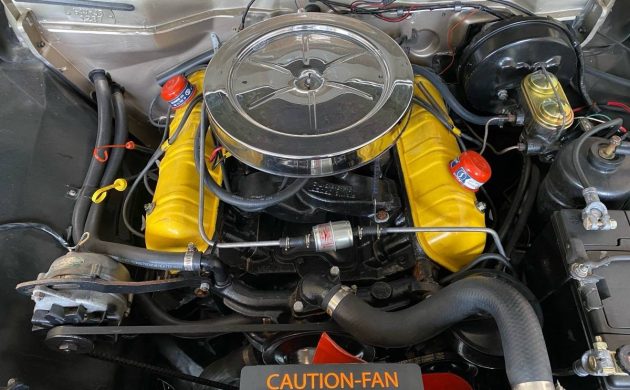
Shuttering South Bend not only meant the end of U.S.-built Studebakers, but it also meant that future propulsion would be outsourced from GM of Canada (Chevrolet). This exceptionally nice 1964 Daytona appears to have a Studebaker 289 cubic-inch V8 under the hood, suggesting that this Stude was probably assembled in Indiana. It was rare when new and even more scarce today, as only 2,414 Daytona hardtops were built in 1964, regardless of which plant had the honor. The seller offers no history on the car, but with 150,000 miles, surely it has been restored from head to toe.
We’re told the flawless goldish paint is a custom color, but I swear I’ve seen other Studebakers wearing this finish. Regardless, the vehicle looks spotless, though a few more photos would help show us why it has collected so many prizes (no pics of them). We’re told it has “no repair with no damage,” but that’s a bit vague. Does that mean the car was solid before it was restored (and when)?
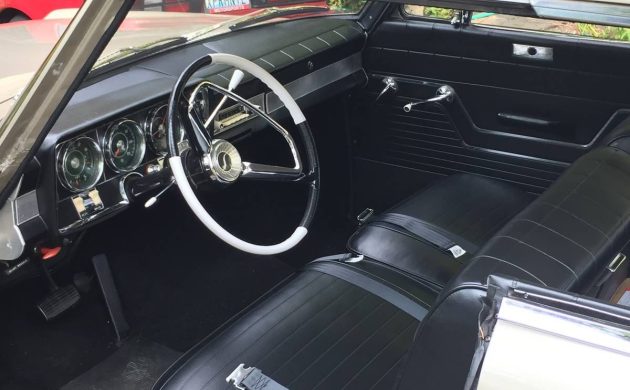
The interior is said to be new, and it looks like it. As you would expect, the automobile runs well, and we’d guess it could be driven to its new home rather than trailered. Anything made by Studebaker is getting harder to find. And with the demise of the Avanti and Gran Turismo when South Bend was mothballed, the ’64 Daytona hardtop is probably the most stylish of the latter-day Studebakers you’d want to search out.




Schmaltz aside( passing owner blah, blah,) I said before, we in Wisconsin had a kindred relationship with Studebaker. Both from mid size Midwestern cities, both important industries for their economy. We struggled back and forth between #4 and #5 car maker in the 50s, both great cars. It was ironic however, we( AMC) were riding high on the recent Car of the Year award( 1963), while Studebaker was going down. We saw no pleasure in that, a fate we ended up seeing later on. Got admit, Studebaker threw everything they had into this car, wonderful cars. Does anyone know what that red handle is under the dash? Automatic (YAY) so not O/D, hood release maybe? There simply cannot be many of these cars left like this.
Red handle is hood release.
You have to wonder if Studebaker somehow scooped Chrysler with the front-end treatment, or did Elwood Engel appropriate Studebaker’s design with the ’65 New Yorker’s front end?
We’ll never know who copied whom, or if the resemblance is a coincidence, but the resemblance is strong.
Now that you mention it Rex. You make a really good point there. I never thought about that grill design.
Looking at the side profile of this vehicle in the lead photo, it occurred to me that, if Studebaker had modified the front and rear areas of this car with new sheet metal to look more like the Mustang, and making the front a bit longer and the rear a bit shorter, it actually might have been more of a sales success. The interior looks great as is, and who wouldn’t want a V-8?
This has got to be at the top of the list of the nicest Daytonas left today. Very nice. Love the interior too. I agree with Russ. I ould have sworn I’ve seen other Studebakers this color. Really nice!!!
How is this not considered the first Pony car? Or hot rod for that matter?
I dunno- perhaps because Daytona isn’t a type of horse?
This is a great looking studebaker.
I could be wrong, but I thought all ’64 Studebakers used Studebaker engines. Once their supply ran out, they started with the 194 and 283 Chevy motors for ’65 and ’66. Maybe one of the resident experts will know. Too bad that he Hawk, Avanti and trucks were cancelled after the move, but by then I guess the writing was on the wall.
You’re correct. There were enough 170 sixes and 259 and 289 V8s avaiable to complete 1964 production at Hamilton. The installation of Chevy engines from McKinnon (GM of Canada) began with the start of 1965 production.
289 c.i. Engine has a real presence under the hood. Looks much larger than 289.
The Studebaker V8 debuted in 1951 and was inspired at least in part by the 1949 Cadillac V8. Studebaker engineers expected compression ratios to skyrocket in the future and designed the engine to withstand that stress. So not much thought was given to size or weight reduction, and thinwall casting had not been invented yet. This resulted in V8 engines that were large and heavy for their displacement.
The 1964 Studebakers were some of the best looking Studebakers ever built. Unfortunately, they did not save the company. Studebaker squandered resources on the Avante, instead of updating their volume sellers. The proposed next generation design was outstanding and might’ve sold well. But we will never know.
Studebaker and AMC should have merged. Two companies that held on way past their prime because of being resourceful. Good engines and nice designs and knowledge of economy of small scale. They could have produced some really nice cars working together. An AMX version of a Hawk? How about a Fiberglass AMX? Or a Daytona version of a Classic wagon?
Ok, I will go away now as it is time for my medication!(,lol)
Another site (Indie Auto) has a lot of ideas along these lines. The best one was Studebaker merging with International Harvester. They were trying to expand their pickup and SUV lines beyond the tight-fisted farmer customer base. Studebaker’s auto dealers in the suburbs and the automobile rows of cities would be just the ticket for selling Travelalls and Scouts.
That merger was “in the works” in the mid-50s. Nash, Studebaker, Hudson, and Packard were to merge, giving them a four-brand car lineup and Studebaker’s trucks to battle the Big Three. Nash and Hudson merged, George Romney ended up at the top of the combined company and decided that he didn’t have any use for Packard or Studebaker, so the rest of the merger didn’t happen, leaving two relatively weak companies instead of what might have been a viable competitor to the Big Three
predecessor to alota designs (AMC, Nash, Chrysler, and even 4 doors). Great design (in my mind) good mechanicals, durable. I’d drive it today…
64’s were nice looking cars but they should have come out 1 yr earlier may have helped a little. The only thing that I don’t like about the 64 design is the roof it goes up toward the back probably should have come down at least an inch or 1 1/2 inches of slope , then it may have followed the body line. Yea I think Chrysler stole some of Studes stuff like names,Challenger,,Daytona the split grill they had in 66 on the Daytona’s,,that looked sharp
I like this car allot, the price seems a bit high at first. However looking closer I think its worth it!
This car may, in fact, be a later ’64 built in Hamilton. The general rule of thumb, as I’ve always heard it, is that Soth Bend-built cars used color-keyed steering wheels while Hamilton-built cars used white steering wheels, but it’s possible that, with the black interior they may have used the white/black wheel. I can’t remember the last time that I saw a photo of a known US-built car with a black interior.
Correct – my Hamilton built 4 speed 1964 Daytona has the white wheel with the blue inside and dark blue outside. It runs the base 259 with the T10 and posi out back and longs for thr R1 that’s in my 1963 Lark Cruiser. My 64 and 63 both have the wide buckets as shown in this car with no console while my 1962 Daytona 4 speed has the small buckets with the baby console.
Forgive me for the lack of paint…..
Needs an R3
The “Lark” name may have been gone, but the body shell lived on. But what a gorgeous transformation! As a mater of fact I’ve ofen wondered if the central part of the Lark shell (A-pillar to C-pillar) didn’t go all the way back to 1953. Any truth to that?
I thought it went back to 48