

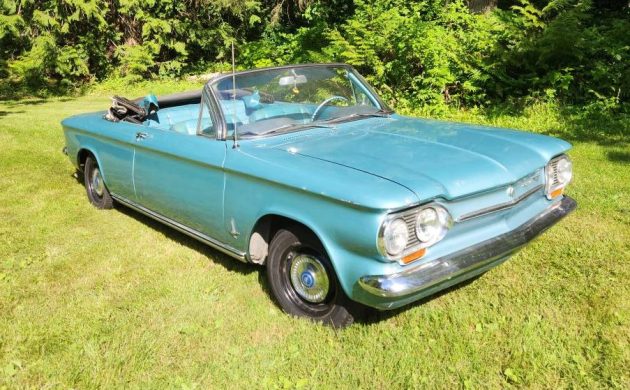
The Corvair was Chevrolet’s first foray into the compact car market in 1960. And borrowed some engineering concepts from the VW Beetle, aka it had an air-cooled engine mounted in the rear. It was popular, but its unorthodox approach may have inhibited sales, so the “normal” Chevy II was added to the roster in 1962. This 1963 Corvair is a Monza convertible with a rebuilt and enhanced drivetrain. Located in Graham, Washington, this nice running weekend driver is available here on craigslist for $7,500. Another great tip from, who else, “Curvette”!
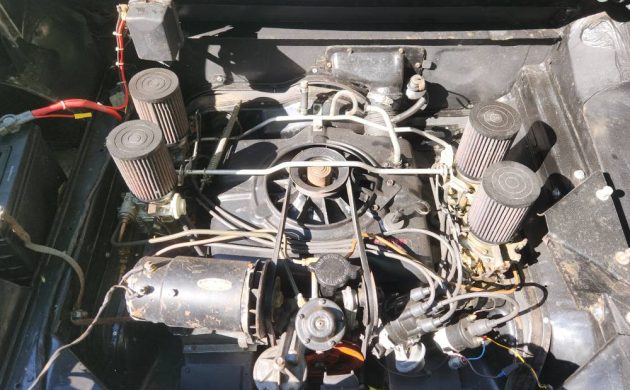
Corvairs were powered by 145-cubic-inch “flat-six” engines until 1964, when they grew to 164 cubic inches. Many Corvairs came with a 2-speed Powerglide automatic transmission that was adapted to work with the car’s transaxle. The pair in the seller’s car has been rebuilt and the engine updated to the 140 hp version of the motor with 4-barrel carburetion and dual exhaust. So, from a performance perspective, this Monza should be up to snuff at 90,000 miles on the overall package.
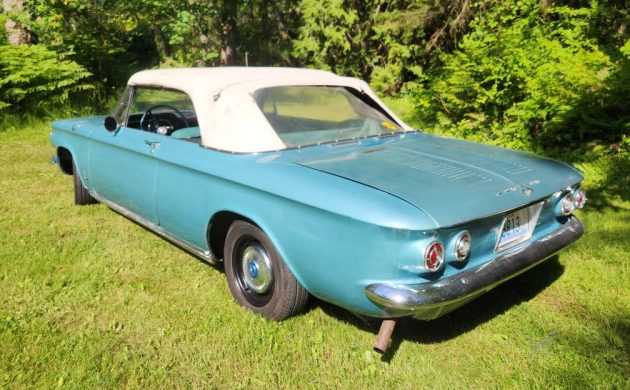
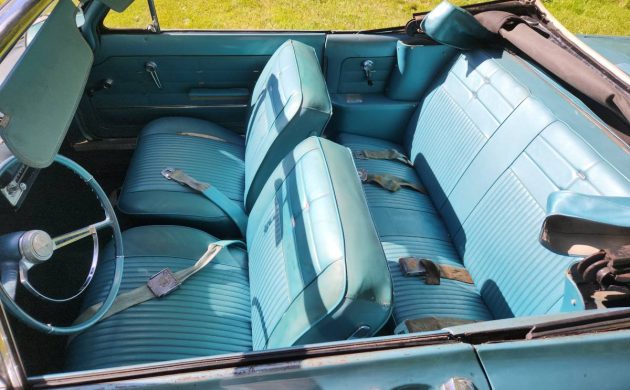
Cosmetically speaking, there are some issues here, but none of them involve rust. The turquoise paint has issues, particularly on the lid over the engine bay, and the interior is okay, though some seam separation in the upholstery has started to materialize. The white convertible top will shield you from the Sun, but not necessarily rain.
The Corvair was starting to hit consumer advocate Ralph Nader’s radar screen by 1963. That led to some suspension reengineering in 1964 that should have alleviated Nader’s concerns, but the car still ended up being the focus of his 1965 book, “Unsafe at Any Speed”. But if you behave yourself, this Corvair should be a nice little summer cruiser.

Ah yes… the old “Unsafe at any Speed” story… The only issue with the Corvair – particularly of this vintage – was that unlike most other American cars of the day that when pushed hard would go into terminal understeer… The Corvair due to its swing axle rear and unique weight balance would go into terminal oversteer… I wasn’t unsafe, it was just different… pick your poison.
Maybe the bean counters at GM in 1959 got what they deserved. It was designed with an anti-sway bar, $23, to keep the rear wheels from tucking under, which they eliminated, so, given the right conditions (and saw it on a straight, level, concrete road, with a big crosswind) the rear would hike up, rear wheels would tuck, and around it would go. They put it in the ’64’s and later, which if you kept the tires correctly inflated, something like 15 lbs in the front and 32 in the rear, made the problem history. So, if this has the bar added, it is a cool car.
In ’64, the swing axles went away, with a fully independent rear suspension fixing the problem permanently. Earlier cars could be fitted with a transverse leaf spring that acted as an anti-roll bar, available through the parts counter at your local Chevy dealer, if you didn’t check that box on the option list when you ordered the car! As seen on the Wheeler Dealers TV show!
It’s true, GM decision to leave off the front sway bar on the early cars and rely on differential front/rear tire pressures to tame the oversteer was probably not the best plan. However, they did start to address things starting in ’63 by making the bar optional and then in ’64 making it standard… along with the rear leaf spring that really tamed things. Interestingly, Triumph went thru the same learnings/evolution with the rear suspension on their Herald/Spitfire/GT6 models. The Herald wasn’t so much a problem because the car was rather slow and difficult to get in trouble with. The Spitfire and GT6 on the other hand were a different story and things could get quite exciting… Ask me how I know….
The aftermarket jumped into the fray early and had all sorts of suspension pieces available to solve the handling problem. It was folks like my mother who owned 2 early models that just drove the cars around town vs. the idiots who liked pushing the limits of the cars. Front sway bars, rear cross camber spring, rear sway bars, etc. I autocrossed my ’65 Monza on the factory suspension and cleaned house. The fix was spot on.
While I prefer the 2nd gen cars, the 1st gen has its own cool factor. This one seems like a good deal for a fun car.
True. It’s got sort of an “In your face, Ralphie Boy!” vibe to it, LOL!
Nader the spoiler? Having driven an early Corvair hard (don’t tell my mother. It was her car) I didn’t see any issues with the car.
Drove my mother’s ’60 a lot as a kid. Never an issue, except the under “frunk” gasoline heater was a headache creator. Drove an uncle’s new Porsche 911 as well, the Corvair was much easier to keep on the road.
Even though I’ve owned five convertibles in my lifetime, having one of these cars has always been my goal, mostly because it was the first convertible I ever drove. A high school friend loaned it to me to make a short trip across town. I still remember the thrill of looking around and seeing nothing between me and nature. As was typical for these cars, the drivebelt slipped off and the car wouldn’t start. I had to call my friend to come fix it. She had all the tools and plenty of experience, so we were back on the road in no time.
Just for clarity, is this the 145 or 164 engine? It has the 140 HP carb setup, but still appears to be using the 145 CID. Maybe not quite a 140? There are other differences than the carbs. An actual 164/140 has larger valves and better exhaust also.
It is likely a complete 140 engine, with the exception of the generator/oil filter stand/mount, and the engine cooling tin. Installing 140 heads on a 145 engine requires a fair amount of work and the effort is hardly worth the time/expense. Most early swaps to a late engine involve a change from the generator to the 65 up alternator.
This looks to be a great beach cruiser as is. First thing I would do mechanically is change that serpentine belt. It snaps, shows over.
Out of curiosity, how would you accomplish that? People have tried to improve the stock setup basically since they were introduced. A good belt, properly tensioned and with the belt guides adjusted correctly don’t come off nearly as often as the rumors make it sound.
I meant put on a new belt.
Ralph Nader, creator of the original “Fake News”…
If this Monza was really road worthy and Nader was still alive, I’d take him on a ride guaranteed to make him crap his pants. I’ve owned three Monza’s, two of which were ’63’s. They handled like a dream and were the original GM/CHEVY Huggers.
I would say to see that!
I mean PAY TO SEE THAT! Duh, curse these fat fingers…
I’m surprised that the person responsible for the engine upgrade chose to stick with the generator, rather than go to the alternator. It is a common change on many non-show type early model Corvairs.
The body/paint could certainly use a redo. I’m partial to the 4-speed cars, to me the powerglide is meh. I would be curious what differential ratio “lower gears” represents. AFAIK, the GM options were 3.23 and 3.55, with 3.89 produced for the trucks/vans. I’ve heard of custom 3.07 and 4.11 sets.
My dad bought the last new 1961 4-door model 700 in August of 1961, in Toronto, Ontario. It was a 110 hp, 3 speed manual transmission, turquoise, beautiful little car. Handled well, and I even drove it on the road, at 12 years old. Great car. Spunky too.