

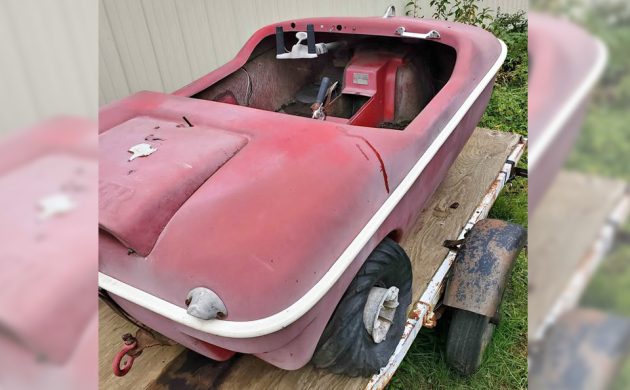
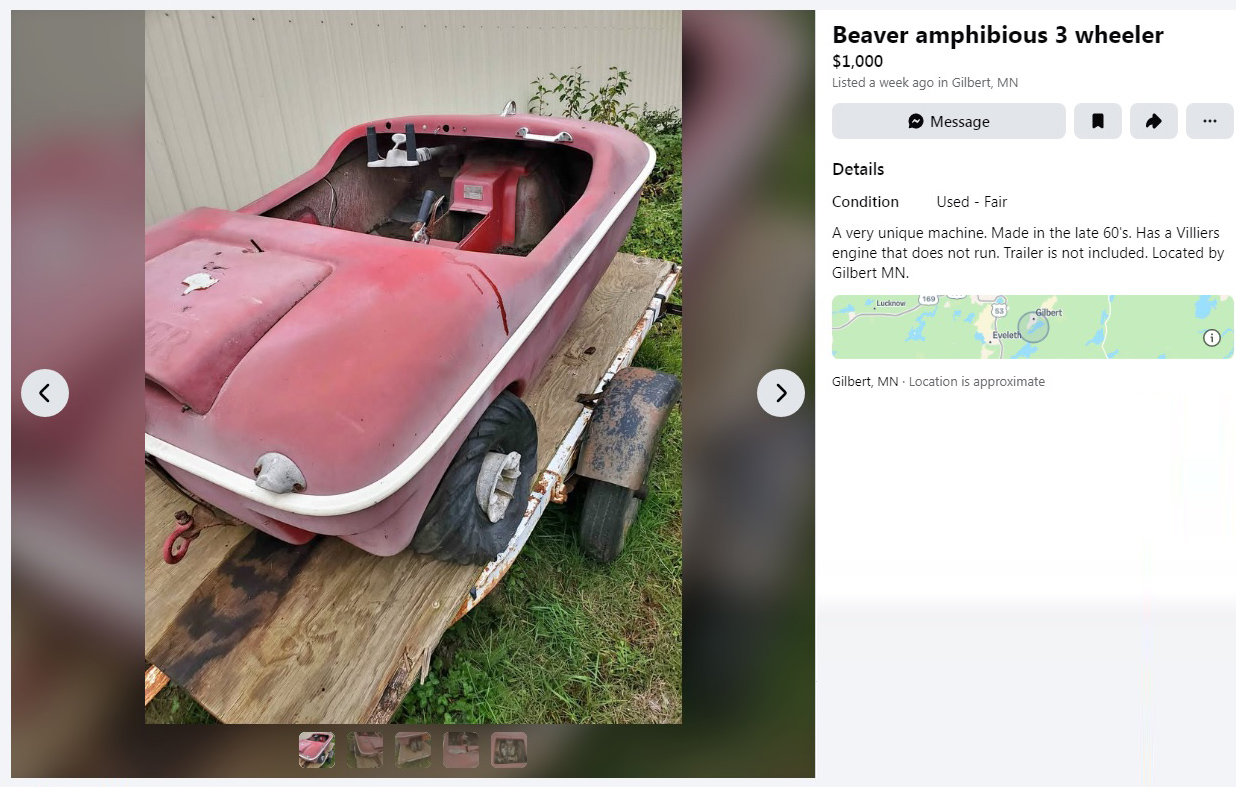
An incredibly enticing project that’s fairly close to home, cheap enough, and looking at least mostly complete, this unusual 1960s Wheeler Beaver Amphibious Vehicle can be found listed here on Facebook Marketplace in Gilbert, Minnesota. The seller is asking $1,000. Here is the original listing, and thanks to Gilbert G. Gilbertson… er… hey, wait a minute. I couldn’t pass up this one when I ran across the listing a few days ago; let’s check it out.
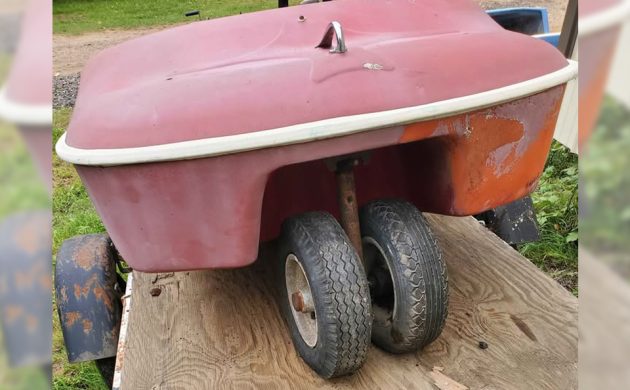
I wish someone had a book of all the ATVs and unusual off-road vehicles made in the 1960s and 70s. I know, just use the internet, you clown! That doesn’t work for everything, as a lot of you know who have spent literally hours, days, months, and sometimes years trying to track down obscure vehicle information, as I have. I like Chevys and Fords, and Dodges, of course, but most of my passion lies with super obscure vehicles such as this Beaver ATV. I just bought two more bike/bicycle restoration projects, and I can’t even find a single photo online of one of them. More on those projects at a later date.
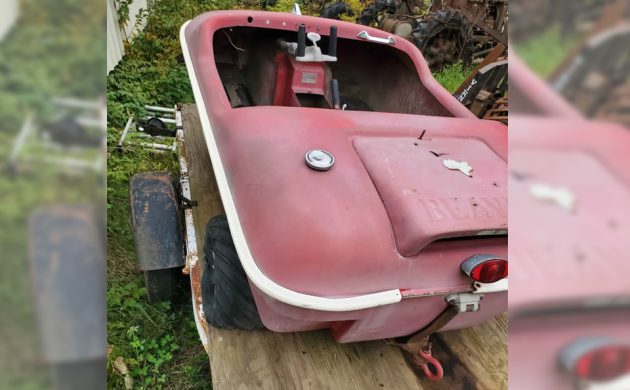
The Beaver ATV is at least somewhat known by a contingent of humans on the internet, and we know that it came shortly after the Penguin ATV. Both were made in Canada, near Toronto in Keswick, Ontario, with the Beaver having been produced from around 1967 until the early 1970s. The absolute golden era for outdoor fun-project innovation, with hundreds, if not thousands, of motorcycle, mini bike, snowmobile, ATV, and other companies making sure kids dream about their products at night, which I for sure did and still do. Here’s a very cool video on YouTube showing the Penguin and Beaver ATVs with some great detail, if anyone has any interest whatsoever. You can see the BEAVER name on the engine cover in the photo above. I love those kinds of details.
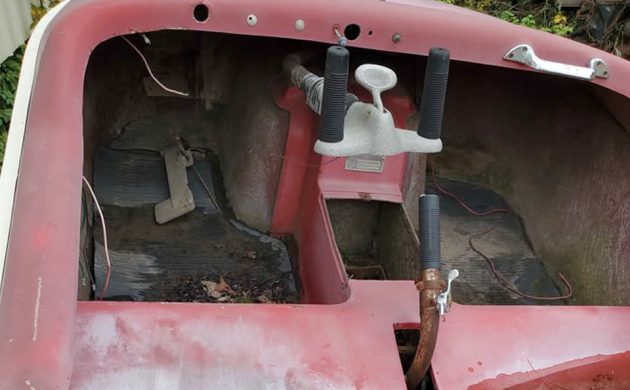
You can see that there are a few things missing here, but with some online sources, hopefully it can be restored to how it looked in the late 1960s when it rolled out of the Wheeler Mobile, LTD factory in Keswick, ON. A fiberglass “two-tub” design, the Beaver has a rubber strip where the two halves meet, and there is room for two passengers inside. It used a chain-drive system, powering the rear wheels, with reverse being accomplished by turning off the ignition and then turning it to the left. It looks like the ignition is missing here. At 350 pounds, this machine isn’t light, but it’ll travel on both land and in the water. Here’s the dash layout of a restored machine, as seen on another auction site a couple of years ago (BaT). That one sold for over $13,000, so this example is worth restoring for sure.
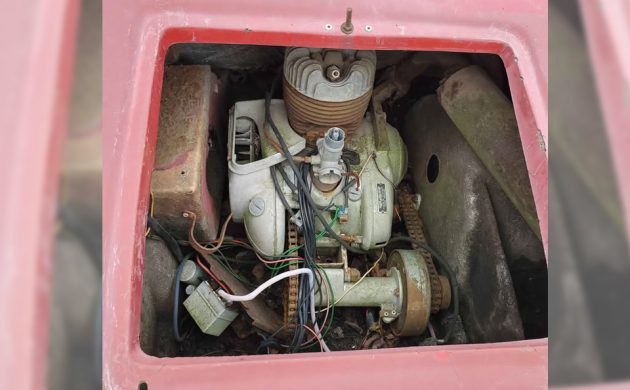
The engine is a two-stroke single-cylinder Villiers, but we don’t know the size. They came with either a 173-cc or 197-cc engine, and this one isn’t currently running, of course. The transmission is a four-speed manual, sending power to the rear wheels with directional tires that provide movement in the water as well as on land. These tires are shot, as you can see, and this thing needs a full restoration, but what a fun winter project. Have any of you heard of a Wheeler Beaver ATV?

This would look totally awesome restored!!!
I’ve never heard of the Villiers engine before. In fact, I’ve ever heard of a Wheeler either. I think Scottys right, we could probably spend years just trying to research how many of these manufacturers were out there in the 60’s and the 70’s. Nice find Scotty. Hopefully someone can restore this.
Villiers was an old name in British motorcycles, buying JAP (J.A. Prestwich) motors via shareholdings as a for instance. Villiers was best known for making engines for well known motorcycle companies as well as making airplane engines (no relation to the French biplane of that name) and not selling a proprietary bike of their own.
Thank you Nevadahalfrack. I always say I learn something new on Barnfinds. It sounds like a really good company.
Never heard of a Wheeler Beaver. Heard of a De Havilland Beaver and a gumball machine called a Round Beaver but not your machine, Scotty G.
Villers 2 stroke?!?! Last time they sold engines was about 1967 IIRC and Greeves had to find another engine to use. But that was actually a good thing for the guys I knew that rode Greeves with the Villiers engine. See, more than a couple times a rider would get the surprise of his life when he gave the kickstart a halfhearted kick and let fly on the clutch only to have it shoot backwards – the engine had fired up running backwards!
If you got your hands on this one, Scotty, we the faithful BF readers would pool our money to buy you a quality flotation device/life vest should you test your luck while determining the buoyancy of said small amphibian craft!
Oh, oh, Capn. Gilby, we have water coming in,,,bail, you fool,,I don’t know, doesn’t look sea worthy to me. What a site, we go from Beaver motorhomes, to Beaver ATVs, what a spectrum! I’ve heard of Villiers, but very few made it to the states, at least not in Briggs and Stratton town. We had that market covered, FOR YEARS! Probably as popular as a Briggs motor in England, but no matter, they all did the same thing.
This thing? Good grief, looks awful tippy, and will sink like a stone, but there was nothing to go on, fiberglass was becoming of age, and ATVs, the sky was the limit, as shown here. On dry land, looks like fun. I wonder how that 4 speed works in the muck? 2 stroke golf carts had the motor that ran backward for reverse too. Generally, they went to infinite ratio belts because there is no time to manually shift gears. I know that because my dad had a friend that bought a homemade snowmobile, some German motor and a foot clutch and 4 speed. It was incredibly clumsy and never survived the 1-2 shift. That shift lever(?) with 2 speed Sturmey-Archer O/D, reminds me of an old GMC semi I used to drive!
Might be a bit of a tight fit for a large person, but still preferable to the train-sized beaver featured a few days ago.
Where’s mustie1 this is right up his river.
It will be really fun calling shippers to quote on moving this little beaver cross country!
I think these look like fun! Here’s some info I dug up:
“The Beaver was descended from the Canadian Penguin amphibious ATV, manufactured by Pengor Ltd. in the early 1960s.
Following Pengor’s bankruptcy, Wheeler Mobile reportedly acquired surplus parts and developed the Beaver with a revised front-wheel arrangement. Many Penguin components were interchangeable with Beaver components.”
Manufacturer Wheeler Mobile Ltd.
Factory Keswick, Ontario
Production Approximately 1967–1970
Engine Villiers 173cc or 197cc, two-stroke
Power Approximately 8.5 hp (175cc model)
Transmission Four-speed manual
Drive Chain-driven rear wheels
Steering Dual front wheels on a common steering assembly
Top speed, land Approximately 35–40 mph
Top speed, water Approximately 4 mph
Hull Two-piece fiberglass
Seating Two people [I wonder if ONE person is “too tippy? – Clip]
Reverse Engine restarted in reverse rotation
A red fully restored example sold on [another website] for $13.4k in 2024.
Manuals, here: https://www.threewheelermanuals.com/wheeler-mobile
Thanks, Clipper. I thought that I had included most of that info in the article?
You did! Apologies for repeating…
Thank you for posting that, sir! It’s a great one-stop shop for info on this crazy machine.
I had one of these Beavers growing up. It was actually a pretty cool rig. Very slow in the water, not much for paddles on the rear wheels. (Warning) With the tricycle gear it dose flip with out much effort. “I’m sure I wasn’t hot dogging it.” it threw me out I laded face down, and it landed across my legs. (I’m pretty sure i was lucky it didn’t land across my back..) Yup reverse was a trip. Just shut it off and turn the key the other way. Villiers engine was the weak link. if I remembor correctly it had an electricial issue and we couldn’t find parts. Off to a small engine shop it went, and I never seen it again.
Looks like someone in the UK has picked up the mantle for providing Villiers engine parts… https://villiersservices.co.uk/
boat big object to throw lots of money in good luck finding parts
The Beaver was made in Keswick, but Penguins were made in Ottawa, then Carleton Place.