

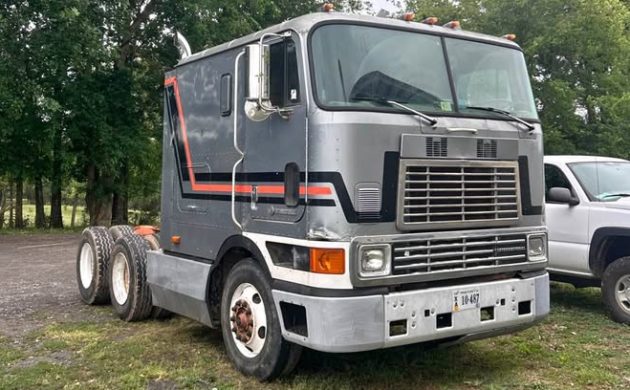
This 1992 International 9700 series cab-over caught my eye for a few reasons, but the most significant of which is that you simply don’t see this era of truck anymore. True, the cabover design has more or less disappeared with the exception of any haulers still using them, but this version of the International seemed to take inspiration from what was happening in the automotive world at the time with cosmetic aerodynamic enhancements to streamline the body as it cut through the wind. The seller has listed his rig here on Facebook Marketplace for $6,995 after recently getting it running following a 10-year slumber.
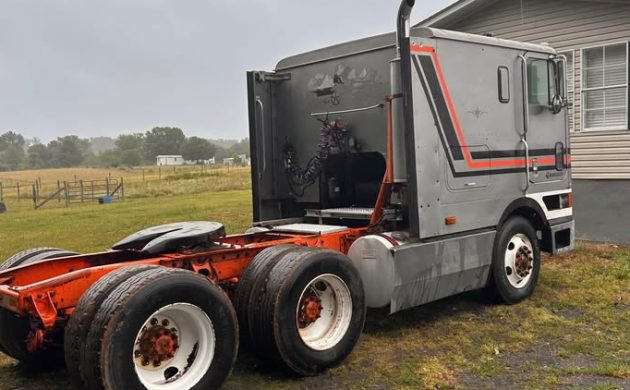
I bet there’s a story behind this body stripe running down the sides of the cab, and the orange paint on the chassis. Surely, this was used by a local company as that paint scheme is way too specific; it didn’t come this way by accident. The cabover design effectively went off into the sunset once laws changed that allowed for trucks to be a longer length, which made for a smoother ride. Of course, many of us have warm memories of the COE as it’s often associated with some of the more memorable cab designs over the years. The seller notes that this 9700 is powered by a N14 Cummins diesel engine with a 9-speed transmission.
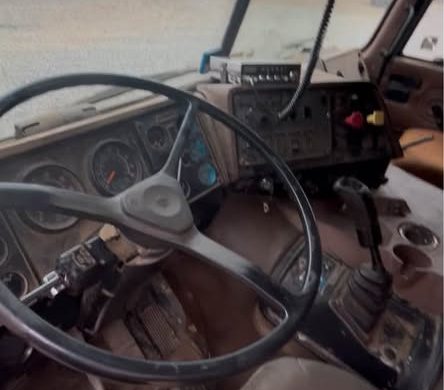
The lower body skirting is the most interesting feature on the outside, but these trucks were fairly unique inside as well. With a completely flat cab floor thanks to a design that eliminated engine intrusion into the passenger compartment, it effectively had walk-in flexibility to the sleeping quarters. Now, I’m not a truck expert nor do I have much experience spending time in a rig like this, but it looks like there’s still a hump here. Perhaps the intent was more to make it easier to walk between the cab and the sleeping areas without having to step down and back up again. I’m sure one of you who has spent time driving a 9700 series could clarify for us.
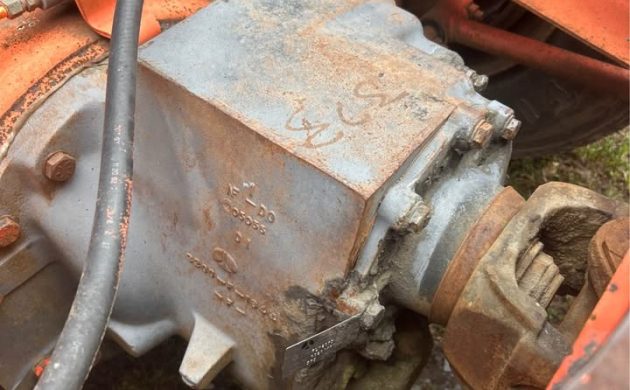
The listing notes it doesn’t have a Jake brake, which is a nice feature when trying to slow down a massive tractor trailer. As far as why this one doesn’t have this feature, it’s likely just a matter of being ordered that way from the factory, especially if this was just an in-town runner for lighter loads. Whether this International is collectible is a subjective matter, but given I’ve not seen one in the road in years, I suspect it has some level of desirability to someone with a cabover collection lacking what was likely one of the last major redesigns of a mass-produced COE. If you’ve got any memories or insights into the International 9700, we’d love to hear them.

When I first saw this. My first thought was Schneider trucking. They used to run Cabover Binders like this. ( I’m pretty sure they were Flat Tops and not Condo cabs, or maybe both). Another possibility is J.B. Hunt, they may have had orange painted frames. The Cummins N14, the 9 speed, and no Jake are also telling me this may have been a fleet owned and operated truck. ( They stick to a low price point). I never ran an N14, maybe Stan, Howard or Geo could chime in on that. But the Cummins M11 with a 9 speed wasn’t a great match. The gear ratios were a bit too spread apart and the Cummins revved down sloooooowly. So whether you were slip shifting or double clutching it took a little long to catch that next gear which could be a challenge going up a hill, but you get used to it. I always thought at least a 10 speed or up would’ve been better suited for that M11. Thank you for writing this old Cabover up Jeff!!! Can’t wait to see the comments.
I drove an N14 hooked to a Super10 for a few years, it was a nice combination. This looks like a standard issue JB Hunt, the flat floor, big sleeper was a big part of their recruiting policy. Our N14s used the “new” computerized engine controllers to run 300 hp on foot feed, 375 on cruise. JB’s were set at a straight-up 300. You had to be a ballet dancer to get through those doors with a front staircase. Not that lots of guys didn’t brain themselves by slipping off the back-of-the-wheel ladders in the wintertime.
This truck is extremely cool, imo.
I drove an International for a few months for Schneider Specialized back around that time frame. It was an 8 speed I believe, with a new at the time Detroit Series 60. Had a three stage Jake.
Sigh, well, it’s not the Peterbilt I was hoping for, but if I don’t comment on this, one might think I’ve gone to the big truck stop in the sky. Well, not yet, consarnit, and we’ll take it. Some additional facts to Jeffs otherwise well written post.
The terms “aerodynamic” and “cabover” don’t belong in the same sentence. Like the Jeep, as aerodynamic as a box. It seems the aerodynamic part, the roof fairing has been removed. Why, is a mystery. It’s what made the truck, aerodynamic. The only exception would be a tanker yanker. I’m quite sure this was a fleet truck, as I don’t know anyone that would actually buy one new. I can say, from experience, they are the absolute worst trucks to drive. I drove a similar setback axle cabover Freightshaker for the union bread company. It’s a testament to my driving skill I never ran over anyone or anything with that truck. I’d take a Transtar 4070, that this truck( 9670) replaced any day, and that’s not saying much.
In 1982, the gubment changed overall length laws, and while trailers could be no more than 48 feet,( later 53 feet) overall length was abolished, and you could have as long a truck tractor as you wanted. There was still a call for these setback axle cabovers. Typically, they can turn better, and provide more weight on the steer axle. That combination proves for an awful ride, and one may as well drive with blinders on. Cabovers have an inherent right side blind spot. The right tank was always dented. As conventional trucks slowly became the norm, the cabover faded from view. I think the last cabover made in the US was Freightliner in 2006 with the Argosy. I say good riddance. I hated every cabover I drove. I knew drivers that would quit if told to drive one. I drove what the boss told me to. Not so in Europe, where one never sees a conventional, all cabovers.
Big freight outfits had hundreds of these, and eventually wound up on farms, as a cheap way of transporting grain and such. They were still good trucks with literally millions of miles.
The shift lever, which I believe was a long cable, was a “find and grind” setup, especially with wear, and the setback axle somehow created more room in the cab, frankly, I don’t see it, it was still a chore. Mechanical repairs, as Geo will agree, were a nightmare, but for a company truck, they hauled a LOT of terlet paper.
Recently, there was a big push for “pre-emission” trucks, from 2000 and earlier, that were exempt from DEF and emission controls. Suddenly, everybody wanted a pre-emission motor, but I think soon, ALL trucks will have to comply, except farm, that skirts a lot of regulations.
Thanks for featuring this, International( dropped the “H”) went through some rough times, thanks to Volvo. Volvo singlehandedly decimated Internationals class 8 business, for years, and only now have begun to make a comeback. This truck here is still what would be called “old school”, and pales in comparison to a new truck. Automatics, emission controls and ELDs have changed trucks, to these rolling apartments that are practically driven by themselves, ( no, self driving trucks will never happen) and encompasses none of the situations us old timers put up with. I’m not sure who is going to drive our nations trucks in the future. I read, 50% of new drivers don’t make it 6 months, and another 25% don’t make it a year. That’s unsettling, and more than we need to go into here, but I feel you will see the National Guard driving AM Generals pulling Swift trailers. I truly believe it will come to that.
Thanks again, Jeff, good job!
Dave..I’ve never driven any cabover. Howard.. you HAVE to always pay attention while driving a manual. Older the rig, even more so.
I agree. I didn’t have a Jake in that truck either. I always downshifted to a stop as much as possible. I always went easy on my brakes. This way, when I DID need them, they were there.
“The terms “aerodynamic” and “cabover” don’t belong in the same sentence.”
Perfect, Howard!
I guess I can put in my 2 cents worth. I have actually driven several cabovers in my 40 years of trucking. My brother taught me how to drive in a 1968 Freightliner COE with a Detroit engine and a 4×4 transmission, it actually had 2 gearboxes, a main with 4-speeds and an auxiliary 4-speed. Hooked up with metal rods from the shift levers to the gearbox. No power steering or no A/C. Talk about having your hands full. I agree with Howard, you should not say cabover and aerodynamic in the same sentence. Except maybe that wrap around part of the front bumper. I do not understand what you mean by ‘flat floor’. Impossible in a COE. The ‘doghouse’ runs from the radiator all the way to the rear of the sleeper, as can be seen in the picture of the back of the cab. There is a special group of truckers all across the country that collect and restore cabovers. I must admit, when I see a custom cabover coming down the road, it will make my head turn!
Woofer, total respect to ANYONE who can drive a twin stick setup in a cabover. I know mine was a super long rod running from the trans up to a stubby shifter in the cab. There’s not a whole lot of room by the doghouse to run one shifter up, let alone two, and the feel is not as good, which you absolutely need especially with a setup like you drove.
Just out of college I went to the oil field.
Got to drive numerous cab overs doing fracturing, acidizing and nitrogen Frac jobs.
Drove an old Mack sand truck with a Quadraplex transmission. Yep, 2 sticks. Found out real quick you skip 3/5 of the gears. Start in low range, shift out to direct get going!
We had International cabovers like this one pulling several Frac Pumps. All had Detroits with 13 speed Roadranger transmissions. Heavy as Hell however they pulled those heavy Frac pumps through the cotton field, muddy roads to the well location!
I completely forgot to mention. The truck I was talking about was a ’98 Freightshaker Cabover that had the Cummins M11 and a 9 speed. I hauled medical gas in the NYC area, Manhattan and the boroughs. I can absolutely agree with Howard on the blind spots. And driving through Manhattan was very tiring, not just because of the vehicle traffic, but also the bicycles and pedestrians that would walk out right in front of you. You had to watch your right side mirrors like a hawk for anyone walking into your blind spot. You cannot see your right side tank. And yet, I still have a soft spot for cabovers. But like Howard said, a conventional is much easier to get into and out of and see out of as well. Plus a better ride too. I felt every bump and pothole on the Deegan and the Cross Bronx Expressway in that Cabover sitting over that front wheel. It was a solid mounted cab no air ride, sprung suspension. Only the seat had air. ( I think that truck singlehandedly diminished my ability to hold it in any length of time). ( In other words…… I drink a lot of coffee as a truck driver, it has to go somewhere 😅)
-Dave
Hey Dave, bunch of old gear jammers a ratchet jawin’, by gar, just like old times, as if. The Frightliner[sic] I drove was a ’95 ish FLA “triple air” ( suspension, cab, seat) 315 Cat and a 9 speed and was a very difficult truck to drive. It had a total of five(5) mirrors on the right side. Today trucks have cameras for blind spots, but it was truly dangerous. Also, the clutch chattered so bad, with the air ride cab, it was downright “jumpy”, and unpredictable. You had to just “sidestep” the clutch pedal and pray.
That was the only trucking job I had an ELD, and would never want another job with one. It goes agin everything I held dear as a truck driver.
Oh, btw, you could always tell someone not used to a cabover, as the right side wheels were riding on the shoulder, :D
Howard. I completely know what you mean. I learned early on a great way to “center” the truck in my lane. But yep I remember seeing “Newbies” off to the right! A I forgot about that.
How about the other way around.. Drove a cab over day in and out. Then when to COE was in for service had to drive a conventional pulling a dump trailer.. Everybody said I was in the middle of the road in and out of the quarry!!
When they tried getting around ELDs and emissions, these were coming out of the woodwork. Guys were bragging about low mile N14 COEs they found and were putting to work. I told them the reason there aren’t any miles on it is because nobody wanted to drive it when it was new. I see this has a Rockwell 9 speed, so you won’t be converting that to a 13 or 18. While this is nice, it won’t be in revenue service.
The best (or worst) thing about a cabover, especially a set back axle cabover is that you’re the first one at the accident.
I think I’ve driven every model truck that IH built since the mid fifties until the nineties, but I’ve never sat in one of the 9000 series, and not sure if I want to.
If I had to guess, I’d have to say this is an old Schnieder truck with a pretty good paint job.
I would like to know, however, how many miles are on the clock.
i think i would remove the 5th wheel plate and convert this to an RV, otherwise i would snag that 5 place car hauler trailer on Hibid and start buying some cars further away for a flip.
AERODYNAMIC ? . . . that thing has the Aerodynamics of a WALMART . . .
I drove a cab over for about 10+ years. First a Brockway (F model Mack cab) and then 2 freightliners. I only drove one of these IH cable shift COE’s once and it was a nightmare!! I have to agree with Drive in Style and Howard this was probably originally a fleet truck as many of the smaller fleets also followed JB’s and Schneider’s specing. Today this truck is really only useful for farm work and/or a collectors show truck. For $7k, possibly dickered down toward $5k, This truck will make a great entry into the antique/historical truck show hobby. With antique/historical plates you would NOT need a CDL going to shows or parades.
I was given a choice of a new tractor back in the fall of 93: a Freightliner bus axle condo or a 9670 set forward steer Condo; guess which one I chose? The best cabover I ever ran and definitely in the top 5 of the best road tractors I ever ran! DD 60, 13 speed(IIRC), excellent handling, fantastic visibility, great ride and a comfortable, livable unit! And to top it off: a very capable tractor! I was a driver trainer at the time and my carrier had a dedicated run from Hayward CA to Waterville ME and back. I had over 25k on that unit in under a month, a truly great rig, I put over 350k on it in 3 years and that cab held together better than many large cars I have pushed!
A sleeper for local delivery work? Come on Jeff. I drove 1 18 wheeler. It was a family emergency (not my family). It was a cab over International that rode “like a truck”. Big surprise right? It was for about 250 miles of mostly flat roads. (Illinois to Iowa) It was an experience I will always remember and (and don’t care to repeat) and created an appreciation for all those who do/did it for a living. Thanks to all those truckers that haul everything we need and desire!
In the late 70’s, a company I drove for had IH cabover sleepers. Terrible trucks with sleepers the size and comfort of camping cots. Between the sloppy shifters to pot metal door handles that would break off in your hand, I’m surprised they’re still alive today as whatever they’re called.
It’s not a flat floor.. You have to crawl over the dog house to get to the sleeper..The way it’s built with the set back front axle, it rides pretty good. i’ve drove a couple of them..
altho not COE (what beat up the drivers) I like small tight turners like this:
https://www.youtube.com/watch?v=jh3VV3ueVhM
I had a White Compact doing P&D for a freight company. No power steering. You had to get it in 1st, and jockey the clutch to get it moving in tight turns. I had a LTL 9000 with PS that turned easier than that White did.
Lots of memories here. Like others, drove some COE, mostly worn out Binders, in the oilfield. Pulled modular houses from north of Denver to southern Colorado right down Federal Boulevard for a couple years with COE Freight-shaker. Used a Western Mack COE to haul sod, all this in the 70’s. Most had sloppy quad box, a couple with 13’s. Have a slow time getting in conventional now, sure would hate to have to climb that COE ladder repeatedly!!
9800 series with the flat floor was the best cabover.
The first cab over I ever drove was an early 70’s GMC with a 318 Detroit and a 13 spd.
I was only 21 and I thought hearing that motor rev and grabbing gears great. But when I got in my later 20’s and got to drive a 78 International Eagle conventional with a 400 Cummins and a 13 spd. I finally got to know what power and comfort was.
I was always amazed that cabovers went the way of the dodo in the states – they still seem to thrive in the European, Asian, and Latin markets, undoubtedly due to the much narrower roads and streets. I would hear the comment “first to the accident scene” about cabovers, which had a hint of truth. The operator was up high enough in these to avoid some injuries or fatalities, with the exception of running into another semi, bus, or train. I kind of miss seeing these out on the roads today.
IIRC a Mann COE participating in the commercial class in the Dakar rally. (a normal occurrence) Had the misfortune of the cab landing face first on a jump. I think there were casualties. (3 in the cab) I suspect that the current issues of C.O.E. trucks in other countries have improved from what they were here in the states 30 years ago. I drove a large ISUZU C.O.E. tractor (not a low cab forward .model) about 10 years ago, and rather enjoyed it. BUT, it was without a trailer and with minimal traffic around. AND I didn’t have to climb in and out several times a day. (My knees start screaming even thinking about it!)