

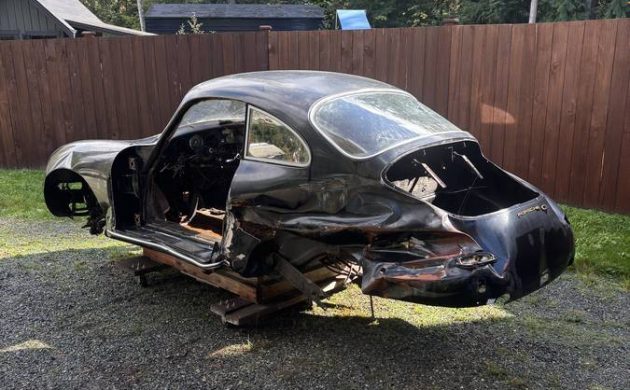
Fate dealt this 1964 Porsche 356C a cruel hand when it suffered significant accident damage years ago. To make matters worse, the engine and transmission are long gone. However, the body is complete, and it has a clean title. Whether it is a viable project candidate will spark debate, and I will be fascinated to hear your feedback. I must say a big thank you to Barn Finder Curvette for spotting this poor Porsche listed here on Craigslist in Enumclaw, Washington, for $7,500.
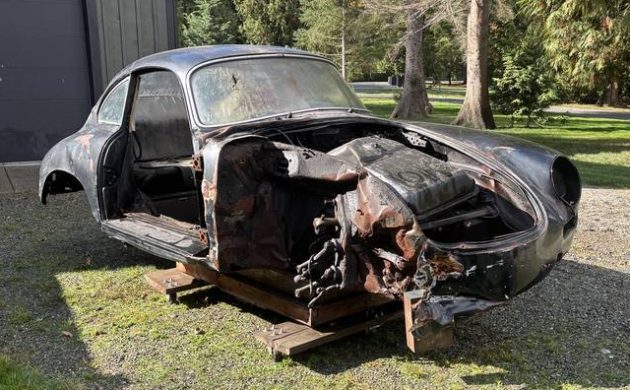
Porsche introduced the 356 in 1948 as its first production model. It aimed to produce a sports car with low curb weight and nimble handling, and although its engine produced humble power and torque, the 356 proved a giant killer on track. The 356C emerged in 1964, with our featured car a first-year example. It was once a glorious piece of automotive engineering, but what appears to have been a significant accident has reduced it to a shadow of its former self. The front-right and rear-left corners bore the brunt of the impact, and the A-pillar appears bent. I believe the passenger-side front footwell may also be bent, meaning any restoration would require significant structural repairs best handled by a professional. The deal includes some additional good panels and, surprisingly, the floors appear free from penetrating rust. The windshield is cracked, but the remaining glass looks okay.
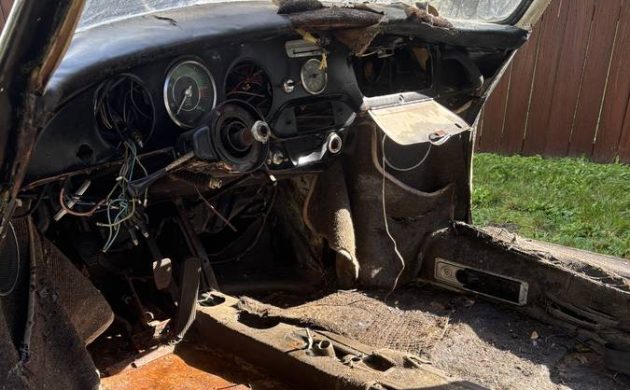
The photos suggest that this Porsche’s interior is a “what you see is what you get” proposition. It retains its wiring harness, steering column, and pedals, and the tachometer and clock are intact. Otherwise, it is a blank canvas. Any restoration would go beyond a retrim, because the new owner would need to source hardware like seat frames and replace other missing components. The deeper we dig, the longer the shopping list gets, and the higher the invoice pile could climb.
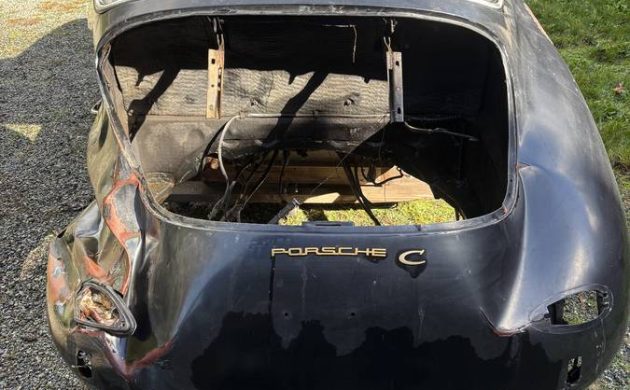
Ferdinand Porsche strongly advocated rear-engine mechanical configurations, arguing that it put weight over the driving wheels and kept most of the noise, smell, and heat as far from the car’s occupants as possible. The 356C followed that philosophy, with its air-cooled 1,582cc flat-four sending 87hp and 91 ft/lbs of torque to the road via the back wheels and a four-speed manual transaxle. Those figures are modest, but the featherweight 356C still provided very impressive performance. A healthy custom market also let owners extract a few additional ponies, which was a common practice. This Porsche is missing its motor, transaxle, and most of its suspension and steering components. There are a few minor parts, but most of the significant items are long gone.
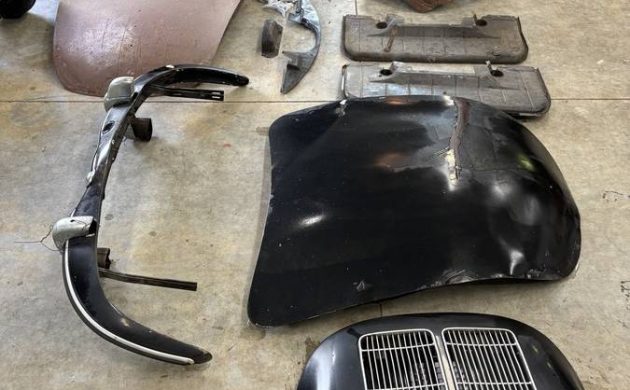
This 1964 Porsche 356C is a sad sight, and with so many parts missing and accident damage, it might initially seem like a lost cause. Any restoration would require significant cutting and welding, and the buyer would need to source almost every mechanical component and a complete interior. Their wallet will be significantly lighter before they can start bolting it together. You can occasionally find a driver-grade 356C for around $50,000, though better examples start at $80,000. From there, six-figure sale prices are not unusual for pristine vehicles. This 356C requires a massive capital injection to reach that point, but do you think it is worth it? I believe it is probably beyond the point of no return, but it will be interesting to read your comments.

I’ve replaced the front half of a 914 but haven’t worked on something this bad. Did pull panels out of a ’59 roadster to fix other cars or built them out of sheet metal, which takes time, skill, and if you are paying someone else to do it lots of money. Got unlimited funds and want a project, buy this one. ”front half” car in picture.
It would not surprise me if somebody actually pays 7500 for this car.
In pristine condition a 1964 Porsche 356C has sold for $80,000-$140,000.
Looks like this one got the Malache Crunch!