

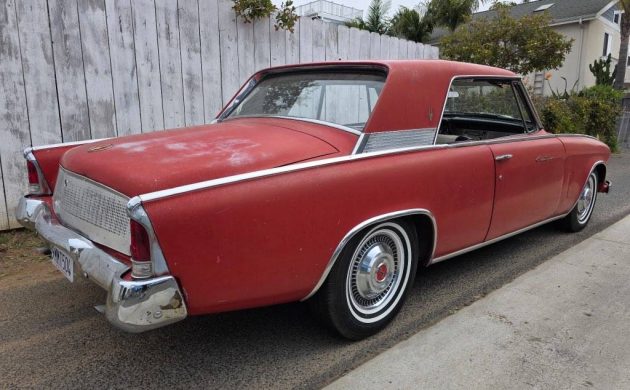
Much has been written and said about Studebaker’s fabulous GT Hawk, particularly the supercharged “Jet Thrust” versions, and for your review today, that’s exactly what I have. This discovery is a 1962 edition, and all in all, it’s in pretty fair shape. There’s one characteristic of this car that concerns me, but I’ll explain that in a bit. Located in San Diego, California, this stylish Studie is available here on craigslist for $11,995.
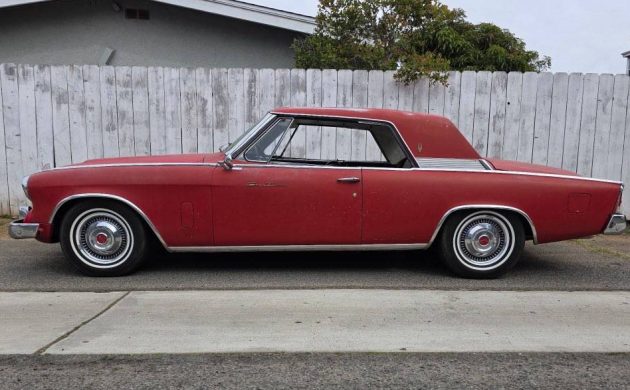
By 1962, Studebaker was closing in on the end of the line for its auto manufacturing business, but it wasn’t going to go down without a fight. Its sporty Hawk model, a staple since 1956, was redesigned for the ’62 model year and designated as the Gran Turismo (GT) Hawk. It was popular at first (9,300 units in ’62), but sales fell off rapidly in ’63 and were further compromised by the cessation of U.S. Studebaker production in December 1963. This example looks pretty sound; the finish is noticeably faded, but the body shows as solid (typical California car?), and there’s no indication of crash damage. Unfortunately, there are no images of the Hawk’s front end included.
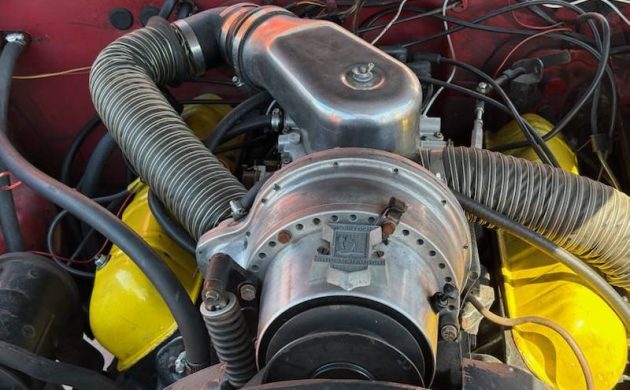
The matter that I raised earlier concerns the supercharged engine. Studebaker’s promotional material and other research sources don’t list the “Jet Thrust” engine as available until the ’63 model year, with only the more staid version (210 or 225 gross HP) available in ’62. This hot “blown” version squeezes one HP per cubic inch out of its 289 CI displacement. So, is this an add-on supercharger, or are my research sources incorrect? I can’t say. Equipped with a four-speed manual transmission, the seller states, “Vehicle starts right up, no overheating, shifts and drives like a dream.”
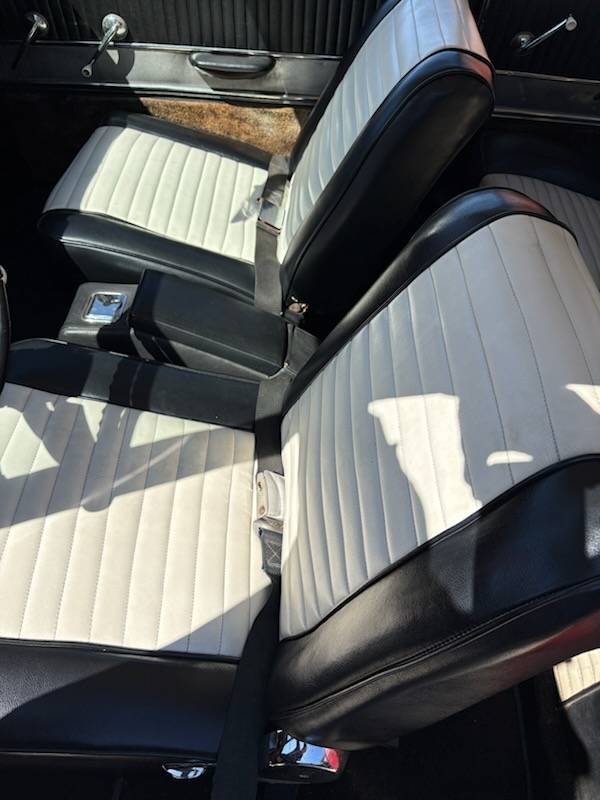
The interior is not well photographed, but from what can be seen, the two-tone black and white upholstery looks great! This is a bucket seat/center console-equipped interior, and I believe it excels in its understatement. Unfortunately, the lower door panels, from what can be spied, are looking shaky.
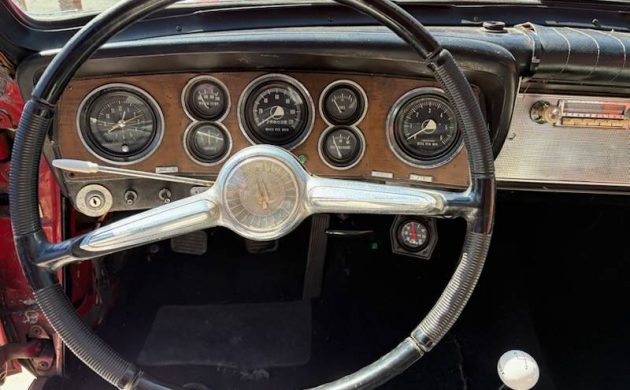
The instrument panel is far and in the way, one of my favorites – it’s all business and easy to read. The gauges are clear, and the Walnut trim looks straight and not warped, cracked, or faded. The dash pad, however, is starting to split.
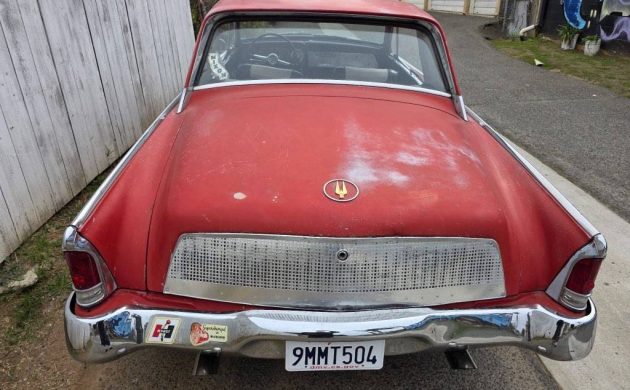
I’d like to know more about the supercharged originality of this car, but I consider that to be a minor issue. It seems that a repaint is all this car really needs, and even that’s not essential at this point. Of course, the mileage is listed as 100K, which I interpret to mean the odometer has been once around, and knowing that, some things like the suspension, etc., may be tired. So tell me, with an ask of $11,995, is this GT Hawk priced right or not quite?

The supercharger appears to be an “owner add-on” – I think there’s a couple emblems which should be on the car if it came from the factory with the Paxton unit, one of which I posted.
Sorry, wrong photo, and I was thinking of the 1963 GT Hawk which had the R2 version available with the supercharger and had a distinctive grille and trunk lid emblem.
Yep Todd…..no factory Supercharged cars in 1962. The motors should be stamped JTS 1111 on SouthBend cars and JTCS 1111 on Canadian built cars on the engine pad in the front above or behind the water pump. The S is for Supercharged – the stock R1 motors would just have JT – for Jet Thrush.
Looks like an older McCulloch unit to me – I would think Studebaker would have deleted the name off the blower’s casting. And stillrunner’s right, no blower in ’62.
The Studebaker Corporation owned Paxton Superchargers
The Studebaker Corporation owned Paxton Superchargers
Wrong, the R1 would not have an emblem, Only the R3
Must be a blast to drive J.O 🏁
Ticks all the Hawk boxes for me. Try shining up the paint a little and then drive it like I stole it. Too far away from me, a good thing. Think this one’s gonna go pretty fast, figuratively and literally.
Apparently the blower is an add on, nowhere in the Craigslist ad is it mentioned as originally equipped ,
Question to all you “I know everything” club. Does this supercharger have a manual boost, and if so, where is it? I don’t see any “Suspicious” buttons on the dash, or at least none within easy reach of the driver.
What is a manual boost? The older superchargers such as this McCullough included a switch in the throttle linkage that caused the variable pulleys to close in and increase impeller speed.
Dial to show the boost and a separate know to dial in the amount of boost.
If only it were closer. That thing is a deal and they were great cars back in the day. Normally not thought of when speaking of muscle cars but these ‘bakers could put some of them to shame.
Those are the ugliest valve covers that I’ve ever seen!
If you could hold your horses another year – the 1963 R1-R2-R3-R4’s would come with chrome covers and valley pan….look for a picture somewhere – those are the correct yellow covers for base V/8’s…..
I agreewith the emblem on the top of the supercharger. Looks just like the emblem on my uncle’s Kaiser supercharger. I also think that the “carburetor hood” is too newish looking.
I still love the car!
I’ve always liked these and the body of this Stude looks solid and it’s a 4 speed! As other folks have pointed out the supercharger appears to be aftermarket and all for a $12k price. If it were closer I’d go take a look.
Pick it apart all you want but to me it’s a steel!! If I had 12 Gs I’d fly down to San Doiego and drive it home to Monterey Co. without asking any more questions. After almost 75 years it’s a very good possibility that several modifications could’ve been made to this classic car and I would be proud to own it.
Cool Studebaker. These are neat looking cars!!
Studies rule!!!!
I’m not a Stude expert but that cut out in the fan shroud for the blower is definately not factory….and it looks like they even failed to paint the cut edge.
Would the tail fins from an earlier Silver Hawk fit this GT? If so, and it became my car, then I would find some and install them on this car, that would be my choice!
At first glance, it looked like a two door Lincoln from the 50s. Always like the car and the year.
These are susceptible to rust. My 62 GT had a passenger door that didn’t close properly. Had to replace inner and outer rocker, floor, door hinges and half of the tranny hump. Good news is that Studebaker International is an amazing source for just about anything you need to fix one…except for fasteners. Heater core is under the pax seat and can be a problem. Replacement cores are not available anywhere I can find. But other than that, these are great looking and driving cars, and this one looks like a steal!
Here’s a picture of my Hawk