
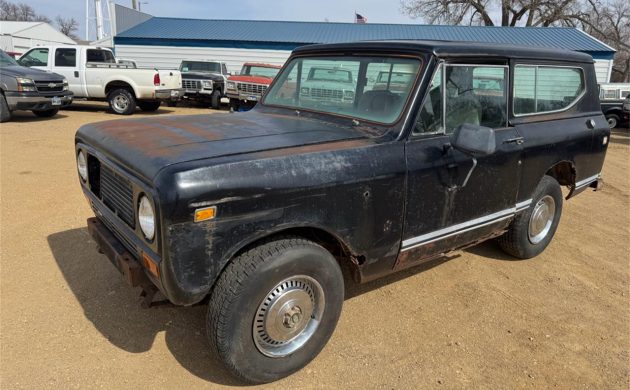
This 1977 International Scout II is listed for sale for a super low price. After looking at the close up pictures, one might say that the $1,250 is for whats left of the Scout II after the rust bug has eaten away the lower fenders, rocker panels and rear quarters. The Scout II is located in Brookings, South Dakota and is listed here on ClassicCars.com. The vintage 4×4 market has grown in popularity recently. Classic off-roaders like the Ford Bronco, Chevrolet Blazer, and Jeep CJ have skyrocketed in value, bringing their once-overlooked competitor—the International Harvester Scout II—firmly into the spotlight. For prospective restorers on a budget, finding an entry point into this segment can be challenging. We appreciate JDC sending us this listing offered by B&B Auto Sales in Brookings, South Dakota, priced at an ultra-low $1,250.
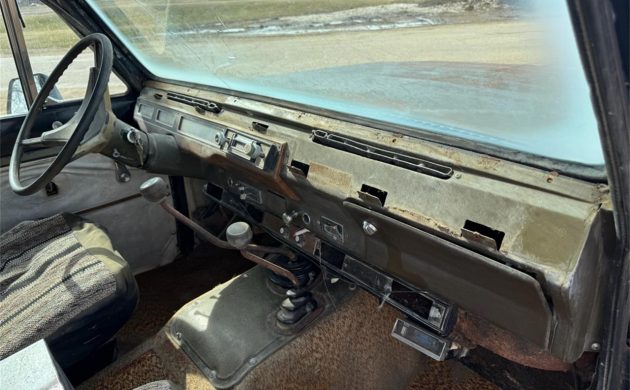
At first glance, the price tag is highly tempting. However, the listing details and accompanying photographs present a sobering portrait of a neglected Scout II. Wearing a faded, battle-worn coat of black paint, this Scout II (Stock #14689, VIN G0062GGD10757) is a textbook project vehicle. The dealer explicitly notes that the vehicle does not run or drive, the engine is completely seized, and the body suffers from extensive rust. In the classic car world, particularly with Scouts, rust is the ultimate adversary. International Harvester did not prioritize rust prevention at the Fort Wayne, Indiana assembly plant, meaning that a Scout with visible body panel rot often conceals even more severe decay along the body mounts, floor pans, and inner rocker panels. Requiring a trailer just to escape its current home in South Dakota, this vehicle represents a monumental fork in the road for any buyer. Do you fix it or part it out? As shown, the interior is shot but looks better than other parts of the Scout II.
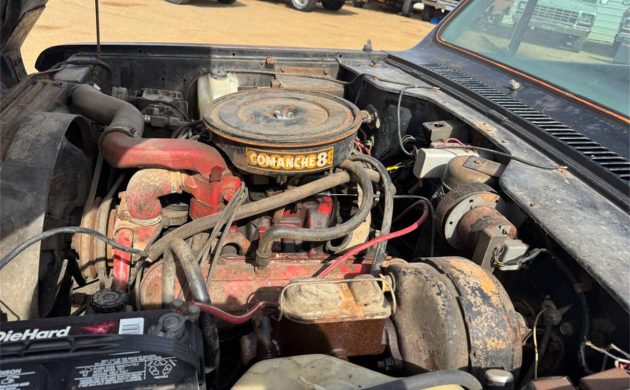
To evaluate its potential, one must understand what a healthy 1977 Scout II brought to the table. By 1977, the Scout II had solidified its reputation as a highly capable, comfortable alternative to Spartan utility vehicles. Under the hood, buyers in 1977 were treated to a robust selection of powerplants. The base gasoline engine was the economical “Comanche” 196-cubic-inch inline-four, essentially half of a 392 V8 block, producing roughly 110 horsepower. Those seeking more muscle stepped up to the V8 options: the 193-horsepower 304-cubic-inch V8 or the 345-cubic-inch V8, which pumped out 309 lb-ft of low-end torque. It is a common misconception among novice enthusiasts to confuse the IH 304 with the AMC 304; the IH V8 was a heavy-duty, proprietary engine built for industrial longevity rather than high-rpm performance. Additionally, starting in 1976, International offered a naturally aspirated Nissan SD33 3.2-liter inline-six diesel engine, which was highly reliable if somewhat underpowered. It looks like this specific South Dakota project is equipped with the popular 304 V8 mated to a rugged four-speed manual transmission, a desirable combination for purists.
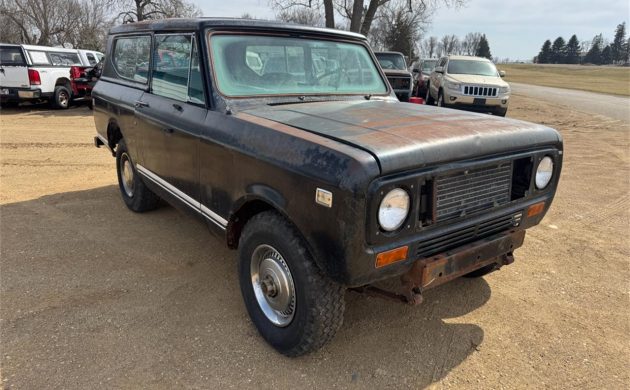
Aesthetically, the 1977 model year epitomized late-seventies automotive styling. The front end was dominated by a distinctive chrome grille (missing on this example) featuring two large horizontal bars and three vertical segments, with the “International” nameplate proudly mounted on the left. The color palette of the era was incredibly vibrant, offering iconic shades such as Glacier Blue, Sunburst Yellow, Grenoble Green, Dark Brown Metallic, Pewter Metallic, Buckskin, Fire Orange, Winter White, and Terra Cotta. Buyers could configure these colors with striking factory applique decals—such as the famous “Rallye” package stripes—or luxury trims. Ultimately, this $1,250 Scout II is not a project for the faint of heart. Restoring a vehicle with a frozen engine and terminal rust will easily eclipse the finished market value of a clean driver-quality Scout II.
$1250 is cheap just for the running gear
More pictures please , thanks TomG
Nice write up. Will Scouts become the next Broncos $$$ I’d say yes.
I think this one might be more valuable parted out????