
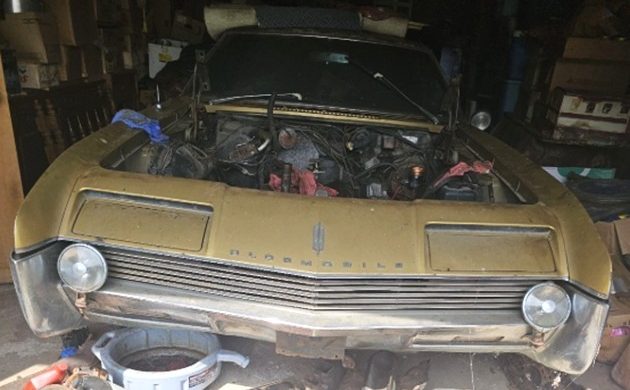
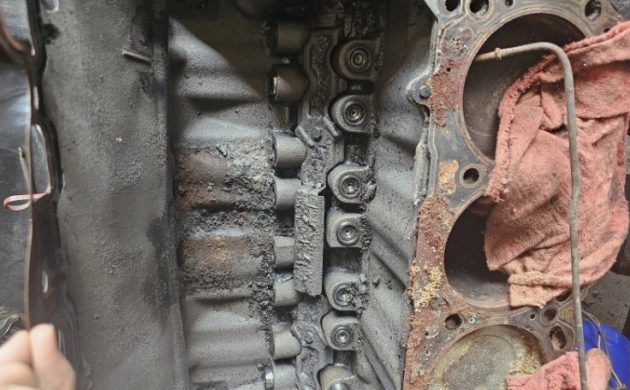
Oldsmobile added a personal luxury car to its portfolio in 1966. The Tornado was based on the Buick Riviera, which arrived three years earlier, but with one important distinction: front-wheel-drive. The Riviera used rear-wheel drive, like everything else built by the Big Three. Cadillac would go the FWD route, too, in 1967. This first year Toronado has been tucked away since 2013 with a troubled and disassembled V8 engine. Located in Cellina, Ohio, this forlorn project is available here on eBay, where the no-reserve auction has only reached $500.
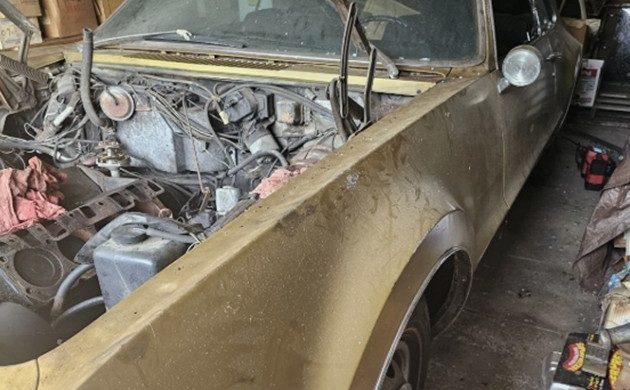
First-gen editions of the Toronado were produced from 1966 to 1970 on the way to a run that ended in 1992. To pull off the switch to FWD, a modified version of the Turbo-Hydramatic transmission was needed, adding a transaxle. In 1966, Olds’ 425 cubic inch “Rocket” V8 was deployed. This car was a huge step forward for GM as it was the first American auto built with FWD since the Cord 810/812 in 1937. The Toronado did well enough to generate sales of 41,000 copies in its inaugural season.
The seller’s car is a Toronado Deluxe, which attracted 85% of buyers with a fancier level of trim. It had been a one-family car when the seller acquired it a dozen years ago. One side of the Olds has a little body damage due to an accident way back when, and also a bit of rust. There were some issues with the engine, so the seller started taking it apart, concluding later a rebuild was needed. That’s where the work stopped. Some extra parts are part of the sale.
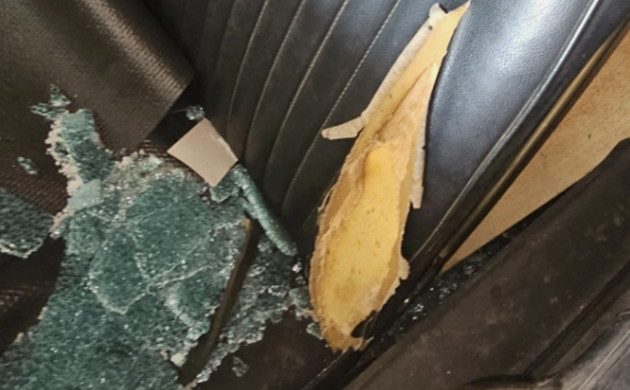
Corrosion extends to part of the floors, but the seller believes the majority of what you’d find should be of the surface variety. We’re told the interior is clean, though the photos don’t help much. The seller would have displayed his wares in a better manner by taking the photos in landscape mode rather than portrait. The seller has run out of time (and maybe interest) to continue with the project, so someone else gets the chance.


I can’t quite grasp how the Toro was based on the Riviera.
The Riv uses the GM X-frame, the Toro has a perimeter frame; The Toro has front torsion bar suspension, where the Riviera uses coil springs; and of course, the Riv uses conventional rear-wheel drive technology, and the Toronado is front drive.
So, the cars don’t share a frame, a floor pan, a driveline, a suspension, and no discernable body panels. Where’s the similarity?
I see what you’re saying Rex. I think I remember reading once that there was certain body panels that you don’t see, and I believe the windshield that they had in common. I agree, the frames and drivetrains couldn’t have been more different than night and day.
That being said. I think the Riv, the Toro and Eldorado were are unique and beautifully designed cars. All 3 have great lines. Although I have to admit, the Riv and Toro edge out the Eldorado to me at least.
This one needs some love for sure.
Curbside Classic recently posted a deep dive into how the ’66 Toro and Riv were related, and how GM pulled off their sharing of major structural elements despite their significant differences in powertrain layout and chassis configuration, not to mention body styling:
https://www.curbsideclassic.com/automotive-histories/1966-buick-riviera-versus-1966-oldsmobile-toronado-closely-related-yet-so-different-part-1/
They both have four wheels and a spare
The makeshift headlights are quite an interesting work around for the (assumed) non functioning pop-up ones.
That’s pretty funny, and possibly, but I think they are merely additional driving lights. Seemed it was Fords that had the wood blocks in the headlight doors.
The headlight mechanisms on these are actuated by vacuum, both up and down, with vacuum being applied to one side or the other of a vertical plastic housing (about the size of a large coffee can) that has a plunger with a rubber seal. The other end of the plunger arm is connected to an arm on the headlight. I see now that there appear to be electric conversions, which I longed for back in the day.
The front wheel bearings on the 66 are one year only- and if I recall correctly they were manufactured by New Development for GM, and they were actually a lathe bearing. 20 years ago they were several hundred dollars a side.
Just to clarify, the Toro was not “based on the Riviera”. Both the Riv and the Toro shared the new-for-1966 E-body platform. The Eldo joined them for the 1967 model year. The 1963-65 Riv was unrelated.
Thanks Joe, but…. specifically what parts of the platform were “shared”? As I posted earlier, the driveline, suspension, floor pan, etc. were not common to both cars as far as I can tell. So, again, where’s the similarity?
The ad text description says it all. What a sad story. This car was abused forever.
It will never roll again under its own power. R.I.P., poor car. We hardly knew ye.
shame that an owner with what looks like no skills ripped this apart. i would guess that motor is now junk by looks of it. this going to become most likely a parts car with the rust issues and other issues it has. real shame here
I really like the “original ” Toronados. This poor old thing was rode extremely hard and put away gasping for breath. Then covered over with a soaked blanket to die. This discussion about the frame reminded me about these. The frame only goes back as far as the front mount for the rear leaf spring. (Just under the rear passengers feet.) The rear mount for the rear of the leaf springs and shocks are entirely mounted to the body. Making this (and I’m sure the Eldorado also) a combination body on frame AND unibody car. Saves weight (which doesn’t seem like a priority on these cars.) But does offer some road noise isolation? Just a guess. Any GM designers out there know the reason??
So not a GM designer, but I am restoring a 1970 Toronado and literally just swapped out the frame-to-body mounts this week (they finally were accessible once the engine and transmission were out!). There are four at the front of the body bolted at the ends of the transmission crossmember under the firewall. Then, there are two more mounts between the crossmember and the body at the rear end of the torsion bars (about mid-body). In the few times I drove the car before disassembly, I REALLY felt the bumps and bruises of the road through those dry-rotted mounts. This is likely because about 70 percent of the car’s ample 4,300 pounds is on the front wheels, and from the factory it is intended to have a slight rake with the nose upward of the rear. I think you are right about weight savings to some extent, though my main belief is that a full unibody simply could not have handled all that horsepower and torque (in 1970, the 455 was rated 357hp/510ft/lb) up front without a lot of body twist and, more important, vibration/noise in the passenger compartment. These were marketed as luxury cars — the gentleman’s hot rod… “the ultimate escape machine,” per Dr. Olds literature — so that cloudlike ride quality was important. And if there ever were torque steer issues, they were solved by 1970. You can steer these with one finger. This is just my experience and my two cents. I just like talkin’ Toros lol. I’d welcome the thoughts of a GM tech or somebody with actual knowledge ont he topic.
Yep! Jimmy got a tool box for christmas. But hey, its got a full tank of gas…. probably where the needle stuck 30 years ago.
The “I’m going to restore it some day” person who decided they weren’t, but made the situation worse by messing with things. 500 is the most it should be.
Oh, on the discussion about the added on lights. These are “Spot” type driving lights. Giving you the longest possible distance for “high speed” driving. Even in their weakest form, you could not use these against oncoming traffic. I appreciate the location not blocking the radiator. However, in the most desirable mounting location(s) for driving and spot beams are to the roof so that you are looking “down the beam” and fog lights are to be mounted as low as possible to look out “over the beam” to help eliminate reflection of snow and water/moisture droplets back into your eyes. Back then the Europeans had the best lighting and “road codes/laws”. And these are “E” code lights. Our lighting rules here were highly inadequate. And in my opinion still lacking in design AND enforcement. Those “quad atacked.headlights” on the newer F series Fords should be banned. Ad to the fact that once you load one of those trucks and the rear goes down just a little. It amplifies the blindness to oncoming traffic.
Maybe the last of the ‘gold cars’, as a popular paint pick?
Broken glass on one of the seats, wonder what the issue was?
Lost the keys (or the keys were in the ignituon) and the car was locked! I’m betting the door glass is not cheap.