

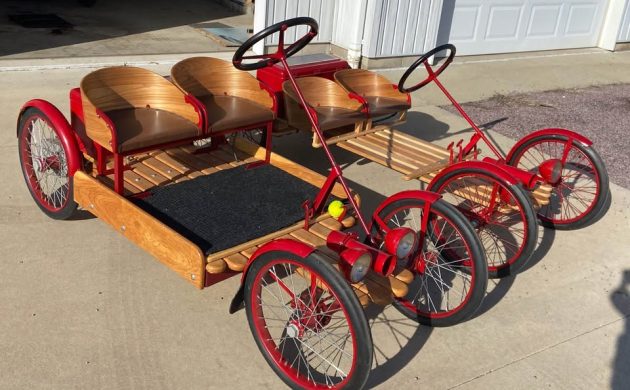
I have previously described some classics as representing motoring at its most basic, but the 1928 Auto Red Bug takes that concept to the extreme. Don’t be fooled by the appearance, because these were genuinely roadworthy motor vehicles in their day, providing motorized transport for buyers on a strict budget. The seller’s listing could represent a once-in-a-lifetime opportunity, because you could buy either of these classics, or take the pair as a package deal. I must say a big thank you to Barn Finder NW Iowa Kevin for spotting this pair of quirky classics listed here on Facebook Marketplace in New Ulm, Minnesota. The “six slat” vehicle will cost you $12,000; you could purchase the “ten slat” for $10,000, or you could throw caution to the wind by taking home the pair for $21,000.
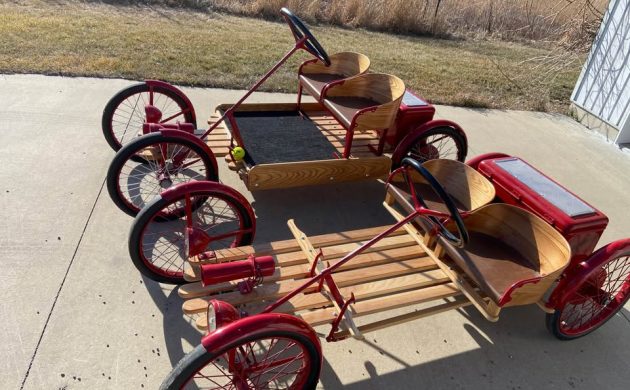
Originally developed by A.O. Smith and marketed as the Smith Flyer from 1916 to 1919, the Flyer’s rights were sold to Briggs and Stratton, who then marketed it as a gasoline-powered two-seater until the rights changed hands again in 1924. Automotive Electric Service Corporation, located in North Bergen, New Jersey, then sold the Flyer as the Red Bug from 1924 until 1930. Although most were bought by wealthy customers as “toys” and others served as resort transport, a few hardy souls actually hit the road behind the wheel of one of these classics. The seller’s listing is interesting because it is rare to find a pair of Red Bugs together. The “ten slat” version would be the more robust of the pair, thanks to the additional timber used in its construction. Both present superbly following restorations that included replacing the wood, tires, wiring, and upholstery. Fresh Red paint was the final touch, returning both vehicles to a factory-fresh state. Overall, either of these vehicles makes a positive impression.
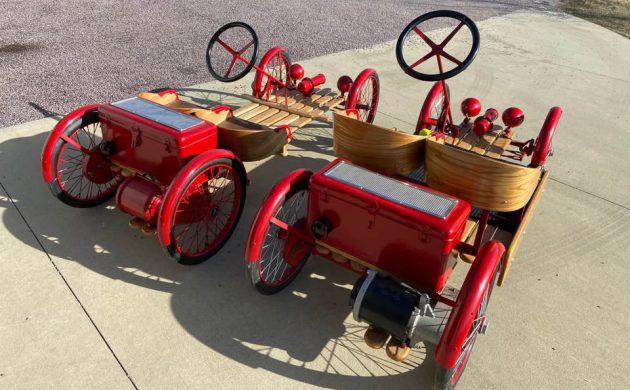
When produced by A.O. Smith and Briggs and Stratton, the vehicle that became known as the Red Bug featured a gasoline motor. However, Automotive Electric Service Corporation chose the electric path, powering the vehicle with a North-East motor. The 12-volt motor drove the right-rear wheel, while the left-rear wheel featured a drum brake. Depending on the load and terrain, a Red Bug could reach 10mph and cover up to 30 miles before requiring a recharge. A few owners upped the ante by fitting a 15-volt battery, improving both the performance and range. The seller’s restoration included replacing the wiring and some hardware, but it appears they followed a faithful approach throughout the build. The seller states that this pair is ready for action as soon as the buyer hands over their cash.
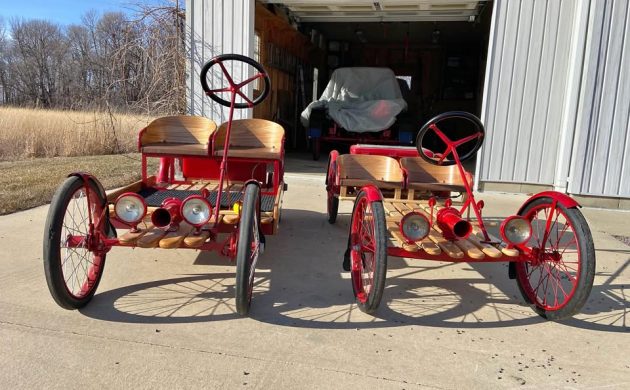
Henry Ford rewrote the rule book with his beloved Model T, bringing affordable motoring to the masses. However, the vehicle manufacturing landscape at this time was quite eclectic, allowing cars like the Auto Red Bug to achieve respectable sales to individuals who couldn’t afford a Ford. Finding one today is a rare treat, but the opportunity to purchase a pair as a package deal is almost unprecedented. I floated the idea of a “His & Hers” purchase, and the asking price makes that concept plausible. Would you give either or both of these gems a new home?

These are cool, I wish I had the cash to drop on them
Amen to that! These are downright kewl!
These two really peaked my interest. Obviously rare. I really didn’t know that such a vehicle existed. I would love to find one to restore myself. $21,000 for one already restored is way to steep for my budget.
That $21K is for both of them, Timothy, individually they are $12K and $10K….HTH
Oops, still too much.
Build one. It looks like everything is readily available in some form as modern materials. It doesn’t have to be original. Collectively, it’s not that expensive.
E-bike running gear (battery, motor, wheels, tires, fenders, even the brakes) would solve a whole host of of design problems.
The toughest thing would be forming the laminated chair backs. Steam form some plywood over a barrel of some kind.
You’d have the same thing, probably faster and more reliable, with better brakes and modern gear and the exact same vibe.
The precursor to the go-cart!! I love them! The seller must love them too as meticulously as they have been restored. I am really struggling with the fact that we have two grandchildren that would have a blast with these machines and would like to buy them for the kids. I think that my saving grace is that those two renegades would probably make demolition derby cars out of them and I would be devastated to see them wrecked (the cars – the grandkids are bulletproof). Whew, got myself off the hook on that one! Hope they find a fantastic home(s) with someone who will appreciate them for what they are. Rare and beautiful classics for certain.
Cute and all that, but I see about $2000 worth of common materials here in each one. You could build one rather quickly and come very close. And at that, you’d get a new one with a modern motor and battery.
Sure, these are production vehicles from big name manufacturers, and not garage-built toys, but even with that history, I am not sure that these things are “investments”. More of a novelty.
Anyone paying anything close to these asking prices is going to be in it for all-the-money and then some. Finding another buyer down the road who is willing to bail you out is rather unlikely.
Fun, but you’d really have to want them at these prices.
There really is something for everyone.
I want the one with the slant six in it!
I recall reading somewhere that these vehicles’ slats were originally wood from the ash tree. Ash is strong and has a wonderful ability to absorb impact, hence its use in many of the lesser cars of old as frame and/or springing material. Specifically mentioned in the article were the electric and IC versions of the Red Bug. I just hope that the re-builder didn’t figure “more is better” when it came time to do the slats, making them thicker… their thinness gave them the only suspensions in these Bug-gies.
I have often mused about building a lightweight vehicle- chassis, suspension, etc.- using ash and super-thin aircraft grade, waterproof birch plywood, on the order of down to 0.8 mm for shear webs.
I may be physically decrepit but my imagination still works.
I agree about the strength of ash. I have an ash body electric guitar with a stain finish – it is a heavy sucker. You would have to try awfully hard to put a dent, ding, or scratch in it.
Dream on!
Today, these are classified as adult quadricycles which means
you can drive them any bike path
or in any bike lane. And no, as
adult quadricycles, you don’t need
a license to own or drive one. But
I agree with Bluesman that you can build a better, safer replica r for a lot less provided you can find a set of plans to build from.
There are companies like American Speedster that do offer
plans to build a quadricycle but
they aren’t the same as a Red Bug. If I were to build one, it would have two bicycle generators mounted at the rear wheels to make power for the lights and to charge the battery as I.used it. It would also have at
least some type of canopy over the seats to keep the sun and rain
off of me and serve as a mounting point for the headlights, tail lights, and blinkers. Would be a fun ride to work for me if I could find a way to build one.
Ummm… I think you’re looking for perpetual motion. Sorry to burst your bubble but those generators would consume more power than they generate.
Better to build in a regenerative circuit to make “juice” when coasting, decelerating or stopping.
they were also called the Flyer when Briggs had them and they were powered by the Briggs motor wheel, a self contained unit with it’s own drive wheel so it could adapt to anything with wheels.
First off, this is a great write up Adam. And a great history lesson too. I have some relatives that lived in North Bergen, as well as other parts of Hudson County in NJ. It’s definitely more city like, than Suburbs. And lots of steep hills as well in the area. I was surprised to learn any cars were manufactured there. These two look like very top quality restorations. I’m guessing at what the 3 pedals do, I am thinking one for forward, one for reverse and one for the brakes? There’s not a lot to these, but I’m sure there’s still a good amount of labor hours in these restorations. How many of these are even still in existence? Hope they go to a good new home.
Caught my INTEREST… then common sense entered-in
Will, the type of generators I’d be
using would be the type that rubs
against the inside of the tire and
spin as the tire rotates. I reasoned that if they work on a bicycle, they’ll work on this application too. Ain’t all that sure
about the parasitic drag these things will cause but it’s far better
than running an alternator using
a sprocket that would be attached to the drive axle with an
auxillary drive chain to spin it. After doing the math on that one,
I diecided on the bike generators
instead. And solar power? Why not? If you’re gonna have a canopy over the seats, put it to work by mounting a solar panel on it. And if I’m right in my assumption, you could extend your range by feeding that power
directly to the motor to power the
car during the day, and then flip a
switch to use you battery power
at night. That’s where the bike generators come in. One powers
your lights while the other trickle
charges your battery as you drive.
If my theory is correct, your voltage meter shouldn’t drop all that much as you are perpetually
topping off a 12 volt battery with
every rotation of your rear tires.
The only time the power would stop flowing would be when you
stop at a stop sign or at your destination. I like your idea for a
regen brake system too Will, gonna have to bone up on that one.
Solar is really intended to charge the battery, and the motor runs off the battery.
Not that it matters, since its all DC 12 v tied to + and – terminals. No need for a night/day switch.
A small 200 w panel is only going to top it off over a long time. There’s not enough juice to run the thing directly.
Regen adds cost and weight and complexity that may not be necessary, as these are slow speed toys, not utility vehicles. You’re not going to go 35 mph, I hope. So there’s little to gain from regen.
Really, 10 mph is pushing the limit here, with no suspension and hard seats. To go faster safely, you’d want and underslung suspension to lower the CoG, and far more stout tires and wheels and brakes and all. More like motorcycle gear instead of bike gear. And a decent seat!
All in all, a way different, modern rig.
If they show in 2 horses this would be a better deal.
I get what you’re saying Bluesman, and it’s not my intention to exceed 10 MPH as here in Florida, if said quadricycle
has a top speed higher than 10 MPH, a license would be required to operate it as well as insurance
this would defeat the purpose of
the build I had in mind. I’m after
something that could be used by
a sight impaired person as a way
of getting around WITHOUT breaking the bank. Uber and Lyft
are very expensive here and if it’s
a foreign driver, they’ll charge you
$20 every 6 blocks! Hence the need for a vehicle I can use to get
where I wanna go. And something like this would fill the
Bill just fine. And you’re right about the wheels and tires too. I’d want something more stable and puncture proof. Something like the new type of tires they’re
putting on mobility scooters these days. They are solid rubber
and made to take heavy use on any type pavement. And so for now, I’ll keep dreaming.