

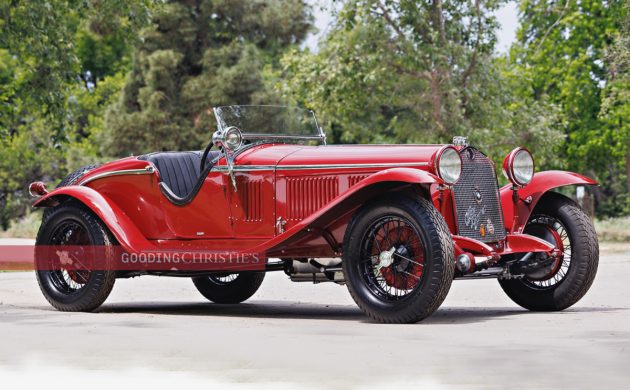
Calling any Alfa-Romeo built with racing in mind “clunky” seems like sacrilege. Yet, Alfa’s early 1920s product was a tall, 3400 lb touring car called the RL – well-suited for the era’s rough roads but barely nimble. A factory-forced diet resulted in a lightweight version that won the Targa Florio in 1923 – Alfa’s first international race win. From then, privateers ran their RLs up hills and across dales, placing consistently but never achieving the significance of the Targa Florio experience. Adding urgency to the issue, World Championship rules had changed, capping engine displacement at 1500 ccs. A new approach was needed, and Vittorio Jano was just the man for the job. Rather than beginning with a road car, Jano used Alfa’s P2 Grand Prix car (which he also designed) as the basis for a fresh model, called the 6C. As important as the RL was in the pantheon of Alfa’s success, the 6C was doubly, maybe triply important, reinforcing and furthering Alfa’s strategy of selling road cars that could also go racing. And as meticulous as the 6C’s engineering was, the chassis also enticed the world’s best coachbuilders into proliferating small-batch variants that have become wildly valuable. This example is lined up for the New York Rétromobile Gooding Christie’s auction in November of this year. No description is available yet, but that didn’t stop me, because chassis #0312957 was previously for sale at Bonham’s in 2023. Perhaps a thing or two has changed since then, but we’ll run with what we have from the old listing….
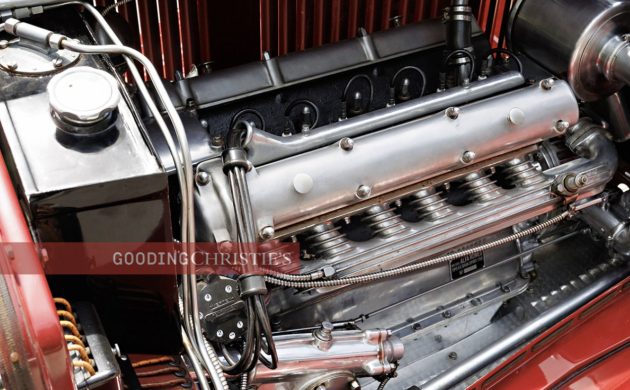
The RL went racing with a monstrous six-cylinder; depending on exact displacement (there were several), output ranged around 90 to 120 hp. The Association Internationale des Automobile Clubs Reconnus imposed a 1.5-liter cap starting with the 1926 World Championship Series; consequently, the first 6Cs were considerably downsized in the displacement department, and made just 44 hp in “normale” form. But output climbed rapidly with carburetion, dual overhead cam construction, rising compression ratios, and finally, the addition of a supercharger. Soon, the tiny six was generating 84 hp. Once again, racing rules shifted, this time to a fuel efficiency standard that made manufacturers unhappy enough that races turned to Formula Libre – “run what you brung”. Without the displacement cap in play, Jano boosted the six-cylinder’s displacement to 1750 ccs; the application of superchargers, more cams, and different carburetors resulted in output ranging up to 102 hp. To improve handling, the fuel tank was repositioned. This car is one of 52 Super Sports made with a supercharger. A four-speed manual gearbox and four-wheel mechanical drum brakes round out the componentry of this beautiful machine.
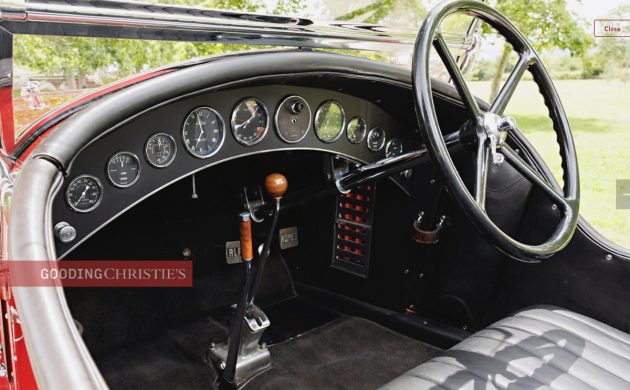
The interior features a galaxy of gauges marching across the curved dash, pedals with embossed letters “Alfa” and “Romeo”, a wide-diameter steering wheel, cut-down doors, and a fold-out windshield. So many of its characteristics typify pre-war sporting cars, but few pre-war cars can hold a candle to the 6C 1750’s racing pedigree, with its countless successes from 1929 on, including two consecutive Mille Miglia wins.
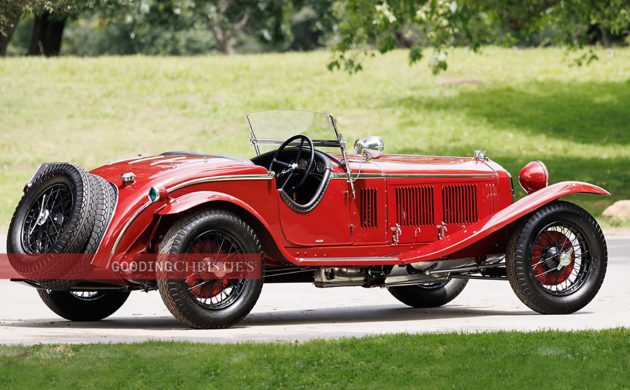
The 6C was a full ten inches shorter in height than the RL, depending on the coachbuilder. This car was bodied by Zagato; others were clothed by Touring, James Young, Caravini, Castagna, Pinin Farina – all maintaining the long, low, and lean profile that helped lead to wins at the track. In terms of value, I’ll be keen to see what estimate Gooding Christie’s settles on here: chassis #0312957 failed to sell three years ago at the low end of its $1.6 to $1.9 million range. A Gran Sport “in the style of Zagato” sold for less than $400k recently; this tourer sold for far less than its estimate. The established pattern shows a tendency to overvalue the cars ahead of the auction – which does no one any good.

This car really caught my eye. Its just a beautiful car. And then….. I saw that dashboard and those gauges and the way they’re laid out. I think Michelle hit the nail on the head describing it as a “galaxy of gauges”. Its just beautiful. The details on the brake and clutch pedals with Alfa and Romeo spelt out on each of them. I really enjoyed this write up. Thanks Michelle.
Of course, Mr Drive. You’re at top of mind when I write, you’re so kind to me. Thanks!
Reading this harkings me back back to an episode of “Chasing Classic Cars” with Wayne Carini as he was making his way around one of these at a Bonham’s Auction. Beautiful automobile and I have to agree – they do set the price way too high initially for some unknown reason. The market for cars like this is drying up pretty fast.
Driving cars of this era fast is something else entirely. I recommend doing so if you get the chance.
I often chuckle at Asian names like “Flowing Happiness Large Deer Pleasant Warmth Restaurant”, but I see the Italians were doing the same in 1930, with their automobiles.
Wow! What a neat old race car.
I need tires
Can you adjust my carbs
Oh crap it’s raining
If it’s art hang it on the wall.
As a race car..
My money is on the chevette.
I would not say these cars are overestimated as a strategy. The markets shifts, and it is difficult for everyone involved to “feel” the market.
This was blue chip until about 15 years ago. Now it is sliding, I experienced this with sales of an Isotta Fraschini, Auburn 12 cyl and some other very special pre war cars.
I didn’t mean to imply that auction overestimating is a strategy; maybe it is, maybe it’s not. The thrust of my comment is that some examples of this car or similar have come to market with beefy estimates and not sold or sold far under. That is a market signal. The auction house is no doubt spending this time touching bases with good bidders to take the market’s temperature, in addition to negotiating with the seller towards reality. Let’s hope both can come together to find this beautiful Alfa a new garage.
My cousin Eddy has one with a Volkswagen motor.
All I had to do was see the lead photo and my instant reaction was “Michelle wrote this!” Sure enough….
As usual, the write-up is informative and beautifully presented. The only thing missing is the delightful howl of a 6C on the open road, mechanical music perhaps surpassed only by an 8C.
These are works of art. I’ve seen one or two unrestored examples, and their detailing was nearly as exquisite as found on this example. One could stare at this all day.
One year, I was fortunate to cover one of the Mille Miglia recreations. There were numerous Alfas entered (of course!), and I loved watching them fly past us on those rugged Italian roads. Except, that is, for one 6C, which had suffered a minor failure not repairable on the roadside. We ended up towing it — behind my borrowed modern Alfa — to the next town, where it could be picked up.
Bring your checkbook for this one. Maybe bring someone else’s, too!
If a Yugo had a dash like that. I’d be proud to daily-drive it.
I have a book some where about a woman who was a very successful Alfa racing driver.
Probably Michelle.
Very kind of you, but I’m a chicken, the more so if piloting an expensive machine. I have flogged a Bugeye Sprite around PIR; my current race car which never sees track time, sadly, is an MGA coupe. Small motors, slow company, cheap cars, that’s about all I can stand.
Nice write-up Michelle
The lady Alfa racing driver in the 1930s. Her name Marriette Helene Delangle. And before any of you start yes I have left the infections of her middle name because I don’t know how to put them on. Better with spanners.
Interesting that some of these are soft on price these days.
Maybe there are too many of them around and not enough buyers willing to deal with the maintenance challenges and all the rest that goes with cars like this. Add in international shipping, insurance, entry fees and personal travel costs to use it at the primo events that it qualifies for and you need to be a “money’s no object” individual that is also a very keen car nut. Vintage event qualification are a major reason why people buy these, but that’s a pricey lifestyle.
Also, each one of these has their own mechanical profile and provenance. I see nothing here about race entries and wins for this one, or famous owners, famous drivers and all of that. Maybe it’s there, but not yet mentioned by the auctioneer.
Price comparisons between similar examples are going to vary wildly.
Your point about ownership provenance and race history is a good one. The more the better in that regard, and no doubt it will add value. The car that sold sub-$400k could not be definitively attributed to Zagato. That halved the price.
Even sub-$400K leaves me out!
What an amazing machine. I’d love to take Derek’s advice and drive this car fast around a track.
Excellent and informative write-up, Michelle, as always.
The estimate on this car has just been published; Gooding is aiming for $1 million to $1.5 million.