

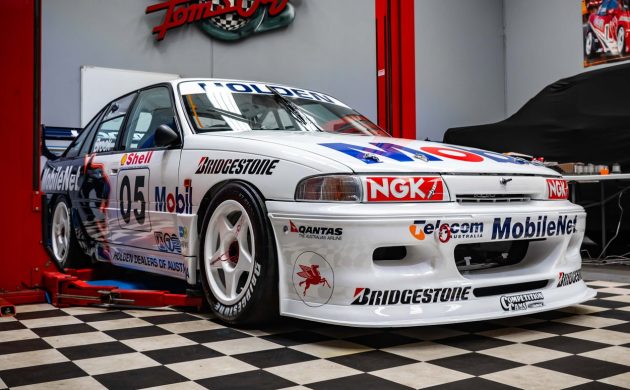
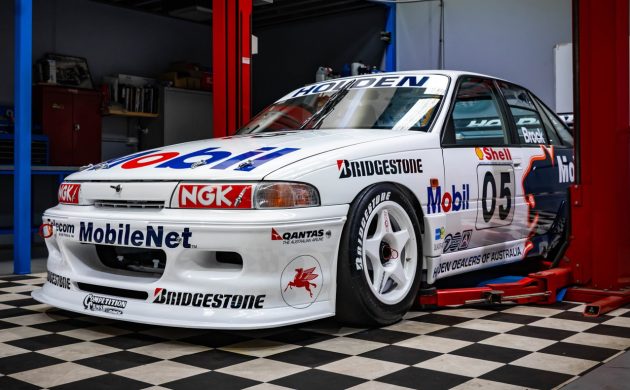
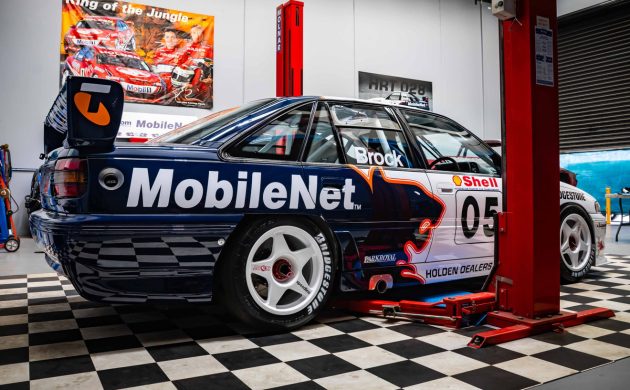
Those of us who grew up on a steady diet of Australian motorsport will never forget September 5th, 2006. That was the day when racing legend Peter Brock lost his life in a tarmac rally in Western Australia. The man dubbed Peter Perfect and The King of The Mountain seemed to be untouchable behind the wheel, and for him to lose his life during competition seemed to beggar belief. With the twentieth anniversary of “Brocky’s” passing fast approaching, now seems an appropriate time for one of his most significant racing cars to hit the market. This 1994 Holden VP Commodore was the car he used as he returned to the factory team after seven years in the privateer wilderness. This car also launched the career of a man who many viewed as Brock’s successor, Craig Lowndes. Meticulously restored, the Commodore is listed here at Young Timers Garage in Keysborough, Victoria, Australia, with the asking price available via inquiry.
Peter Brock established his reputation in the 1960s behind the wheel of a self-built Austin A30 powered by a Holden six-cylinder motor. He became part of Holden’s factory racing team in 1969, but left the fold at the end of 1974 and struck out as a privateer. He was enticed back in 1978 and became the team owner in 1980. He enjoyed considerable factory support from Holden, who also collaborated with his newly formed HDT Special Vehicles to produce high-performance vehicles covered by Holden’s factory warranty. However, it all unraveled in 1987, with Holden severing all ties with Brock after he refused to provide an example of the new model, the HDT Director, which was scheduled for imminent release. There were also issues surrounding a Brock accessory known as the Energy Polariser that he wanted to fit to his vehicles. However, the Director and questions regarding whether it complied with Australian Design Rules were the catalyst for the collapse. Without factory support, Brock began racing BMWs, and then did the unthinkable by purchasing and racing a pair of Ford Sierra RS500s. He was back in a privateer Holden in 1991, and rejoined the factory Holden Racing Team (HRT) in 1994.
Australian motorsport entered a transitional period in the early 1990s. International Group A Touring Cars was the premier formula, but cracks were appearing. Holden had homologated its VN Commodore SS Group A, but it was on a hiding to nothing. Drivers had around 500hp at their disposal, with power feeding to the road via the rear wheels. It sounds like a tasty recipe, but when you’re battling the Nissan GTR, which features a twin-turbo DOHC six sending over 600hp to the ground via all-wheel-drive, you don’t need to be a rocket scientist to realize that success was a long shot. The upshot was the development of a unique local formula, which became the new premier category in 1993. It restricted the manufacturer count to Ford and Holden, with their Falcon and Commodore models. All cars would feature a 5.0-liter fuel-injected V8, identical six-speed Holinger transmissions, and the same racing weight. Ford teams had to discard their Sierras and start from scratch, but Commodore teams could upgrade their existing machines to comply with the new regulations. That’s where our feature car enters the picture. Built by HRT in 1991 to Group A regulations, the team updated the lightly-raced machine in 1993 for the new V8 category. When Peter Brock returned to the factory fold, it was behind the wheel of this car. He was immediately competitive, and brought the team its first championship round win in only his seventh event with the team. Brock moved into a new car later in the year, and this car competed at that year’s Bathurst 1000 in the hands of Brad Jones and Craig Lowndes. That race established Lowndes as a force to be reckoned with, as the rookie and Brad Jones finished second. Lowndes joined the championship full-time in 1996, and would eventually win three championships and seven Bathurst 1000 crowns. Brock mentored Lowndes in his early career, and Lowndes is doing likewise today.
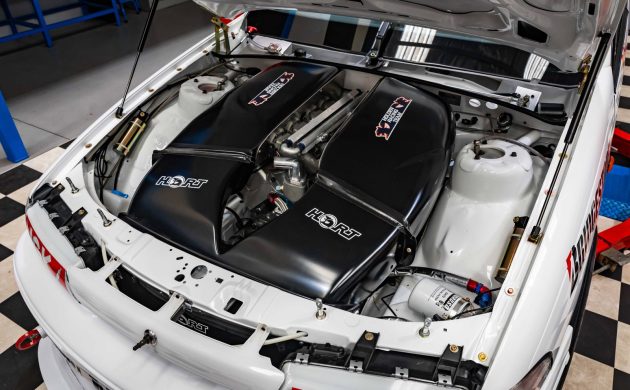
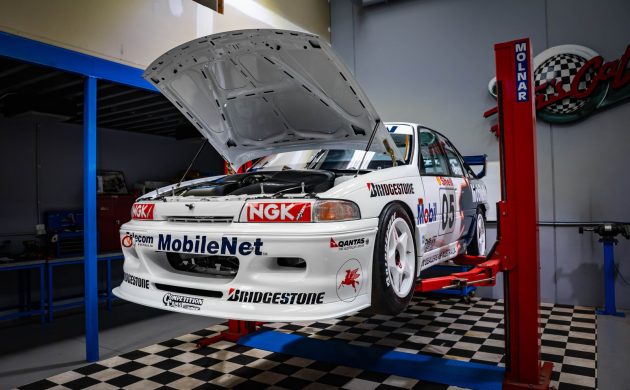
The new racing formula, which would later become known as V8 Supercars, and then Supercars, was elegantly simple. Ford teams could use the company’s 5.0-liter SVO V8 to power their machines, while Holden teams had the 18° Chevrolet V8. All cars complied with the same minimum weight, utilized the locally produced Holinger six-speed manual transmission, a Ford 9″ rear end, and enormous four-wheel disc brakes. The governing body envisaged a power output of around 450hp, but it wasn’t long before development pushed outputs closer to 600hp. Our featured car enjoyed a long racing career beyond its original HRT home, and was upgraded to later models as the rules allowed. It then remained hidden for a decade before the current owner purchased it and faithfully restored it to the form it was in when Peter Brock first slipped behind the wheel. It included sourcing a correct Chevrolet V8, transmission, and the appropriate Harrop brakes, Speedline wheels, and Bridgestone tires. The car presents as new and is ready for track action with its new owner behind the wheel.
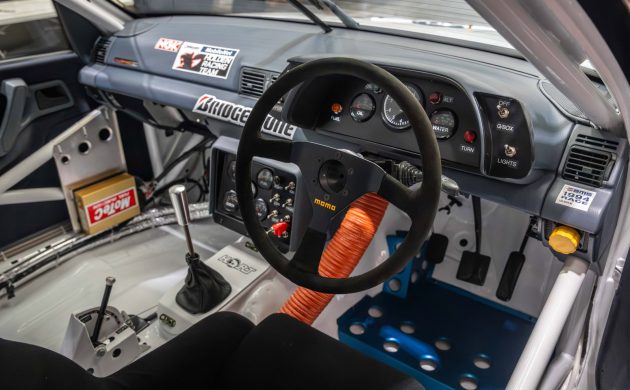
The rules governing the V8 formula had a few odd points, and this Commodore’s interior exposes the most obvious. Car constructors could discard the carpet, sound deadener, and most of the interior trim. Some created bespoke carbon fiber door cards, while others adapted the factory items. However, the upper dash and pad had to remain intact, although they could be modified to accept different gauges and switches. This Commodore reflects that approach, and every surface is clean enough to eat off. It is also purely functional. Critical gauges and switches are easily located, the brake balance control is clearly visible, and the shifter falls easily to hand. There is an anti-roll bar adjuster beside the seat, and the MoTeC ECU is mounted on a bespoke aluminum bracket, allowing easy access. Interestingly, this car predates the MoTeC LCD dash display, meaning that the driver faces old-school analog gauges and warning lights. The LCD would become a standard feature in most cars by the end of 1994.
September 8th, 2006, was one of those days that I will never forget. I remember where I was and what I was doing the moment the news of Peter Brock’s passing broke, and the total disbelief I felt that “Peter Perfect” could fall victim to such an accident. However, his legendary status is timeless, and even those who were too young to see him race speak of him with awe. Next week will mark two decades since that fateful day, making it the perfect time for such an important, beautifully restored machine to hit the market, one that marked his return to the factory team. The seller doesn’t specify a price, but considering the role it played in Peter Brock’s life and in establishing Craig Lowndes as a racing force, I suspect it will be in seven-figure territory. It will be fascinating to discover whether our Australian readers agree.
This car is out of my league. It would make for a fun day at the track though.
Having just lost a close lifetime racer friend to a boat accident I can closely stand by the friends and competitors of Peter Brock. Problem is it doesn’t all go away rapidly if at all. I have watched the Australian series and it’s one of the best world wide. This car is a beautiful representative of the series.
Very well said, bobhess. Couldn’t have been said better.
Yes it is the best series .Way better and more talented drivers than nascar.The Australian Super Cars are way more stock cars than the so called “ stock cars” of nascar.Ive been to a Super car race at COTAand it was very bad ass and fun to watch .Id lover to watch some nascar drivers try to run their “ stock cars” at COTA against the Super cars. Takes a lot more talent to run road courses than ovals in cars that are all the same bodies with different stickers on them .
Have meet Peter a few times over the years i still got my Wild-Turkey shirt he signed for me i was on the way to work when the news came on the radio that he was killed in a rally in WA i had to pull over and let that sink in a very sad day.
That would be a great buy for a wealthy person, like Lindsay Fox to have in his Museum.
That was also the same Day I think but could have been a day each side Steve Irwin which so many people recognize as the Crocodile man was killed by a stingray.
Brock had flown back from England I think it was after competing there at a meeting and hopped off the plane and went straight to that Rally. That car slipped off the bituman and hit a tree right in the drivers door. Some say it could have been fatigue that took him. He was driving what I call a look alike Cobra Sports car at the Rally.
I was over on Stradbroke Island changing deep well water pumps when that news came through, just an unbelievable accident.
Craig Lowndes I understand was the man who also helped the Kiwi driver in the 888 team who now drives Nascar in the U.S. when he started in Supercars SVG as he is known in the States.
….. and SVG is doing a whale of a job over here. Nice write up JT.
I’ve seen more highly modified cars road registered.
The status that Peter Brock achieved in the early 80’s cant be overstated, he was treated like a god by the fans, he really was the bloke who could do no wrong. Even though is image was tarnished for various reasons later on he was easily the most popular racing driver right up until his death, all the other drivers put together couldn’t equal the brand recognition of Peter Brock.