

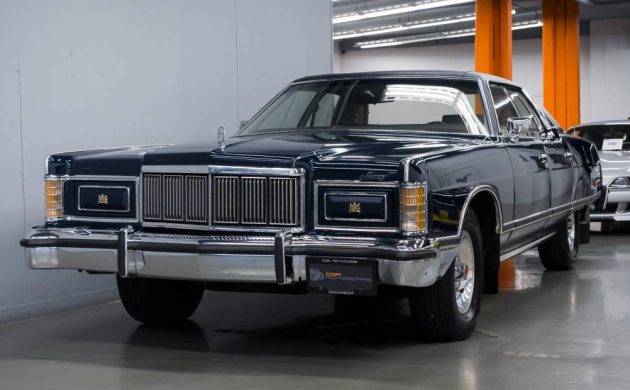
If you’re the type of enthusiast who favors comfort over outright performance, this 1978 Mercury Grand Marquis deserves more than a passing glance. It carries the hallmarks of a treasured possession, presenting in as-new condition forty-eight years after it rolled off the showroom floor. Its odometer displays 34,000 kilometers, equating to approximately 21,100 miles. It is loaded with creature comforts, and I must say a big thank you to Barn Finder Curvette for spotting the Grand Marquis listed here on Craigslist in Burnaby, British Columbia, Canada. The seller set their price at C$17,000, and with the prevailing exchange rate, that figure translated to approximately US$12,125.
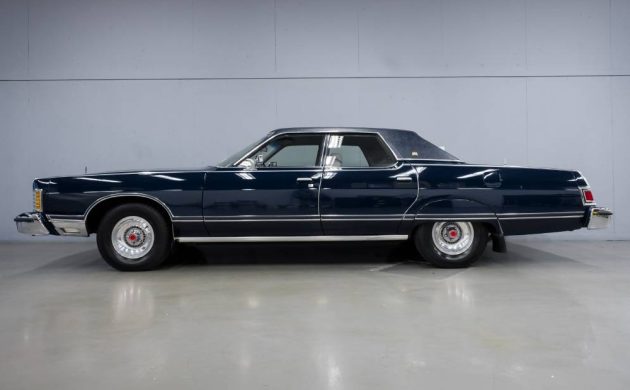
When Mercury retired the long-lived Monterey badge in 1975, the Marquis stepped in as its premium full-size offering. Buyers could choose from several trim levels, with the Grand Marquis positioned as the range-topping variant. Our featured Grand Marquis left the factory in 1978, making a stunning and classy first impression in Dark Midnight Blue with a matching vinyl top. Add fender skirts and forged aluminum wheels to the equation, and this car looks stunning. The only thing that it needs is narrow whitewalls, because I have always believed that cars of this type deserve that touch. Finding fault with its presentation is seemingly impossible. The paint’s depth of color and shine is incredible for an unrestored survivor of this vintage, and the panels appear perfect. The cleanliness of the engine bay and lack of visible corrosion on the peripheral metal components suggest the vehicle has been protected from snow and salt, leaving the car rust-free. The exterior trim is spotless, and the tinted glass is crystal clear.
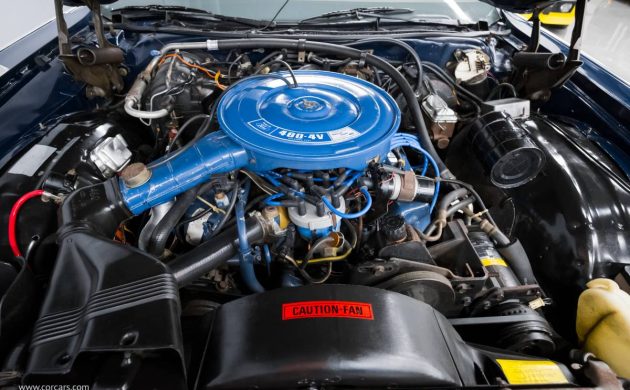
If there really is no substitute for cubic inches, this Mercury is a winner. The first owner teamed the new-for-1978 range-topping 460ci V8 wth a three-speed automatic transmission, power steering, and power brakes. The Grand Marquis is a heavy beast, weighing over 4,600 lbs. The V8’s power and torque figures of 202hp and 348 ft/lbs were both quite respectable for a car that emerged at the height of the Malaise Era. Admittedly, this Mercury won’t be a jet off the lights, but its ability to cope with heavy city traffic or cruise on the freeway at 70 confirms it has no genuine weaknesses. The seller recently replaced all of the components you would typically expect when performing a service and a tune-up. They also installed a new battery and new tires, and replaced the diff pinion seal and valve cover gaskets. It comes with service records, which might confirm the mileage claim. Otherwise, it appears to be a turnkey proposition, allowing the buyer to fly in and drive it home.
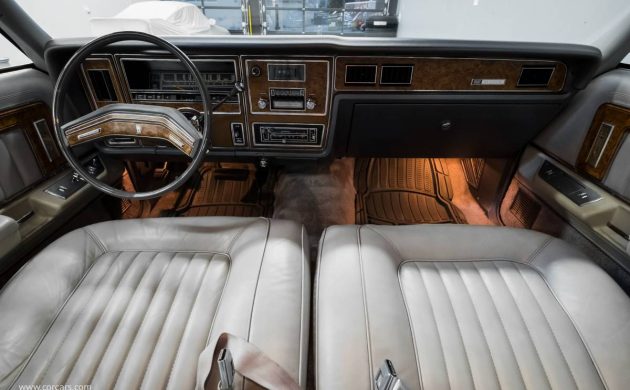
When assessing the overall condition of any classic, the interior often provides clear insight into the life they have led. Sellers will sometimes touch-up minor exterior imperfections, but retrimming seats or replacing broken plastic interior components is less common. With those thoughts in mind, the listing images seemingly confirm that this Mercury has led a sheltered existence. Trimmed in Dove Grey, the leather seatcovers have the typical light wrinkles, but they look supple and inviting. There is no wear or evidence of abuse, and the pale carpet looks remarkably clean. The faux woodgrain isn’t worn or lifting, and the dash and pad are spotless. If you like luxury touches, this Grand Marquis ticks plenty of boxes. It features air conditioning, power windows, power locks, six-way power front seats, a digital clock, cruise control, remote exterior mirrors, and an AM/FM radio/8-track player.
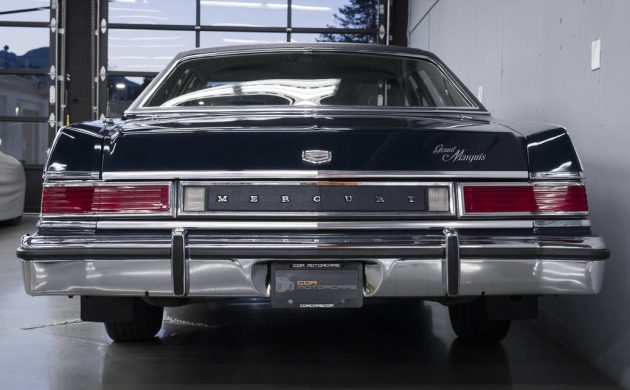
The listing images suggest that the original owner threw caution to the wind when ordering this 1978 Mercury Grand Marquis. They left nothing on the table, equipping it with almost every conceivable factory option. Its condition is astonishing, and the recent work performed by the seller ensures it is a turnkey proposition promising decades of reliable motoring pleasure. Their price is higher than I would typically consider for a genuinely affordable classic, but the buyer will undeniably receive a lot for their money. If you’ve been searching for a car combining immaculate presentation with a luxurious motoring experience, could this Mercury be a contender?

What a big beautiful boat.
Yes, but can a bris be performed in the back seat on a bumpy road? :)
Ready and waiting for Steve McGarrett to roll away…
Book’em Dan-O! Murder One, two counts!
These ’70’s LUXURY cars should only have white wall tires installed; they were designed with them in mind, and (IMO) black walls look CHEAP on them. This one is a real beauty! GLWTA!! :-)
you mean “white line” tires. No one used full whitewalls in the 70s unless the car had a diamond in the back, sunroof top, diggin the scene widda gangsta lean woo hoo..
Whoever heard of white line tires? They have always been called whitewalls and they simply vary in width.
🎯 again Moparman. What a perfect and stunning Merc 👍
awesome car but why is the front bumper higher on the left side than the right?
That’s how you know it’s really “like new”. The late 1970s were about as bad as it got for domestic car build quality. If you wanted even panel gaps and straight-mounted bumpers you bought Japanese.
Right on. My 74 Cadillac falls into one of the worst I’ve owned. I bought it in 75 with less than 20k miles. The build quality was simply awful. This was my fourth caddy that I traded my 66 CDV for it. The 66 was the absolute best car I ever owned. Hands down.
I checked the eyeball measurement of the bumper to the bottom of the tires, and I believe the floor is sloped from the wall to a (drain?) lower part of the floor. I could be wrong, but only an on-site visit would confirm it.
Just a click below a full-blown Lincoln, in 1978 these land barges had just about everything…including engines that were so smog-choked they barely ran. If I had this car, that engine gets a makeover including higher compression pistons, headers, aftermarket carburetor and ignition…and of course the “pollution” garbage would get lost along the way.
Yeah. Who needs clean air?
Not the owner/drivers of a 1978 Mercury Marquis. That’s for dang sure! Ain’t freedom great?
I’m almost there with you, except for the part about removing the anti-smog gear. Fortunately, with today’s technology, there’s no need to trade clean air for performance. Instead of a carburetor, I’d go with either throttle body or port fuel injection instead of the mechanical fuel mixer. The higher precision of Electronic Fuel Injection (EFI) makes the exhaust cleaner than these could ever be from the factory, while improving both fuel economy and performance! Oh, and BTW, in most cases, these used low-compression cylinder heads, not low-compression pistons to reduce the compression ratio, so either milling the stock heads or fitting a set of aftermarket cylinder heads from the usual suspects (Edelbrock, AFR) will do more for the engine than fresh pistons will.
Exactly what I was thinking! Imagine this with a Godzilla motor 😃 makes me happy just thinking about it.
And of course it needs some thin white walls and make sure all those options still work!
Last year for the big Merc. ’79 would be the downsized ones like the Crown Vics. If this boat floats yer boat ya better jump on it. I don’t know where you would find a nicer one and they’re not gonna make any more. No more Mercurys and even Lincolns now are just gussied up Ford SUVs. I don’t think there are any more American made luxury cars any more.
When i was younger, I always told myself I’d have a luxury car (Cadillac, Lincoln) when I got old. Now that I’m old, they don’t exist!
Now now, JDC they still make Cadillacs and Lincolns. You just have to be a millionaire to buy one. A new Cadillac Escalade ESV V starts at $150,000. You want a Cadillac Celestiq? $400,000. Load it up and you’re talking half a mil.
I wouldn’t waste my time with a Lincoln. For less than half the price you can get a fully loaded Ford Expedition which is esentually the same SUV.
Can you even imagine if Chrysler had kept the Imperial going all these years what it would look like as a SUV? There are plenty of luxury SUVs out there, just not a lot of cars and even less big luxury cars. Cadillac still makes the CTS but that kinda small and still up there in the $70,000 price range.
You’re best bet is to get a classic Cadillac or Lincoln. You can pick up nice ones for $20/30 thousand.
Angel, I’m talking about the big land yachts of yore. Today’s Lincolns and Cadillacs have nothing in common with those. I always thought I’d be able to go buy a new Sedan de Ville… but time changes everything.
Priced for movement -try and find another one that presents better. Pop Neil Diamond in that dashboard 8-track, crank up the A/C, set the cruise and get rollin’ . . . for the next fuel stop.
Priced for movement – try and find another one that presents better. Pop Neil Diamond in that dashboard 8-track, crank up the A/C, set the cruise and get rollin’ . . . for the next fuel stop.
Just plain LOVELY! This was the car for seniors to have in the 70’s/80’s on the east coast. My in-laws and all their friends had them!!
I miss these big cars and the comfortable ride, remember seeing them on the highway with the removable trailer mirrors attached to the fenders pulling a travel trailer to wherever it was the family was going.
needs a set of pinstripe w/walls. the black wall look doesn’t work for this ride.
What a find! This condition, this color combo, leather, every option, reasonable price… Wow!
But Adam, the Marquis filled the top spot in 1969, after the demise of the Park Lane in 1968.
Such a nice mercury! It all looks pretty great, except it needs white wall tires. Isn’t it amazing that Ford sold a whole line of cars, and mercury sold a whole line of cars, and Lincoln sold cars,. Look what happened now. Jim Farley says Ford can’t make any money selling cars. Unbelievable!
I’m going to be in the minority by saying I think the b/w look good because of the rims & the dark color.
Brighter colors? Definitely w/w.
That is truly a stunning car.
460 ci equals 202 HP? What a tank!
Crate versions of the 351 have been bored and stroked out to 460 cubic inches, and are rated for up to 575 hp! The “385” block crate motors that started life as 429 big block production engines, are now available as crate engines that have been bored and stroked out to 572 cubic inches, good for up to 655 hp! So, with a little competent machine work to increase the compression ratio, combined with the usual assortment of go-fast goodies, one of these bad boys could easily be restored to it’s former pre-federal glory, producing well over 300 hp without breaking a proverbial sweat! See links below.
https://performanceparts.ford.com/engines/#Big%20Block
https://performanceparts.ford.com/engines/#351
Why do all that to an ORIGINAL vehicle which is fine just the way that it is? Robert Atkinson, HOW much HORSEPOWER do you NEED in a luxury cruiser?
The Buick 455 only put out 205 hp. Tank?
Vogue Classic tyres with the blue stripe would do wonders for this car.
This is so beautiful. You’d almost expect Charlie Townsend to pull up in it. Great colors and nothing missing except the miles. Somebody put some care into the order and didn’t drive their creation. It’d be cool to hear Rick W give us a few words of wisdom.
Beautiful car. Replaced all door lock actuators: that says it all, right there: BIG weakness with these cars — Panthers, too! But I am not ready for 12.5 m.p.g. and 8-track tapes. Besides, it’s all of the way on the other side of the continent once again. Is that speedometer calibrated in kilometers?
This exact car was owned by my 75 year old landlady my first year of college in ’79. Light blue in color, I got a chance to drive it for a few days when my Barracuda threw a fanbelt in the middle of freezing January.
I had never driven a car like that before, so I’ll never forget the sheer proportions of navigating that thing, and the very cushy ride.
I’ll also never forget that landlady – always smoking those long, brown, More cigarettes, doing all the maintenance on that old house, mowing the lawn, etc. I asked if I could help her and she laughed and told me to focus on my studies.
Desperately needing “correct ” white stripe tires…can’t quite appreciate it without.
To Mr. Reed: I’m less concerned about absolute power than I am about drivability, and these Malaise Era motors were notorious for stalling, hesitating and dieseling, thanks to the primitive anti-smog gear of the period. 200 hp out of a 460 cubic inch plant is abysmal, particularly when they could produce 300 hp straight off of the showroom floor not too many years earlier. Fixing that while keeping emissions in line won’t be inexpensive, but it makes the car much easier to live with. Besides, asking 200 hp to move over two (2) tons of car is asking a lot, especially if the upgrades also produce somewhat better fuel economy in the bargain. I used the crate motors to show what is possible, not necessarily what I want to achieve. You could have a motor that produces 300 hp all day long, without any risks of having it blow up, while lowering emissions and improving fuel economy, if Ford can use the same block to make almost 600 hp that runs on stock pump gasoline and has a full factory warranty!
Of course, if you want that much power and can afford it, why not? There is no replacement for displacement, LOL! It would be a deep “sleeper” that’s for sure! If Chrysler can put a hemi into a full size car, then why can’t you do it to a Mercury?
Here’s a link to the Fantom Works episode where Dan Short & Company restore the horsepower to a 1970 Chrysler 300 Hurst Edition, that came from the factory with a 426 Hemi under the hood! Who says big cars have to be slow? LOL!
https://www.imdb.com/title/tt7061976/?ref_=ttep_ep_2
I agree that malaise era cars are terrible. But I would not want to disturb this one’s originality, except to do “hidden” mods to update its original engine and remove some of that sluggishness and certainly the rough running and stalling out. But I would not use a crate engine; I would use the one already in the car, and hopefully at the same time work better fuel economy out of it.
I agree, starting with the engine in the car is much better. Any mods should be “bolt-on” only, so the car can be returned to “bone stock” condition for a future owner. But there are bolt-on mods that will make these big block engines perform better and use less fuel, while looking virtually stock in the process. Again, I only cited the crate engines as examples to show what is possible, not that I would actually do that!
All is forgiven, Robert Atkinson, Jr. (smile). But I’m still not ready for a car this size that needs its front bumper aligned and sports an 8-track player. F.M. car radios in this era were analogue with an A.F.C. you could not turn off. With to-day’s stations often just one channel over from one on an adjacent channel less than 30 miles away, you’d find your listening repeatedly interrupted by the adjacent station suddenly locking-in where the one you had selected was. Even if you had a technician disable the A.F.C., the adjacent channel selectivity on F.M. tuners (except for top-line home audiophile equipment) was vastly too poor in 1978! Enjoy the A.M. on this one, or listen to a local “blowtorch” F.M..
Again, keep the factory radio for a future owner, but an aftermarket stereo can fix that for short money. Back when I was in high school and college, when cars like these had attained “beater” status, the first thing you did was swap out the factory AM radio for a Pioneer, Kenwood or Clarion cassette deck and added a pair of 6×9 Jensen Coaxial speakers in the rear deck and a pair of 5-1/4″ Jensen coaxial speakers in the front doors!