
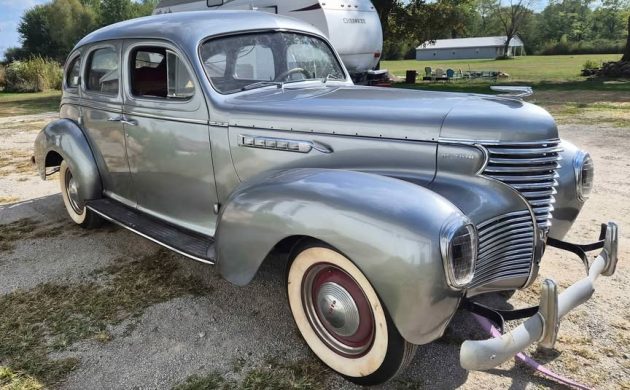
It’s a dizzying array of domestic automobile marques that have disappeared in the time I’ve been on this planet. Some make sense, I suppose, with all of that “survival of the fittest” business, and what have you. Others seem intentional, as in the holding company just didn’t want to be bothered with it anymore, even though it still produced results. DeSoto (1929-1961), such as this 1939 touring sedan, may have simply been the wrong car at the wrong time – more on that to follow. This citizen of Amherst, Ohio, has undergone a restoration – and looks good, but the seller notes, “I just don’t have the time to finish.” Let’s see what else it needs; those with an interest will find it here on Facebook Marketplace, where it’s available for $9,000. Thanks are due to Ted for this tip!
DeSoto was founded by Walter Chrysler the same year, 1928, that Plymouth was created and Dodge was acquired – almost seems like too much circus for the tent, all at the same time. Plymouth’s marching orders were clear, but DeSoto and Dodge vied back and forth for hierarchy positioning. DeSoto was responsible for about two million vehicles over its 33-year life span (45K in ’39) or an average of 60K units a year. That average fell off sharply after ’57, however, and there didn’t seem to be room for a recovery – the marketplace had gotten pretty crowded, so 1961 was DeSoto’s end of the line.
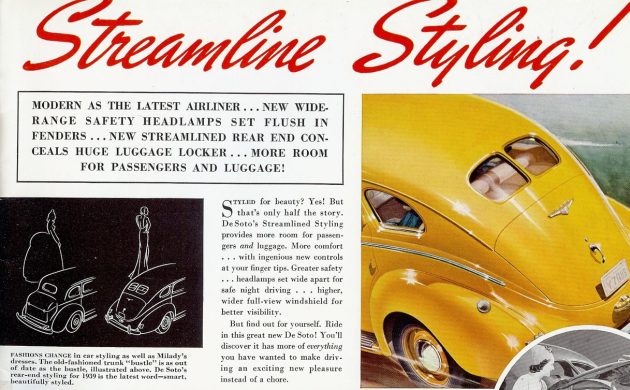
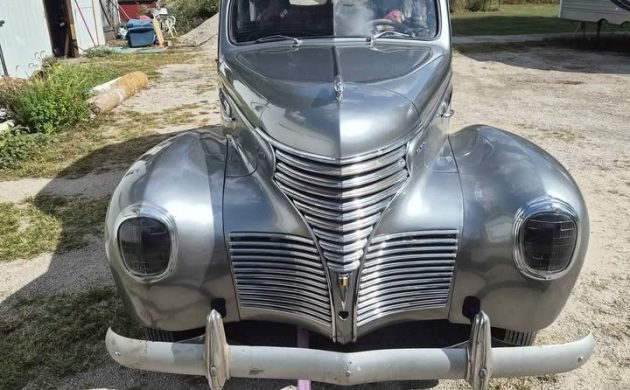
DeSoto offered both Custom and Deluxe trim levels in ’39, though the listing is silent regarding which one this car is. They were pretty sanguine about the design, especially the emphasis on the streamlined rear end (try that in an ad today!). This example shows exceptionally well. The finish is deep and shiny, while the hue projects an industrial nature. It appears that a piece or two of the stainless trim is missing, and the bumpers could stand rechroming. The seller doesn’t provide us with details on the restoration specifics, so I’ll assume the underside is sound; however, it’s probably worth conducting a visual inspection. BTW, I love the shape of those headlights!
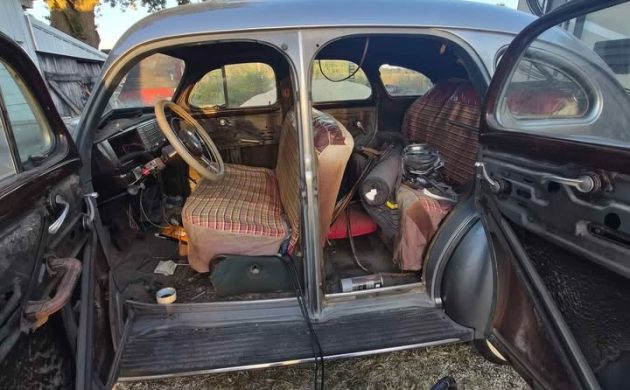
The resto appears to have fallen short on the interior, however. The image isn’t close up enough to be revealing, but I spy duct tape on the driver’s side seat back, missing driver’s side door panels, and that rumpled plaid upholstery looks like the pattern of a bathrobe I had when I was a kid. All the detritus piled into the backseat isn’t exactly helpful either.
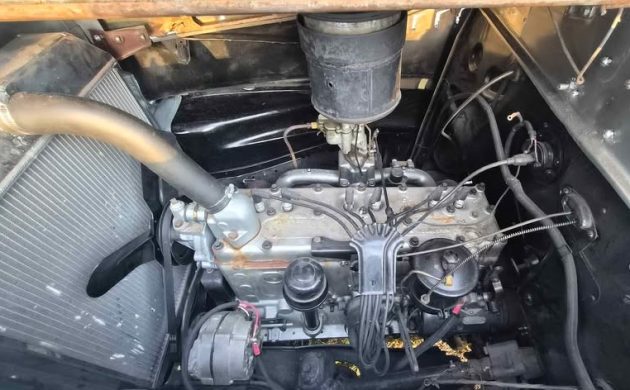
In the mechanical department, we find a 93 HP, 228 CI, in-line, flathead six-cylinder engine paired with a three-speed manual transmission. There’s no 411 on running and driving characteristics, but the seller does tell us, “It has a rebuilt engine, rebuilt transmission, new wiring harness, new battery cables, aluminum radiator, GM alternator…”
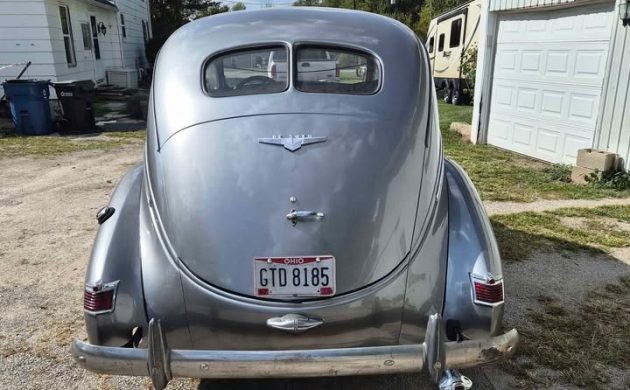
As with so many cars of this era, it’s logical to assume that the market is probably contained. Still, this is a fallen flag and a once-prominent brand, so I’m sure there will be at least some interest. As far as completing the restoration is concerned, it would seem that most of the needed effort is likely inside, and the heavy lifting has been covered. This is one project I could see taking on and completing; how about you?




I was born in 1941, my second word was CAR. I have never seen one of these, I knew a Chevy from a Ford, year by year, by the time I was 6 in 1947. A Chrysler, a Plymouth, a Dodge, of the years 1938 – 1942, I could identify them all, the ’42 DeSoto had disappearing headlights and was a long way from this, but I doubt you will ever see another one of these. At the time DeSoto must have been the design pioneer of Chrysler Corp, as Pontiac was, for GM, for a while. I am talking sheet metal, not mechanical parts underneath, and the basic sheet metal was shared, but not the trim.
What a streamlined eye-catcher! Perhaps some sales literature would guide on interior restoration. I wonder if a hand crank for the starter was supplied when new.
I recall seeing a Graham from about this time period. It had the same type headlights. Coincidence?
’39 Chrysler corp, some independents, and Ford had the integrated headlights in the fenders, GM did not, Ford’s went back further a few years. My father’s ’38 Studebaker Commander had them. But by 1940 most had switched to sealed beams, even in the early ’40’s there were adapted kits to convert either to exposed sealed beams, or, to put them behind the integrated lenses.
I know these older cars are not as appealing to most readers, but I love their history!
Great write up, Jim!
Am I the only one who sees the REO Speed Wagon from the other day in this Desoto’s front face?
“especially the emphasis on the streamlined rear end (try that in an ad today!”
LMAO!!!
this is a classic for sure and a great bargain at this price, this is what the old car hobby is all about enjoying older vehicles that are unique and rare, although not perfect but for a car 86 years old not bad at all this styling will never be duplicated help us to appreciate the beauty of these cars of the late 30s and 40s