
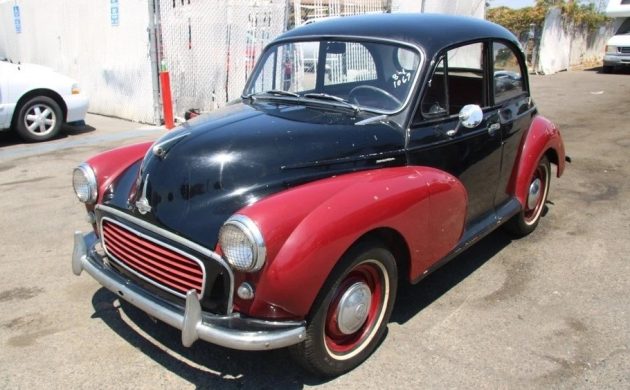
Although the original Mini is viewed by many as one of the “Cars of the People,” the reality is that it was the humble Morris Minor 1000 that managed to get the British public mobile again after World War II had ravaged the country. It was also the first British badge to sell more than one million vehicles, remaining in production for many years following the Mini’s release. This 1960 Minor needs work, but there are alternatives if total authenticity is not the goal of this build. It is listed here on eBay in Orange, California, and bidding sits at $999 in a No Reserve auction.
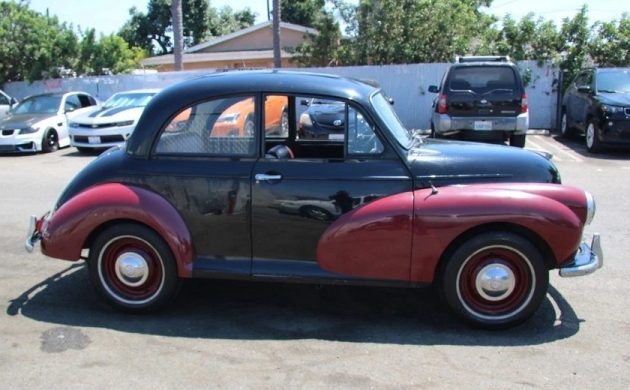
Launched in 1948, the Morris Minor remained in production in three distinct Series until 1971. As long-distance travel became more common, the “1000” variant hit showroom floors in 1956, remaining largely unchanged until the company retired the badge. This 1960 example has been donated for an online charity auction, showing promise as a project candidate. I admit that I’m not taken by its two-tone color combination, although that is a matter of personal taste. However, the paint holds a pretty respectable shine, and leaving the cosmetics untouched would be an option for those on a budget. Otherwise, performing a refresh would be seemingly straightforward because there is no evidence of significant panel damage or rust. The latter is unsurprising if this beauty has spent its life in its current location, because the Californian climate is excellent for preserving classic steel. The Minor retains all of its trim, which appears to be in reasonable condition, and the glass is clear.
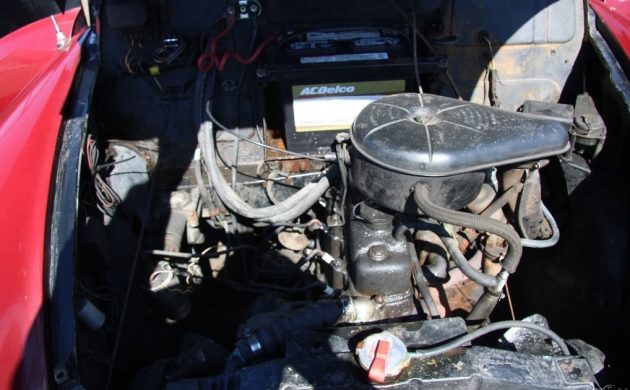
Initially launched with a 918cc flathead four under the hood, the Minor received a significantly updated 948cc OHV powerplant in 1956. This change dramatically improved performance, courtesy of the new engine delivering 37hp and 50 ft/lbs of torque. Those figures might sound modest, but they are considerably better than the 30hp and 40 ft/lbs produced by its predecessor. There was no transmission choice, with very Minor 1000 receiving a four-speed manual. The seller indicates that this Morris doesn’t start or run, and requires work for the engine to roar into life. These A-Series engines are not complex units, so performing a rebuild could be relatively straightforward. However, I have seen plenty of these classics fitted with Nissan/Datsun A-Series engines, and the performance gains provided make that an option worth considering.
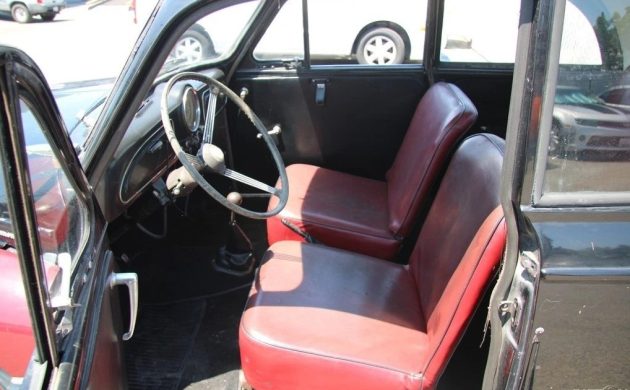
This Minor’s interior is tidy and serviceable, but there is scope to improve its appearance by performing a retrim. That option is worth considering, because kits are relatively affordable. The dash is free from problems, and the “banjo” wheel looks surprisingly good for its age. The Morris Minor design was the work of Alec Issigonis, the man who later brought us the Mini. I have always considered these underrated vehicles, because they demonstrate his ability to pen designs providing exceptional packaging efficiency. The Minor is almost two feet longer than the Mini, but the conventional engine layout accounts for much of the additional length. However, by adopting a more upright seating arrangement, the Minor’s interior offers room for four adults, and its trunk is positively cavernous when compared to the Mini’s. Therefore, this tiny British classic could serve enthusiasts with growing teenagers quite well.
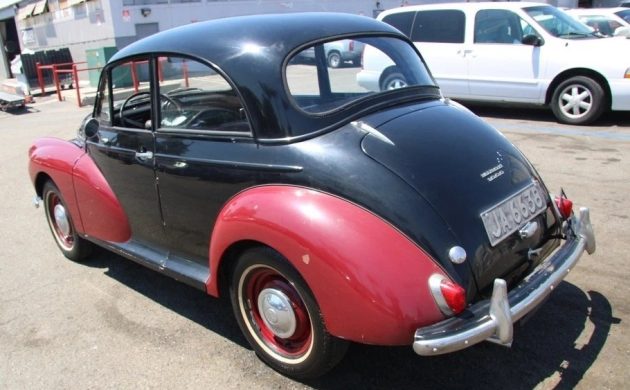
This 1960 Morris Minor 1000 is a promising project candidate that may be attractive to those seeking an affordable classic. That is perfectly reflected in the listing statistics, which demonstrate that this little British gem has garnered plenty of attention. The bid tally of twenty-three is impressive, but the View and Watch List figures of 665 and 221 at the time of writing are more so. They demonstrate that there are plenty of people who would love to give this Morris a new home. Are you one of them?




Biggest issue I have with the paint is which way to go with a partial redo. Black was an original color for them and would involve repainting less, especially keeping the red wheels rather than painting those the correct aluminum silver, but the car would look so good in all red.
These are an indeed a practical classic. I drove the convertible version of one of these in college. My solution to making mine usable was a 1275, the higher rear end, and disc brakes from a couple of MGs. The 5speed from a Datsun wagon gave her some relief for interstate runs when needed.
What a great little around town commuter
I first obtained a 60 tourer when a friend leaving town in 70 gifted it to me because he owed me $50. Top down, engine locked and a tree growing in the back floor. A 1098 went in and vacuum cleaner hose and duct tape connected the exhaust. Drove it for years, though I upgraded to headers and an intake manifold plus larger exhaust pipe and bullet muffler. The Sid pump failed so the car backfired loudly when letting off. Pulled many from scrapyards, maintained many for friends. Learned to hate master cylinders. Last one was a 61 2 door. I tried to put a 1275 in Discovered the trans shaft was too long to mate with the crank. Took the engine to a machinist who drilled it deeper. Didn’t discover that he used a tapered bit until the installed motor spewed oil all over the floor? Thought something had punctured the oil pump on the back end ( maybe the cam cover?) but a dental pick found the problem. By that time I had enough!
There is one in Reno with a hopped up Nissan/Datsun engine and transmission that just screams! It’s cool looking also. I have played with Bugeyes, MGBs and GTs. But never one of these. They keep popping up in my radar and wonder if I will some day own one. Being a CA car. This might be the one! ….. Na, not this time.
@Slomoogee. Your upgrades are exactly what I have done on a couple I have owned. 1275 dropped right in, 3.9 rear and disc brakes from a Spridget. Of course 25 years ago, there was a much more plentiful supply of cheap Spridget parts cars than today. They are one of the most fun and easy cars to work on. Unfortunately today they are not good highway cars as even here in quiet Vermont, you would get pushed off the road by everyone in the big hurry!!
Developed in secret during WWII, with Alec Isigonis as the project leader, it was a big step forward for affordable cars. The Buick (yes) inspired styling was a cut above, and the wheels were pushed much farther out to the corners of the body to improve passenger space. The suspension was also engineered to provide quick, responsive handling to give the owners a rewarding car to drive, and not just cheap transportation
The problem with these was that they were never improved. No power and no brakes.
Had the British done yearly improvements on the MM, it would have been a much better car than the VW.