

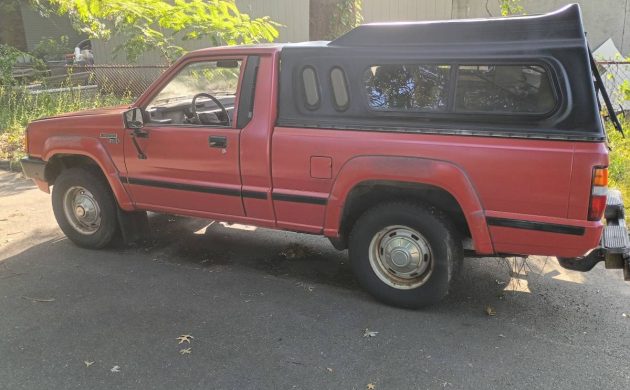
We all have a vehicle or two that we have some odd fascination with. There’s no one redeeming feature or reason why we want it; it just hits us a certain way and the obsession is born. The Mitsubishi Mighty Max pickup is that vehicle for me. I suppose it’s because it’s the classic underdog; it’s not that sought-after Toyota Hilux that got the star treatment in Back to the Future but it’s likely just as capable and nearly as reliable. Plus, you don’t see the Mighty Max in the desirable 4WD configuration all that often, like this one-owner truck listed here on craigslist for $6,000.
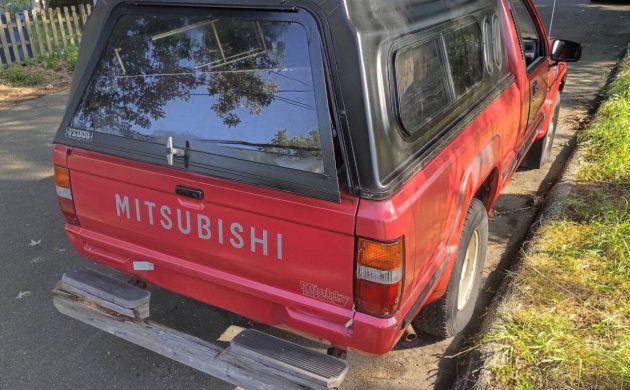
Thanks to Barn Finds reader Jack M. for the find. The Mighty Max was seemingly overshadowed – perhaps unintentionally – by the far more popular 2WD version, which was otherwise known as a Dodge D50. The smaller trucks seemed to find far more takers at the time, which was likely why Dodge chose to rebadge the Mitsubishi in the first place: they needed a compact, fuel-sipping pickup to plug a gap in their lineup. Whether there was poor marketing on Mitsubishi’s part or simply too hard to go up against the benemouth known as Toyota, we rarely see these trial-rated Mighty Maxes.
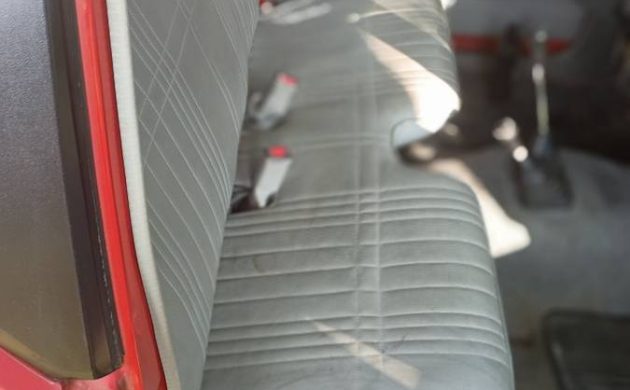
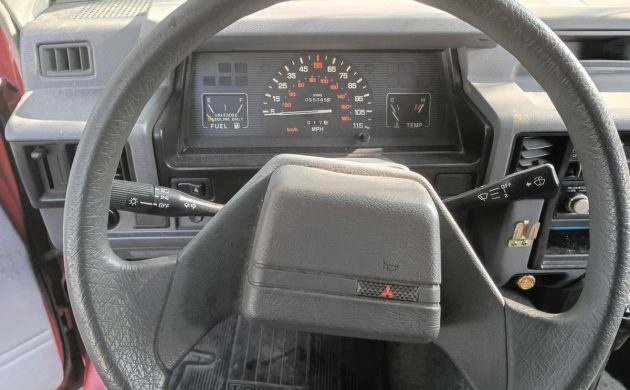
There’s something about the Mighty Max that just makes me smile, with much of the attraction likely due to the fender flares and jacked-up 4WD stance. The seller’s truck remains in wonderful stock condition, right down to the original steel wheels. The interior is quite basic with no illusion of luxury inside, just a gray vinyl bench seat. With just 55,000 original miles and one owner, it looks to be largely un-messed with, down to the OEM shift knob, and a basic AM/FM radio – not even an aftermarket head unit.
Under the hood is a 2.6-liter inline-4 engine, which came standard on the 4WD trucks. It wasn’t powerful, pushing out a humble 109 b.h.p., but that was pretty much standard operating procedure for the era. A larger V6 engine would become available after 1990. The Mighty Max is located in Greenwich, CT, which isn’t exactly known for being spared winter conditions, so it’s notable that this Mitsu doesn’t appear to have much rust. If you’ve been looking for one, you know how rarely they come up for sale.

These are great trucks. I wanted a Mitsubishi pickup from the late 80’s for a long time. I would have been happy with a 2WD short bed base model with a stick. This one looks very solid. Something that’s unfortunately very rare these days.
Wish I could purchase this same truck new today 💁♂️
Preaching to the Choir Stan!!! We need more new trucks like this.
It’s crazy that no manufacture makes a small truck anymore! Of course, most have quite making small cars, too. The claim that consumers drive the market is nonsense. Profit does. If the consumer has no choices, they have to buy whatever the manufacturers produce, which is exactly what’s happening.
Small trucks are still manufactured abroad, they just aren’t manufactured or imported here anymore due to our absurd CAFE regulatory scheme, which is also why wagons (also still made abroad) have largely given way to truck-based SUVs and car-based CUVs here.
In a nutshell, CAFE sets fuel-economy targets that increase over the years, but allows laxer targets for “light trucks” vs. passenger cars, and also allows laxer targets for vehicles of both types with a larger “footprint” than smaller ones.
Truly compact pickup trucks like these can’t meet the MPG target for their CAFE footprint size anymore while also offering acceptable performance, equipment and pricing that enough buyers would want to buy, so those aren’t made or imported here anymore.
As for station wagons, take that car-based wagon of yore, rotate its rear cargo volume from horizontal to vertical to shorten the rear overhang enough to increase the maximum departure angle, give it larger tires and a lift to raise the ground clearance, bumpers with an overbite to increase the approach and departure angles further, and suddenly it’s a CUV that technically qualifies as a “light truck” subject to a laxer CAFE target.
Thus a regulation ostensibly meant to promote better fuel efficiency has perversely incentivized larger, less efficient vehicles instead. How did Europe handle this objective? They just applied a tax scaled to fuel consumption instead, fostering a market incentive favoring smaller, more efficient cars by making those cheaper to buy and operate.
Perhaps another VW Caddy (Rabbit P/U), or Dodge Rampage, or ??? would find a niche in today’s market and meet the CAFE standards as well.
The 1981 (gas 5 sp.) P/U that I drove for a few years consistently returned 30 mpg.
Even the Mazda from the mid – 80’s on up along with the small Ford Ranger’s
were really decent (overall) As previously said IF they still made these new
then at a decent price of about $12 – 16,000 then that’s actually realistic for all.
@Jeff Lavery…I, too, have a fascination with these great lil Japanese trucks and have owned 6 or 7…with both Mitsu and Dodge nameplates. FYI your comment about the Dodge 2 wd variant being more popular makes it sound like they only came in 2wd; the 4wd version was called the Power Ram 50 and was very popular…the Ram 50s last year was 1993 but the Mitsubishi soldiered on until 1996.
Tempting, as I have a few parts vehicles on the property, but that is also the deterrent. The frames of the late 80’s Monteros that I drove rusted out. My advice would be to get a good look underneath if you’re interested.
Both Mitsubishi and Dodge versions were available in RWD and 4WD variants. The Dodge was only called D-50 for the first two years ’79-80 of the first-gen production; from ’81-93 continuing into the second-gen, they were called Ram 50, or Power Ram 50 for the 4WD version.
I’ve got an ’87 Ram 50 RWD longbed with the 2.6L engine and can vouch they’re smooth-driving but rugged trucks and easy to work on, and the the MightRam50 forum is great for shop talk.