
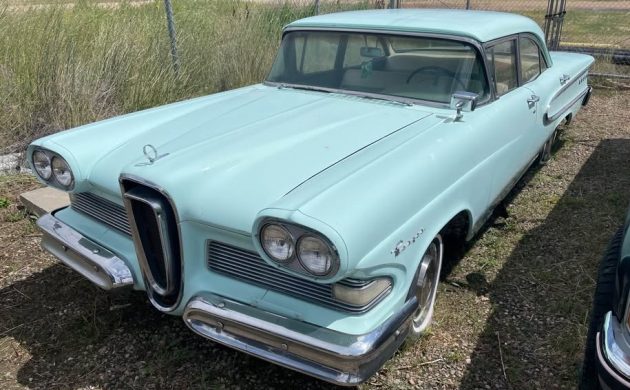
The Edsel project seemed like a good idea at the time, although history demonstrates that it was one of the automotive industry’s greatest follies. It proved to be the wrong car in the wrong place at the wrong time, losing the Ford Motor Company millions of dollars before the company pulled the plug on its failed experiment. This 1958 Edsel Ranger can be considered a first-year survivor. It wears its original paint, with the seller’s images suggesting that it could be an excellent project candidate. I must say a big thank you to Barn Finder T.J. for spotting the Edsel listed here on Facebook in Casper, Wyoming. The seller set their price for this promising project at $7,900 OBO.
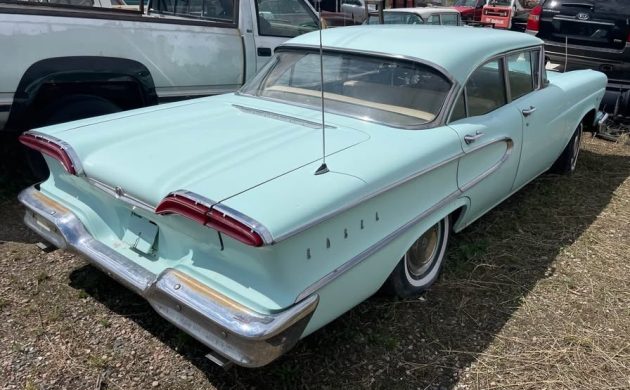
There are many reasons why Edsel proved to be a failure, including such factors as an economic downturn, quality control issues, and styling that polarized opinion. However, some people believe that Ford made a strategic mistake with its lead-up to the brand’s unveiling, hyping its upcoming model in a fashion never previously seen. It raised buyer expectations to new levels, undoubtedly contributing to poor sales when each offering proved more expensive than originally suggested. This first-year Ranger is a survivor, wearing what the seller claims is its original Ice Green paint. Its condition is particularly noteworthy if that is the case, because it appears that the exterior might present respectably if somebody hit it with a high-quality polish. There are no significant panel imperfections, and no evidence of rust. One interior shot provides a clear view of the floors, and they appear to be rock-solid. Some plated pieces exhibit mild surface corrosion, but most of the trim and the glass appear to be in good order.
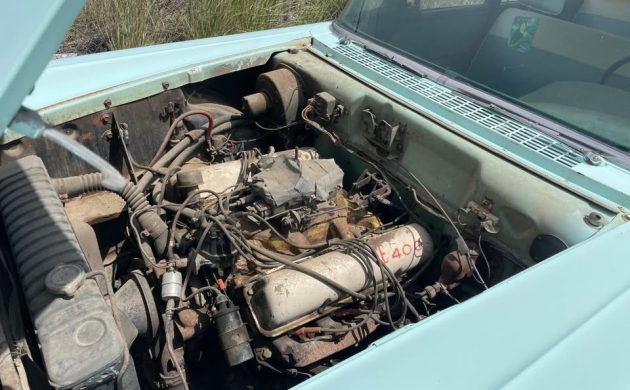
Although 1958 Ranger buyers didn’t have access to the range-topping 410ci V8, this car’s 361ci powerplant would have provided very respectable performance. It generated 303hp and 400 ft/lbs of torque, which was fed to the road via a three-speed automatic transmission. One factor that hurt outright performance was the Ranger’s curb weight, which fell north of 4,000 lbs. However, coping with city traffic or cruising on the open road at 70mph was a breeze for this beauty. The seller doesn’t indicate whether this classic is numbers-matching or how healthy its mechanical components are. They haven’t tried to coax the engine into life, but if it turns freely, it may not take much time or money for this beauty to return to its rightful place on our roads.
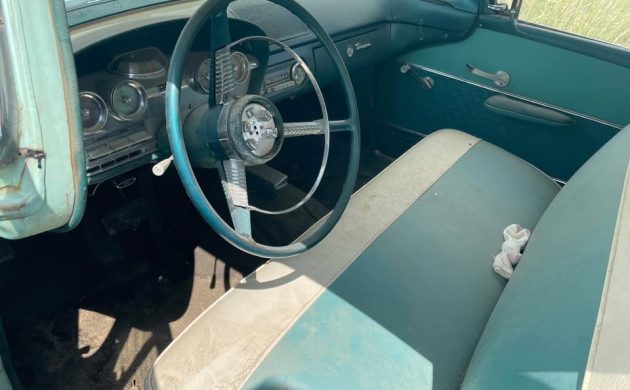
This Edsel’s interior is a surprise packet, because it looks far better than I expected. There is a split on the back seat base, but the rest of the upholstered surfaces are free from major problems. The impression conveyed is that the Green and White vinyl could look pretty nice if treated to a deep clean. Some plastic and plated items show mild deterioration, but the dash is in good order. One feature that may attract potential buyers is the “Teletouch” transmission selector located in the wheel center. More of a gimmick than a practical option, it added $231 to the Ranger’s sticker price. It was prone to reliability issues, but is considered extremely desirable in the current classic market.
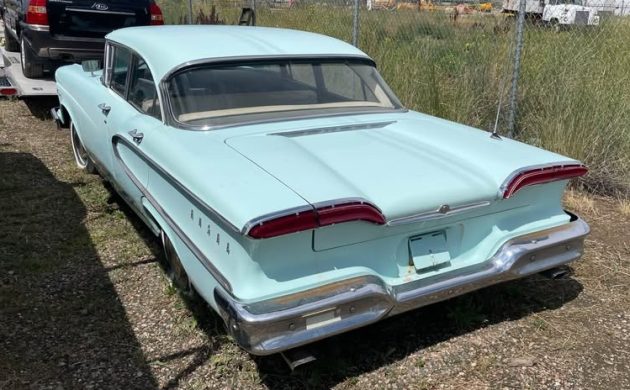
Ford held high hopes for its Edsel project, envisaging healthy sales that would immediately cement the marque in the new car market. However, it faced a perfect storm of issues, and some potential buyers couldn’t warm to the bold front styling. The Ranger sold a mere 21,701 examples across all body styles in 1958, and although that tally rose in 1959, it proved to be too little, too late. The end came quickly, with various sources claiming that Ford lost over $300 million on its failed experiment, equating to almost $3 billion in modern terms. This 1958 Ranger looks like a gem, and returning it to active service as a genuine survivor may be possible without spending a fortune. With the Edsel brand now enjoying a healthy following in the classic market, is it a project candidate that tempts you?



Looks like a good project. Somebody put duct tape over the top of the carburetor, I guess the air cleaner “disappeared”!
It was the hideous grill that did this in. What were they thinking?
Matter of taste. The style is fine with me and certainly blows the ’58 Ford out of the water.
I must be reading too much Barn Finds. I’m starting to like these.
I like the “differentness” of these cars. But I don’t like the weight of a loaded Mercury. Always wondered how they got away with the push button transmission shift cable down the steering column. I never got to inspect one closely. The last Edsel I was able to spend some time with was 3 speed on the tree. (It may have been pirated from a “regular old” Ford. As I’m unsure that any Edsel was available with a manual transmission. Anyone have an answer for that one?
If I remember correctly, the teletouch push buttons were electrically operated, no cables…I once had a Bermuda station wagon… and the Pacer and Ranger were based on Ford models where Corsair and Citation were based on Mercury.
That’s correct. The system was all electrically operated. There were no moving cables.
The main trouble spot was the wiring harness and the shift actuator sat too close to the exhaust manifold and pipe. All that heat negatively affected their function.
The center of the steering column is fixed in one position. The steering wheel rotates around the center. The pushbuttons never change their orientation.
Thanks guys! I’m ow a little wiser!
(Was I wise to begin with????)
Thanks guys! I’m now a little wiser!
(Was I wise to begin with????)
Where is Edsel Al?
♥♥♥
I feel bad for Edsel Ford having had the car named after him.