

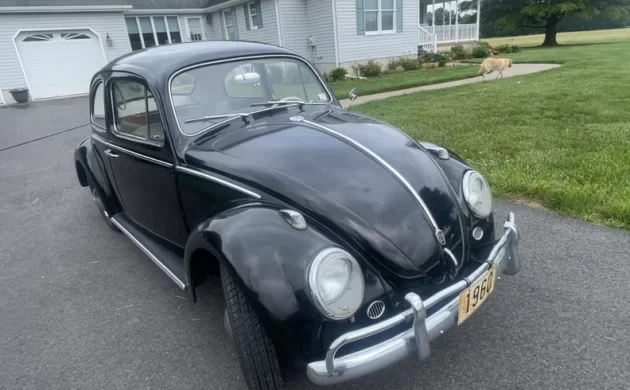
I’m usually on the fence regarding the coverage of a Volkswagen Type I (Beetle). There’s not much more that can be said about the iconic German compact that hasn’t already been said. Regardless, this 1960 example from Monroeville, New Jersey, is so original – it’s just “primitive cool,” so I thought I must take a gander at it. Those with an interest will find it here on eBay, where it’s available for a current bid of $7,100 with the reserve not yet met.
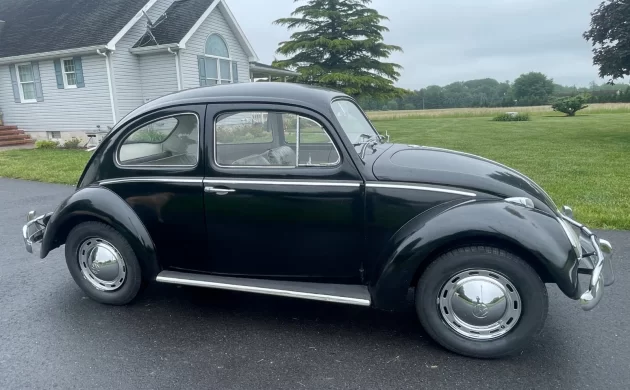
Volkswagen’s production numbers had been building all through the fifties, and by 1960, they managed to produce 739K copies. Detroit’s Big Three took note; as you’ll recall, the Corvair (GM), Falcon (Ford), and Valiant (Chrysler) were all introduced for the ’60 model year – obviously, there was something to this compact car craze. The Beetle remained as basic and optionless as a budget compact can be, but it didn’t deter buyers – it was an everywhere car. The seller states, “Stock and original based, probably as unmolested as they come, just a basic original well-kept car that has not had someone changing it from factory standards, it shows no accident damage, front and rear never been pushed in, does not show any rust, and repair of battery tray is excellent.” That last comment references the battery tray, which is located under the passenger side of the rear seat. They were notorious for rusting out and then it was “bombs away” for the battery, right through the floor and out onto the highway. Also stated is, “Paint is not show quality, just a car to invest in, drive and enjoy.” There’s something to be said for not having to worry about the inevitable road rash that occurs even with infrequent driving.
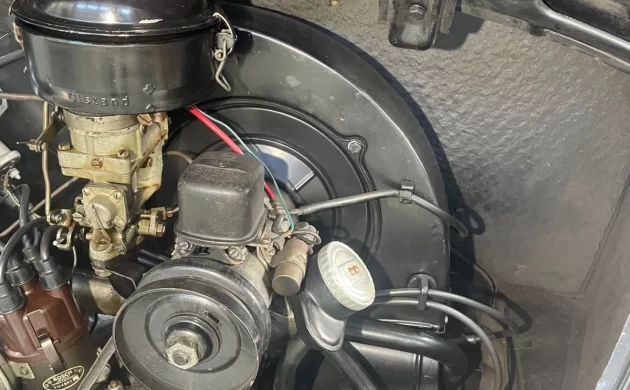
Laboring away in the boot is a 40 gross HP, 1.2 liter flat-four cylinder, air-cooled engine that’s attached to a four-speed manual transaxle. The seller claims, “Completely reconditioned engine, new heads, etc., transmission shifts excellently with no noise, the car drives like new.” The engine image is off-kilter, but the bottom side photos do reveal a powerplant that’s clean with no oily residue from a failed block seal or leaky pushrod tubes.
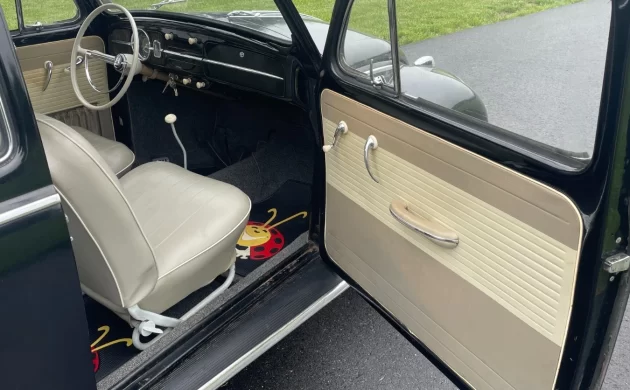
Inside, it’s pure VW Beetle all the way – just the basics. The seller mentions that there’s even an optional fuel gauge. A good college friend had a ’60, and his didn’t have a fuel gauge. In his car, you needed to open the under-dash reserve valve when the engine started to sputter. That provided you with one gallon of gas and the obvious need to find a gas station – quickly. Beyond that, the vinyl two-tone interior is in excellent condition – nothing appears to be out of place – well, a radio is, there isn’t one installed. There is a heater, but as the seller states, it’s not hooked up, and the underside images reveal the missing connection hoses.
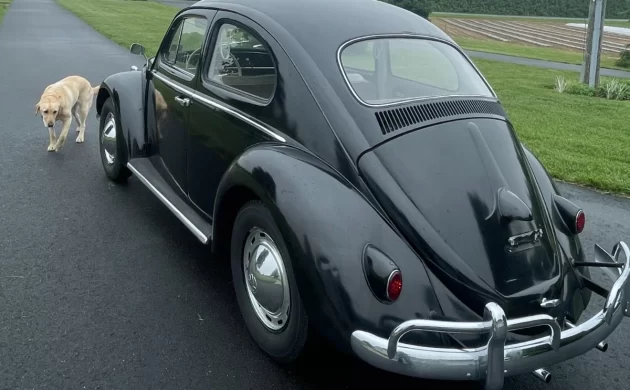
One of the Beetle’s biggest enemies is rust! This car, however, appears to be exceptionally sound – it’s as good as it gets for a 66-year-old bug. The originality of this VW is spectacular, and that explains its nine bids and current price. I’m not one to usually notice a Beetle, but this one’s caught my attention, and I like it; how about you?

I hate correcting any author, but I believe this is a 36 HP motor. I read 1960 they changed to a 40hp in June of 1960 with engine numbers starting with 5,000,001. Also fan shroud is a 36hp and that gas gauge, called a “Dehne”, was a very rare option. In pic 17, you can still see the reserve lever next to the gas pedal. A gas gauge wasn’t offered until 1962. Pretty much has already been said about a VW Bug, they were for good times, unless the #3 exhaust valve took a hike, something remedied by the 40hp movement of the oil cooler. Make no mistake, aside from a few niceties, like sun visors, it was still a basic Bug and for $1565 new the options were few. A radio was almost $80, and omitted here. The aftermarket gas gauge, I read, cost about $55 new, and a wise decision. In 1960, Maynard G. Krebs had revolution on his mind, and Bugs were simply “puddle jumpers” for a very limited group. I’d say, it wasn’t until the late 60s, that VW Bugs really had their heyday as an iconic symbol of the counter-culture of the time. Naturally my old man hated them for a number of silly reasons. All hail the VW Bug, and the great times they represented.
I’ll probably hear from Scotty on this, but he sent me a picture of his late dads VW, not sure the year, but one of the 1st Baja Bugs. I forget which one is Scotty, but if you knew him personally, he is a spittin’ image of his dad.
“Has an optional gas gauge,” per the seller’s listing. And it doesn’t look like an aftermarket piece. I believe you are correct about the gauge being standard equipment in ’62. The way to know for sure is to see if the existing gauge is date stamped on its reverse.
My source: https://kairousinc.com/1960-vw-beetle/
JO
AFAIK a gas gauge was never a factory option before it was made standard in ’62. Looking at the one on this car with its’ vertical “thermometer” reading, it’s a period aftermarket accessory and likely very rare.
on the gas gauge issue.I had a 57 convertible that was obviously top of the options list, possible dealer installed, .but the gas Tank feed had that regular handle on the bulk head under the dash for the extra gallon. Many of this vintage ultimately had 12-Volt battery and generato installed. The heaters on those VWs required a wool blanket in the back seat.In 1964 I drove it from Ohio to SanFrancisco to Seattle, Minneapolis and back to Ohio in 16 days…unforgetable moment was a west to east wind storm crossing the Washington desert where the speedo needle came round the bottom and headed back up..an estimated 100MPH. At Moses Lake we turned north and went back to 60+….Loved the car but grew up, worked in a Porsche garage and sold it for a 1957 Porsche Coupe with a 1600 Normal engine….Like many on this website I wish I had been able to keep some of the gems I owned.
Check to see if it has the fuel tap lever on the lower firewall.
“My source: https://kairousinc.com/1960-vw-beetle/”
Not so sure I’d take that source as entirely accurate, Jim, as it also says the ’60 Beetle “had a bench seat in the front” (nope) had a 40 hp engine (nope) and that “The roof could be partially opened to improve ventilation or completely removed” (nope on “completely removed”).
Anyway, the fuel gauge is a Dehne mechanical unit that was an aftermarket/dealer-installed accessory back in the day. You can buy a repro today that is electrical and uses LEDs to show the fuel level. The mechanical version has also been repro’d.
It was a pick-and-choose exercise; obviously, there are errors on that site. The issue with the engine’s power rating appears to be more of a matter of when in ’60 it was produced. I’ll admit that I can’t tell the difference between a 36 HP and a 40 HP version on visuals.
Thx for the info on the fuel gauge.
JO
Is it 6 or 12 volt?
I don’t believe that 12 volt became the standard until 1966 or 1967.
What an awesome car! Now this might be a little bit of a deviation from the topic at hand but seeing this car leads me back to my younger days when the VW was the 1st car I/we learned to “acquire” (steal) in the US Military through a course known as Surreptitious Vehicle Entry Program – in other words – “hotwire” a vehicle. VW’s were very easy to do and I can imagine this one just sitting there ripe for the taking!
That said – this really is a nice car and a great piece of history.
But the “hot wire trick” is easy on any vehicle without a steering lock. A hunk of wire with a couple of alligator clips and a flat bladed screw driver to jump the solenoid usually all you need. AND AWAY YOU GO! Yee Haa!
When are you free to go car shopping ?
😉
I never “shopped ” that way! Sorry, too honest.
This does look pleasingly original, refreshing in its own way. My Dad had a business in the day, C/A, for Competition Accessories, selling metal polish, license plate mounts, fuel gauges, visors, under-dash parcel trays, pedal pads, etc. This aftermarket gauge MIGHT be one of those. It looks to be powered by a 36 HP unit, an original 28 PCI Solex carb, a manual choke in place, supporting an oil-bath air filter looking to have (can’t really tell) a 6 volt regulator and generator. It might have the original drive belt ! The aftermarket wheel-rim inserts are pleasing, offering a Porsche look. Our 1st ‘family’ car was a ’55 Beetle sunroof, we 3 kids were raised with early forms of ice-scrapers in our hands, managing to keep the windows clear, everyone bundled and breathing in our mittens in the miserably cold MidWest. Ahh, the memories …
I learned how to drive in an orange 4-speed 1974!
1961 for me. My father also took it to the train station. One day I put the gas on reserve and forgot to tell him. He ran out on the way home from the station and was not happy!
Heater? What heater?
give it time, by the time spring rolls around it will start working.
Unless the heater control knob sitting on the trans tunnel next to the driver is rusted and won’t turn, or the cables going to the vents are rusted shut/open. Regardless, you’ll need a scraper for the INSIDE of the windshield unless you follow my dad’s idea of mounting a fan on the driver’s side A pillar pointed to the windshield.
Loved that ‘56 Bug. Jack up the car. Drop the engine onto an old lawn mower frame and pull it out. Easy peasy.
IIRC, the generator stand on a 36HP was part of the engine block; the 40HP had a detachable yoke (or “pedestal” in some languages).
The only thing we have left of the car besides the memories is the original owners manual and FWIW nowhere in there does it warn the user to avoid drinking the battery water, but it outlines the process to set the intake/exhaust valves amongst other needed maintenance and repair procedures..
Oh and we repainted it with a Kirby vacuum cleaner paint attachment.
Progress?
This is without a doubt the 2nd coolest import car of the ’60s.
Who was first you ask? 4 letters, Swedish, rhymes with “Bob”.
A “Slob” 96 with the two-stroke motor?
You pick – .7/.8L 2-stroke or 1.5/1.7L V4 – doesn’t matter. Monte Carlo winner 2 years straight. European rally champions multiple years. Heck, Baha 1000 class winner. Legendary. I have 2 daily drivers, a ’68 96 V4 Deluxe and a ’67 96 V4.
Saab is Swedish for Sob. 😭
The Bug wasn’t really any more susceptible to rust that any other car, except in the battery tray, for obvious reasons. And the engine here, as stated earlier is likely a 36 horse unless it’s been “punched out”. I believe ’60 was the first year for the square rear window too.
1958 was the first year for the square rear window. My father had both a used 56 a new 58. As I said in an earlier post about Detroit Diesels, You had to drive one with both feet flat on the floor. The speedometer had markings (little bars) in it to tell you when to shift. Did not hurt that little engine to over rev it!!
VW BEETLE FLOOR
My ’67 beetle is on its third floor
the steel is thin and subjected to the weather
my ’78 beetle is on its second floor
How much for the dog?
forget the bug i will take the dog.
When I was a kid we had a ’57 Bug with a fold back sunroof. One day while driving home it started to sputter. My dad reached down and tried to turn the lever for the reserve, but nothing happened. Turns out a broken or missing cotter pin as I recall. He pulled over. In the trunk was a camp stove, for whatever reason. It ran on white gas. He poured that in the tank, and there was enough to get us the mile or less to the nearest gas station. The lever was promptly fixed after that.
I remember too, it was important when getting gas, to return the gas lever from reserve back to main. There were times the motor would cough, only to find out you were already on reserve!
My 61 (first car, 500 bucks) had the reserve lever and it was 12 volts, having been upgraded at some point along with re-painted a Chrysler color, light metallic blue. We reversed the back wheels so they stuck out. Wish I had photos.
PERHAPS SOME READERS REMEMBER AUTOHAUS VW AND PORSCHE, AN I NDEPENDENT GARAGE THAT ONLY DID THOSE TWO BRANDS. We started in Yellow Springs,Ohio and moved to nearby Fairborn ,Ohio ( because B-52 pilots at Writght PAtterson liked to drive Porsche. Owner Lou Gregg was also a regular SCCA national competitor. I worked there for four years and learned a lot about cars and life from Lou, a wise gentleman . happy to hear from anyone ([email protected])
Auction ended with bid at 11,300., reserve not met.