

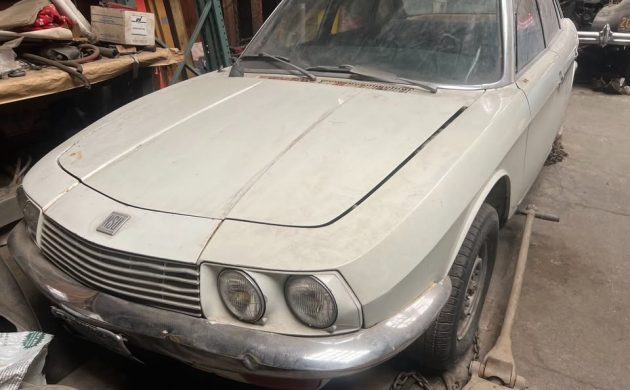
By now, you’ve likely figured out that I enjoy oddball vehicles, especially if they’re German in origin and have four doors. Basically, this all stems from watching Ronin a lot when I was a kid and finding fast sedans that looked entirely benign in traffic enormously cool. The NSU Ro80 wasn’t exactly the 1970s version of a BMW M5, but it was still a significant car in its own right based solely on engineering heft and a zest for building one of the most advanced platforms the industry had ever seen. These days, it’s mostly a footnote for many enthusiasts, but we still pay attention when one shows up as a project like this 1968 example listed here on Facebook Marketplace.
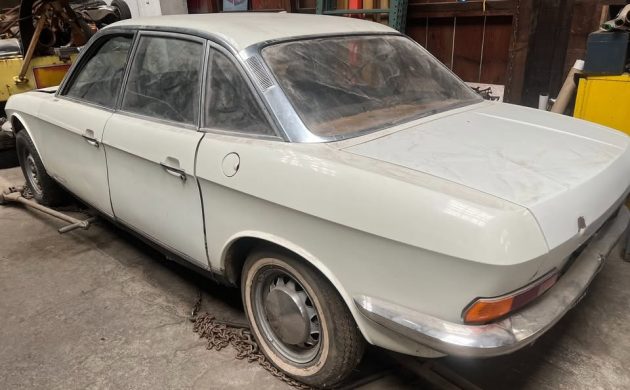
The last time I saw an NSU was at the Tampa Bay Automobile Museum, which had added one to its collection of vehicles that were highly advanced for their time. The museum prides itself on featuring vehicles that broke the mold in some way, and the NSU certainly did that. Everything about this car was a game changer when it was introduced, from the slippery profile that gave it a wind-cheating drag coefficient to the twin-rotor engine that was ultimately its downfall, the Ro80 was like nothing on the road. The NSU also featured front-wheel drive, four wheel disc brakes, and a Tiptronic-style automatic transmission.
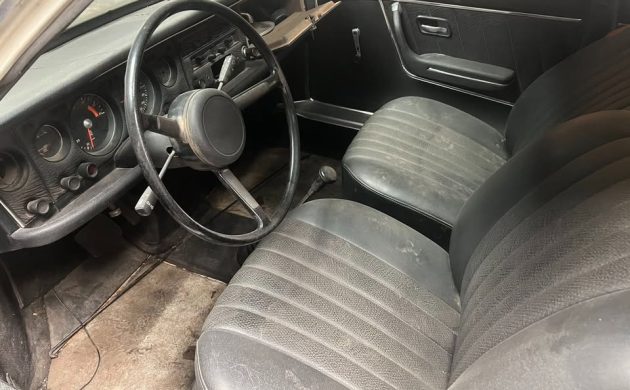
All of this in 1968 from a small German company is slightly bananas. The NSU was also lightweight thanks to its novel engine design and emerged on the market to enormous acclaim. After all, on paper, there was very little not to like, so it’s no surprise most automotive editors at the time had high hopes for the Ro80. Even the interior is quite handsome, and if you have a chance, check out a driving video on YouTube so you can see those beautiful gauge faces. The interior of this NSU remains very presentable despite 40 years in storage, with barely any deterioration on the seats or the dash.
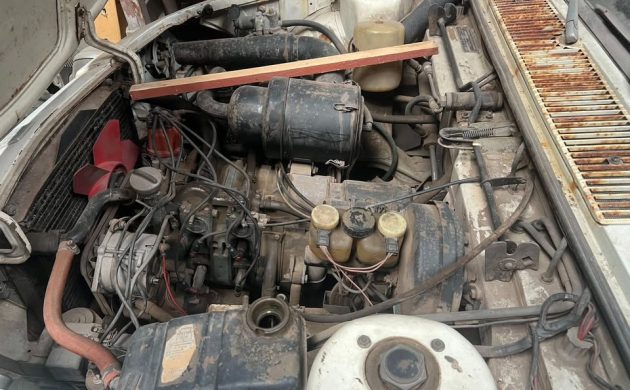
Sadly, due to an engineering flaw in the early editions and owner neglect in later cars, the Wankel engine was problematic for NSU. The company ended up replacing engines by the truckload, sometimes for the same customer multiple times. The 117 b.h.p. engine suffered from low compression due to worn rotor tips in the first few batches of cars, while drivers who couldn’t figure out the transmission caused further damage by lugging the engine and fouling spark plugs. If you get this example to run, you’ll want to quickly perform a compression test and check for overheating issues before spending much money on its revival. Hopefully, this is a replacement engine that was looked after before it was parked. Thanks to Barn Finds reader MisterLou for the find.

I’ve driven a Ro80, and it was a delightful little car. The rotary was smooth, as was the ride, and the shape looked better in person than it ever did in photos. I had a bit of trouble with the transmission — putting any pressure on the shift knob disengaged the clutch, often at inopportune times — but other than that, it was a real pleasure.
It surprises me a little that NSU had trouble with the rotary engine, as they have previously used it in the Wankel Spyder (another fun little ride, by the way), but since they never approached the volumes achieved by Mazda, I guess they didn’t have the real-world experience or funds. Even early Mazda rotaries had more than their share of issues.
I don’t know where one would go to get engine parts if a rebuild was necessary, but other than that it might be a fun project.
This Ro80 was listed two years ago by the same seller for $8500, and now at $6000. The seller might well be open to offers….
The Spyder sold in astonishingly small numbers and, even then, had already shown that the Wankel posed some potentially catastrophic problems.
Of course, given NSU’s faily small size. the Ro80 was a make or break car. Unfortunately for NSU, the apex seal failures meant doom for the company and even if they’d managed to fix the problems, the initial bad press doomed both the car and marque.
Of course, NSU’s problems became VW’s salvation, as the Ro80’s failure made it possible for VW to acquire NSU and, with it, NSU’s nearly ready for market K70. I personally think that if they K70 had come to market as an NSU before the Ro80’s launch, NSU could have weathered the storm and we’d have an NSU today and probably not Audi.
I agree with Ray. These cars look much better than the photos shown here.
The early units of Ro-80 engine, with two plugs per housing, 4 in total, had shaft problems, solved from 1972 on.
Perhaps finding an adequate NOS shaft of later versions could help in engine life.
The Suzuki RE-5 apex seals, in ferrotic, Suzuki had the NSU-Citroen Comotor engine Rotor, may be good too.
What a cool little car worthy of a restoration! Rotary engines are very unique and smooth and reliable.
My cousin had an NSU Prinz. It treated him fairly well although it was definitely faster downhill than uphill. I remember one that was traded into a local Chrysler dealer with a collapsed piston. The car was eventually scrapped because the cost of fixing the engine was prohibitive.
Personally, if the situation was different now, I would be tempted to take on a project like the Prinz, but I would avoid the Wankel like the plague.
A friend of mine had a Mazda R100. It went like Jack, the Bear, but suddenly it died, no warning, right in the middle of rush hour traffic. He was barely able to coast to the side of the road.
The car was 10 years old at the time, less than 50K miles and he could NOT find parts. He could’ve bought a new engine that was going to cost more than he paid for the car. He eventually scrapped the car.
It was about then that we started to hear a lot of stories about how unpredictable the Wankel engine was. It was a good principle but still left something to be desired when applied to the masses.
I remember GM talking about producing Wankel engines and making them available throughout their car and truck range. They talked about a 2-rotor compact, then adding more rotors the larger the vehicles got. Well, their own tests on the larger vehicles, especially when you tried to work them very hard, like a truck, they were getting extremely poor life out of them. It seemed that no matter what they did, 10K miles was a major achievement.
Alright in theory but sometimes the reality wasn’t so sweet…
I always wondered if some of the manufacturers had used a Wankel running at a constant speed at the best rpm for efficiency and used a generator motor system to propel the vehicle and could they make that work? Add regenerative braking and today’s ability to use kinetic and heat reuptake modules for a very efficient hybrid… Noting that the weight of these late 1960’s cars as compared to today’s cars…
What’s old is new again.
The Mazda MX30 range extender is still available in Europe (to the best of my knowledge). The car being built as a dedicated EV but with a Rotary Engine powered generator that serves as a range extender.
In so many applications that would make a lot of sense. You would be in a controlled environment as far as the primary power source would be, and the rest of the drivetrain would be something that is flexible yet serviceable. I seemed to work in large rock trucks and locomotives; why not cars?
As @JMB#7 noted, the MX30 has a Wankel range extender. I actually spent a good deal of time poking around an MX30 with the range extender at Mazda’s Hiroshima headquarters in 2024. The packaging of the range extender is extremely compact, yet far more accessible than the scooter motor in the BMW i3.
As bad an electric car as the MX30 is, I think the range extended version would be an awesome daily driver.
I first drove a rotary when an RX3 was traded in on a new Civic. It was fun and SMOOOOTH! By then the reputation was already poor. A few years later at the Daytona 24 Hours I was impressed watching the RX7s just “Humm a long” and never miss a beat. IIRC all finished. And later still when the dealership I worked at took on the Mazda franchise. I drove an RX7 every chance I got. Back then Mazda had an exchange program for engines that were in the $500 range. I like rotorys but am also aware of the draw backs. Definitely not fuel sippers!
I owned 2 NSU Prinz cars a 1960 & 1962. The 62 has a mini corvair look to it. Both had VW quality and great on gas. Both were 2 cyl engines. Never owned a rotary one and wouldn’t want to, they were problems galore.
I had a 1967 NSU Prinz, had a 4 cylinder motor similar to the Munch Mammoth motorcycle. Back in 1970 it got great mileage 40 mpg and would never get beat by a VW Beetle. Alas it got totaled at a stop sign after a woman took out a couple of cars she hit. Often wonder how long I would have kept it. Insurance company just listed it as a VW and paid me $800.00 just to keep me happy. Never saw another one.
I well remember the Munch Mammut motorcycle. Kind of a pricey thing in its day but it was quite the bike…
If I were going to own a fragile European car with a Wankel, this would be the one. I say that because I really had to sit on my hands the other day when I saw a listing for a Citroën GS Birotor. At least the Ro80 had a ten year run instead of the 900 units total for the Citroën.
Were these ever imported into the US? These were beautiful cars, but I’ve never seen that headlight treatment. Looks like it had to comply with the archaic late 60s US headlight rules.
Never imported to the U.S., as NSU had practically no dealer system here. The rotary engine in my Maxton was an amazing performer, and parts were easily available, but you must be able to do the work yourself. Mazda rotary mechanics are very few and far between, mainly centered on racing. Mazda dealers just give you a blank stare. Gas mileage is poor, but the performance makes up for it. This is another oddball but exciting car where you’d rely on a lot of help from a model-specific club. I’d love to have one!
Maybe not factory imported, but there must have been a small-time private importer at the time, as I’ve seen several Ro80s for sale here over the years going back to the Hemmings classifieds print edition in the ’80s, nearly always with this sealed-beam headlight conversion except for cars more recently shipped over.
Frank, NSU Ro80s were imported to the US. I have a dealers book along with a lot of info on the US dealers.
That goes with my 1976 Ro80 in Stuart Florida, with a running engine, a spare never used engine in a crate, manuals in both German and English, and a trunk full of spares.
My car I imported from Germany, but I had two others bought in the US.
One is a green one you can find if you research NSU Ro80s on bat.com.
Len.
The NSU Ro80 was at the time in Greece the car editors’ favorite car but then the hype ended mainly because of lack of knowledgable mechanics to service the engine and lack of spare parts. I recall a bike with a rotary engine that i was offered to make a test for a car magazine in Athens, the Auto Express, that i was keeping a monthly column at the time. It was more silent than a 2 stroke or 4 stroke engine and when you rev it higher it reminded of a jet engine noise that i liked. My article was never published though probably because it was a short 1/2 hour test. I cannot recall the maker of the bike, maybe NSU but i’m not sure after 50 years.
Possibly Norton or Suzuki? Those offered some rotary-engined bikes back in the day.
Thank you but i’m not sure. Probaly Suzuki because the shop owner was selling Japanese bikes and Florrets, a German cheap little bike, popular in Greece at the time.
Thank you SG. Probably a Suzuki because at the time the shop was selling Japanese bikes and Floretts, a Germany made cheap bike 50cc, then popular in Greece.
Located in Williams, CA
Don’t blink driving down CA20. You will miss Williams!